Claude Fable 5.2 Review and AI Agent Memory Mechanisms Explained
Claude Fable 5.2 shines on general and creative tasks but its coding cost-effectiveness is questionable; the AI acceleration report and Agent memory mechanisms deserve equal scrutiny.
The article extracts three main threads from podcast episode 47. First, Claude Fable 5.2 is cheaper and faster, with standout general and creative performance, but its coding benchmark lead over Opus 5.5 is under 10%, so upgrade value is questionable, and the hosts are reserved about minor version iteration motives. Second, an Anthropic internal report claims AI capabilities doubled in a year and research efficiency rose tenfold, possibly nearing recursive self-improvement—but key data is heavily redacted and timing overlaps with IPO plans. Third, Agent Memory uses a layered design from transcripts to notes to structured knowledge to context injection, with compression called dreaming; Fable 5 extracts rules rather than piling up details. The article also mentions GitHub secret leaks and Hinton's risk warnings.
Introduction: When a Podcast Discusses AI's "Acceleration" and "Hidden Concerns"
Episode 47 of Artificial Developer Intelligence (ADI Pod) covers three topics: a review of the Claude Fable 5.2 model, a recent report on AI accelerating AI research, and AI agent memory mechanisms. The three hosts weave in plenty of hands-on experience and industry observations, and also surface several signals in the current AI landscape worth digging into.
This article doesn't aim to recap the podcast content, but to extract three main threads from it: Is model iteration entering a zone of diminishing marginal returns? How credible is the narrative of AI accelerating scientific research? Why is the design of Agent Memory more complex than one might imagine?
Claude Fable 5.2 Review: General Capabilities Shine, Coding Cost-Effectiveness Questionable
Pricing and Speed: Cheaper and Faster
Anthropic's Claude Fable 5.2 is priced at $8 per million input tokens and $40 per million output tokens, down from $10/$50 for Fable 5.1. Anthropic officially states that the new model is about 30% faster than 5.1 without degrading output quality.
Benchmarks: Limited Gains in Coding
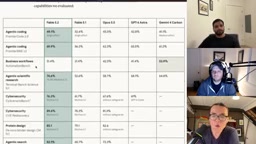
When comparing benchmark data, podcast host Shemin pointed out a key detail: Opus 5.5 achieves a 55% success rate on the Frontier Code 2.0 benchmark, while Fable 5.1 reaches only 32.4%. Fable 5.2 improves to 49.1%, but its lead over Opus 5.5 is less than 4 percentage points. On coding-related benchmarks such as Frontier Suite, Automation Bench, and Cyber Scenario Bench, Fable 5.2's advantage over Opus does not exceed 10%.
"Fable 5.2 is not a coding-specific model. If you look at coding benchmarks, its lead over Opus is only a modest incremental improvement—whether it's worth the extra cost is questionable."
But on general tasks, the gap widens noticeably: on the Remote Labor Index benchmark, Fable 5.2 is about 20% ahead of Opus 5.5; on the chart-recognition benchmark Chartography, it shows a 10 percentage point gain; and on the Artificial Analysis Intelligence Benchmark, it improves by about 6 points.
Creative Tasks: From "Usable" to "Impressive"
The most convincing part of the podcast is the custom creative benchmark. In a Shakespearean monologue generation task, Fable 5.2 not only produced a working browser animation but also autonomously decided to synthesize audio with a small speech model and added a camera push-in effect. The host described its facial expressions as having "genuine emotional expression"; although the overall result carries a certain uncanny valley effect, "I can't find any obvious serious flaws."

However, in a paper-cut animation task based on "The Great Wave off Kanagawa," all three frontier models exposed flaws in visual understanding. Fable 5.2's waves were described as "looking like they're waving at you," with unnatural motion logic. This shows that current models still have a clear ceiling on animation tasks requiring precise spatial reasoning.
Summary: A Favorite Model, but Not a No-Brainer Upgrade
Shemin's conclusion is that Fable 5.2 is his current favorite model, citing concise output, strong general-task performance, and outstanding creative-task results. But Dan and Rahul are more reserved, arguing that the cost-effectiveness in coding scenarios doesn't justify an upgrade and that minor version iterations look more like positioning for an IPO.
AI Accelerating AI Research: A Heavily Redacted Report
What the Report Says
On the show, Rahul introduced a report on Anthropic's internal research (summarized by Ajay Akotra of Planned Obsolescence). The core conclusion: Anthropic's internal capability index doubled within a year, and researchers using AI tools can accomplish what previously took ten days of work. If this acceleration forms a positive feedback loop, it could approach the so-called "recursive self-improvement" threshold.
Why We Should Treat It with Caution
The podcast spends considerable time discussing the credibility of this report. Much of the report itself is redacted, with the justification of "preventing acceleration of other AI developers." This means the outside world sees secondhand interpretation, not raw data. In addition, Anthropic mentions in its S-1 filing that its responsible scaling policy may be "approaching" a certain threshold, and the company plans to go public—the timing coincidence led host Dan to say bluntly: "I'm looking for something that may not exist. A new model release, a report saying AI can build itself within a year, an IPO next week—you're telling a specific story."
"Recursive self-improvement" is a core concept in AI safety, first proposed by I. J. Good in 1965 as the "intelligence explosion" hypothesis. The basic logic is: when AI systems can participate in improving the design and training of the next generation of AI, each generation's capability gains shorten the development cycle of the next, creating a positive feedback loop. Nick Bostrom lists this in Superintelligence as one possible path to superintelligence, while also noting the risks of "goal drift" and "loss of control." The current debate focuses on the fact that although large models can significantly speed up code generation, experiment design, literature review, and other steps, there is still a key gap before they can fully autonomously propose new architectures, validate hypotheses, and iterate training. Thus "recursive self-improvement" is more a conceptual framework for assessing the slope of the trend than an established fact.
Consensus and Disagreement
All three hosts agree that regardless of the report's details, the felt reality of accelerating model capabilities and agents running unattended for longer periods is genuine. The disagreement is whether this is a reasonable linear extrapolation or narrative packaging ahead of an IPO. The show doesn't reach a verdict but reminds listeners to take it "with a big grain of salt."

An S-1 filing is a registration statement required by the U.S. Securities and Exchange Commission (SEC) for a public offering, in which a company must disclose key information such as its business model, risk factors, financial condition, and governance structure. For AI companies, the risk factors section of an S-1 often touches on model capability boundaries, safety policies, and regulatory uncertainty, so it is often viewed as a window into a company's self-perception. The podcast mentions that Anthropic states in its S-1 that its responsible scaling policy "may be approaching" a certain threshold, meaning the company needs to explain to potential investors the compliance and reputational risks posed by capability gains. Placing this disclosure alongside a concurrently released internal acceleration report is precisely the starting point for the host's skepticism about "narrative packaging"—not that the content is false, but that the timing and combination of information releases may serve a capital-market narrative.
How Agent Memory Works: From Raw Records to "Dreaming"
Layered Memory Structure
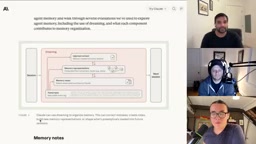
Rahul explained Anthropic's technical breakdown of Agent Memory. The system is divided into several layers: at the bottom is the complete conversation transcript, tagged as "potentially useful"; above that are notes extracted from it; further up, the notes are organized into structured, linkable wiki-style knowledge; and finally, when needed, the system injects relevant memories into the current conversation context. Anthropic calls this compression process from raw stream to usable context "dreaming."
A "context window" refers to the total number of tokens a model can directly read in a single inference pass; anything beyond that is invisible to the model. The essence of an external memory system is to re-inject the most relevant historical information into the window through retrieval and compression, under the hard constraint of the context window. This contrasts with "fine-tuning" and "continual learning": fine-tuning solidifies knowledge into the model by updating weights, but it is costly, slow, and hard to do in real time; continual learning attempts to keep updating parameters after deployment but faces catastrophic forgetting and stability issues. Therefore, current engineering practice generally adopts a "frozen parameters + external memory read/write" architecture, delegating memory management to the retrieval and compression layers while the model itself only reasons within the given context. This also explains why the design quality of the memory system directly determines the upper bound of an agent's performance on long tasks.
Memory Evolution as Seen Through Pokémon Red
The comparison between two versions is compelling. When playing Pokémon Red, Sonnet 3.7 stuffed a lot of details into memory, which instead polluted key information. Fable 5, by contrast, can focus on the strategic level, infer game rules, and store those rules, so that even if it fails in one run, it can reuse them in later matches. This shows that improvements in the model itself directly change the effective boundary of the memory system.
The Cost of Memory and the Human Analogy
An interesting observation from the podcast: injecting too much memory context actually makes management harder, similar to the imbalance between recent and long-term memory weights in human cognition. Moreover, each act of recall is a slight rewriting—if the agent follows a similar mechanism, its memories will gradually drift from the original facts. Rahul also noted that models cannot update weights at inference time because that would cause the model to collapse (recent data dominating the weights eventually leads to chaotic output), which is why external memory systems have become the mainstream approach.
"Catastrophic forgetting" is a classic problem in continual learning for neural networks: when a model updates its weights with new data, previously learned representations are overwritten or interfered with, causing a sharp drop in performance on old tasks. In online learning scenarios, if gradients from recent data repeatedly act on the same set of parameters, the model's output will shift severely toward the recent distribution, manifesting as repetition, confusion, or forgetting of old instructions. This is the technical background behind the podcast's remark that "updating weights at inference time causes model collapse." Mitigation methods include elastic weight consolidation, experience replay, and parameter isolation, but the engineering cost of these methods on large-scale language models remains high. Hence the industry prefers retrieval augmentation and external memory to bypass weight updates, decoupling "what to remember" from "how to reason."
Other Signals Worth Noting
The news segment of the podcast also mentioned two things. First, a study scanned public GitHub repositories and found 2,539 real secrets in 1,900 repositories; one source of the problem was Claude Code permission settings being committed to public repositories. Second, Geoffrey Hinton warned in an interview that AI risks may become clear within a decade, named several industry leaders he does not trust, and predicted a warning incident similar to "Three Mile Island."
Dan's Vibe & Tell segment showcased a practical case: he used Claude to decompile the C# code of the Godot engine game Slay the Spire 2, locate a touch-coordinate bug, and package it as a mod—all in about 20 minutes, without manually inspecting the patch code. This demonstrates the real productivity of coding agents and also echoes the podcast's teasing of Anthropic's policy against agents reverse-engineering games.
Conclusion
The value of this episode lies not in offering conclusions but in presenting disagreement. Whether Fable 5.2 is worth upgrading depends on your use case; how credible the AI-accelerating-research report is depends on your tolerance for redacted data; and the design boundaries of Agent Memory depend on how you view "memory" itself. All three topics point to one fact: AI systems are getting more capable, but the frameworks for judging them are far from mature.
One-line Summary
Claude Fable 5.2 shines on general and creative tasks but its coding cost-effectiveness is questionable; the AI acceleration report and Agent memory mechanisms are equally worth scrutinizing.
Paragraph Summary
This article extracts three main threads from podcast episode 47. First, Claude Fable 5.2 is cheaper and faster, with standout performance on general and creative tasks, but its lead over Opus 5.5 on coding benchmarks is under 10%, raising doubts about upgrade value—and the hosts are also reserved about the motives behind minor version iterations. Second, an Anthropic internal report claims AI capabilities doubled in a year and research efficiency rose tenfold, possibly nearing a recursive self-improvement threshold, but key data is heavily redacted and the release timing overlaps with IPO plans, so its credibility should be discounted. Third, Agent Memory uses a layered design from transcripts to notes to structured knowledge to context injection, with the compression process called dreaming; Fable 5 can extract rules rather than piling up details, unlike Sonnet 3.7. The article also mentions GitHub secret leaks and Hinton's risk warnings.
Related articles

Dify in Practice: Three Ways to Build an AI Literacy Teaching Assistant Chatbot
Bilibili creator Peter Sun Dasheng demonstrates three ways to build an AI literacy teaching assistant chatbot in Dify: manual Chatflow, AI-assisted workflow generation, and Agent creation via natural language, covering knowledge base integration, publishing permissions, and monitoring.

One Settings File Leaks a Thousand Keys: The Security Blind Spot in AI Coding Tools
Over 100,000 Claude Code settings files exposed on GitHub, 1,122 with real high-privilege keys. How a convenience feature bypasses version control, plus Anthropic's new models, evaluation credibility crisis, and local backlash against data centers.

48 AI Agents Discover a Maya Pyramid in 72 Hours: A Google Engineer's LIDAR Archaeology Experiment
A Google engineer used 48 AI agents to scan NASA LIDAR data, flagging an unrecorded Maya pyramid structure in 72 hours. We break down how multi-agent remote-sensing archaeology works, the false-positive risk, and how AI and human experts divide verification.