Claude Fable 5.2 Teams Up with Higgsfield to Build a Complete Racing Game from a Single Prompt

Claude and Higgsfield collaborate to autonomously complete the full development of a playable racing game within a single chat window.
The article describes how a creator used Claude Fable 5.2 and Higgsfield's MCP interface to build a neon racing game called Hyperloom from scratch in a single chat session. Claude handled autonomous planning, writing Three.js code, running tests, and fixing errors, while Higgsfield provided over 35 image, video, and audio models to generate key art, a 3D spaceship, announcer voice lines, and a trailer. A test bot completed three laps using keyboard, gamepad, and touchscreen; the first version passed all 50 checks, and after iteration it passed 66 checks and added an AI takeover feature. The article argues that this demonstrates AI's capabilities in long-task planning and multi-tool collaboration, and that the technical barrier to game development is dropping dramatically.
From Zero to Playable: A Game Studio Inside a Chat Window
Recently, a neon racing game called Hyperloom has been drawing attention on YouTube. It features racing spaceships, a synth soundtrack, and even lets you blast straight into a tunnel of light. Most surprisingly, the creator didn't write a single line of code—all the work was done by Claude Fable 5.2 in a single chat session.
According to the video, Fable 5.2 is the latest model in the Claude series, designed for long-running tasks. It can autonomously plan steps, write code, run tests, and fix its own errors. But a game is more than just code—it also needs art, voiceover, and 3D models. That's where Higgsfield comes in: its MCP interface plugs more than 35 image, video, and audio models directly into Claude. So Claude handles the thinking and programming, while Higgsfield handles the art and sound—the whole workflow is like stuffing an entire game studio into a single chat window.
MCP (Model Context Protocol) is an open protocol proposed by Anthropic, designed to standardize how AI models connect with external tools and data sources. You can think of it as the "USB interface" of the AI world: models don't need to write separate integration code for each external service—as long as the service provider implements an MCP server, the model can call its capabilities in a unified way. In this case, Higgsfield exposes its 35+ image, video, and audio models to Claude via MCP, so Claude can directly "request" generated images or speech within the conversation without leaving the chat window. The key value of MCP is that it turns models from something that can "only talk" into something that "can get things done," and the tool ecosystem becomes plug-and-play, greatly reducing the integration cost of multi-tool collaboration.
Three.js is an open-source JavaScript 3D graphics library built on WebGL, widely used for rendering interactive 3D scenes in the browser. It wraps the underlying WebGL API and provides high-level abstractions like cameras, lights, materials, geometries, and animations, allowing developers to build 3D games, data visualizations, or product showcases with relatively concise code. In this article, Claude uses Three.js to build the track, spaceships, and city environment—meaning the game can run directly in a web page without installing any client. Three.js's mature ecosystem and rich documentation also make it a "safe choice" for AI-generated code—models are more familiar with its API and thus more likely to generate correct code.
Workflow Breakdown: From Key Art to a Playable Game
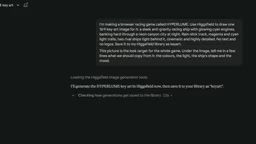
The whole project started with a key art image. The creator asked Claude to generate key art for a racing game: a sleek spaceship banking through a neon city on a rainy night, with two rival ships in hot pursuit. Claude called an image model through Higgsfield, and about a minute and a half later, a high-quality image was born—at a cost of just 2.75 credits. Claude then analyzed the visual elements in this image—the cyan and magenta neon tones, the wet reflections, the shape of the spaceship—and used it as the visual target for all subsequent work.
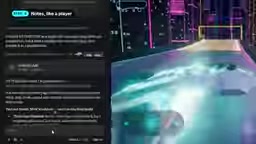
Next came the core task: building the actual game with Three.js. The requirements included: a complete track winding through the city, with banked turns, tunnels, and jump points; boost pads and a drifting mechanic; five AI opponents; and a three-lap race. Even more surprising, all sound effects and music were generated through code, without using any audio files. Before delivery, the creator asked Claude to have a test bot drive three laps to check whether everything worked properly.
Autonomous Planning and Testing: An Hour of Unattended Work
After receiving the task, Fable 5.2 first drew up a 7-step plan: track and city, spaceships, opponents, sound, controls, testing, and release. Then it began executing autonomously: writing code, taking screenshots of its own game, observing the visuals, and fixing anything that looked wrong. According to the video's author, this process ran fully automatically for about an hour, with no intervention from him.
In the end, the test bot completed three laps of driving using three input methods: keyboard, gamepad, and touchscreen. All 50 checks passed with no errors. The first version of the game was fully playable, and even included a minimap, lap timer, and boost gauge.
Iterative Upgrades: More Speed, Real Rivals, and AI Autopilot
After the first version was done, the creator made improvement requests in natural language: make the game feel faster, make the opponents genuinely fight for position, add a real announcer voice for the countdown, add a title screen featuring the key art, and have the AI take over the race when the player isn't controlling anything. He also asked for the spaceship from the key art to be turned into a real 3D model.
This is where Higgsfield played a key role once again. Claude called Higgsfield to generate the announcer's voice lines ("Three, two, one, go!") and to handle the 3D spaceship. Since the original key art was too wet to convert directly, Claude first had Higgsfield draw a clean view of the spaceship, then turned it into an actual 3D model—even rendering it out to check the result. It then deployed the entire game to Higgsfield so that all files could be used, and once again had the test bot run through a race test.

The second round of testing completed 66 checks (out of 70 total), and the game was more feature-complete. The title screen used the key art, the announcer did the countdown, the player could pilot the spaceship from the image, speed lines appeared when boosting, opponents genuinely swapped positions with each other (according to the video, 62 position changes in a single race), and if the player put down the controller, the AI would take over and race on its own—in one demo, the AI came from last place all the way to first and won the race.
Text-to-Speech (TTS) and procedural audio are two easily overlooked but crucial technical points in this article. The announcer's "Three, two, one, go!" is not a real human recording, but synthesized by the audio generation model integrated through Higgsfield, which falls under TTS—the model generates natural speech directly from text. Meanwhile, the in-game sound effects and music are entirely generated by code, i.e., procedural audio: engine roars, boost whooshes, or background music are synthesized in real time by algorithms rather than played from pre-recorded audio files. The advantage of procedural audio is that it's extremely small in size and can change dynamically (e.g., the pitch rises as speed increases), making it ideal for AI to quickly build a complete sound experience without external assets.
Trailer and Multi-Model Collaboration
The game needed a trailer. The creator had Claude use Higgsfield's Seed Dance 2.5 model to turn the key art into a trailer, and even generated the sound. The entire process was completed in the same chat. The video's author points out that traditionally this would require multiple roles—concept artist, programmer, sound designer, voice actor, 3D artist, and trailer editor—whereas here, all the work was done in a single chat.
What This Means: The Barrier to AI Game Development Is Disappearing
This case demonstrates the current capabilities of AI models in long-task planning and multi-tool collaboration. Claude Fable 5.2 can not only write code, but also autonomously test, fix errors, and iterate based on natural language feedback. Higgsfield's MCP integration seamlessly plugs in image, video, and audio generation capabilities, enabling even non-technical users to complete complex multimedia projects through conversation.
Of course, this still requires a certain amount of prompt engineering and aesthetic judgment behind the scenes. The creator needs to know how to describe the desired effect and guide the model through iterations. But one thing is certain: the technical barrier to game development is dropping dramatically. As the video's author puts it: "You don't need any game development jargon—just play it, and write down what you want."
Higgsfield offers a free plan, a starter plan, and an Ultra plan. According to the video, the Ultra plan includes all models and 3,000 credits per month, enough to support a similar project. It's currently running a Black Friday promotion with discounts of up to 60%.
For developers who want to give it a try, this path may be worth exploring. After all, a complete playable game, 3D models, voiceover, and a trailer—all from a single chat window—was hard to imagine before.
One-line Summary
Claude and Higgsfield collaborate to autonomously complete the full development of a playable racing game within a single chat window.
Paragraph Summary
The article describes how a creator used Claude Fable 5.2 and Higgsfield's MCP interface to build a neon racing game called Hyperloom from scratch in a single chat session. Claude handled autonomous planning, writing Three.js code, running tests, and fixing errors, while Higgsfield provided over 35 image, video, and audio models to generate key art, a 3D spaceship, announcer voice lines, and a trailer. A test bot completed three laps using keyboard, gamepad, and touchscreen; the first version passed all 50 checks, and after iteration it passed 66 checks and added an AI takeover feature. The article argues that this demonstrates AI's capabilities in long-task planning and multi-tool collaboration, and that the technical barrier to game development is dropping dramatically.
Related articles

Gemini 4 Neon Leak: A Potential Strong Contender Against Opus 5.5
A Hacker News thread suggests Gemini 4 Neon looks like an Opus 5.5 competitor. This article unpacks the product positioning behind this community signal, shifts in the top-model competitive landscape, and what it means for developers' model selection strategy.

Claude Fable 5.2's Self-Authored Short Film 'Fable' Sparks Discussion
A short film 'Fable,' credited to Claude Fable 5.2 for script, visuals, and directing, appears on Hacker News. This article analyzes the significance of full-pipeline AI creation, community reactions, and what it means for content creators.

Anthropic IPO Pricing: A Signal of AI Giants Going Public
Anthropic's IPO pricing draws attention. This article analyzes its potential impact on AI industry valuation, commercialization paths, and the competitive landscape, and highlights public-market expectations and challenges for AI companies.