Claude Fable 5.5 Leaked, GPT-6.2 Launch Sparks Controversy as AI Model Wars Escalate

Behind dense releases, benchmark scores are converging, and the real difference lies in reliably getting actual work done.
This round of AI releases is dense: Anthropic appears to have leaked Silicon 2 (possibly Fable 5.5), with timing matching its approaching IPO; OpenAI launched GPT-6.2 Astra and Soul with benchmark gains and major cost cuts, but community usability reviews are polarized, and the system card shows coding consistency-obstacle misses rising from 11.09% to 22.28%; Google's Neon model appeared, and Gemini task features are free to hundreds of millions of users in 6 countries; Microsoft released 7 models, with MAI Image 2.7 topping image editing benchmarks; Anthropic introduced code mode and linked billing; Perplexity's annualized revenue surpassed $1 billion; NVIDIA reported Q1 revenue of $115.8 billion and announced a $150 billion buyback. The core conclusion: as benchmark scores converge, the evaluation system is breaking down, and the best model is the one that can reliably get work done.
The pace of AI model releases has become unprecedentedly dense. On one side, a mysterious new model from Anthropic appears to have surfaced; on the other, OpenAI's dual GPT-6.2 releases have sparked fierce disagreement in the community, while Google and Microsoft have also made new moves in quick succession. Behind these releases, the same question is reflected: when benchmark scores keep converging, where do the real differences between models actually lie?
Claude Fable 5.5 Suspected Leak: Silicon 2 Appears, a Key Step Before IPO
According to a breakdown by Bilibili creator WorldofAI, a stealth model named Silicon 2 appeared under Anthropic's cloud service category, priced at $10 per million input tokens and $50 per million output tokens, exactly matching Fable 5.1. The creator also noted that these may simply be placeholder prices, so the model's identity has not been definitively confirmed.
What's truly interesting is the timing. Anthropic's IPO is approaching, and currently all other models in its family besides Fable are already at version 5.5. Releasing a 5.5-level Fable checkpoint to balance the version catalog is logically quite reasonable.
A chart from independent analysis firm MHR provides further evidence: the rate of improvement in frontier AI benchmark scores is about 1.4 times the previous rate, accelerating from roughly 17 AE points per year to 24 points per year. Several unidentified checkpoints internally labeled Model 1 through Model 4 at Anthropic sit near the top of this trajectory, with the latest checkpoint, Model 4, positioned at approximately 179 on the AE scale, indicating continued progress. Whether Silicon 2 is Model 4 remains undetermined, but it most likely points to Fable 5.5.
AE Points and Frontier Benchmark Acceleration
The "AE points" mentioned in the article are an index unit used by the Artificial Analysis organization to measure a model's overall intelligence level, formally known as the Artificial Analysis Intelligence Index. It is derived by normalizing and weighting multiple categories of benchmark tests including coding, math, reasoning, and knowledge. The MHR chart's statement of "accelerating from 17 points to 24 points per year" refers to this index's annualized improvement rate rising from about 17 points to about 24 points over the past year, meaning frontier models' overall capabilities are growing at roughly 1.4 times the previous pace. This acceleration is related to factors such as compute investment, synthetic data training, and inference-time compute scaling, and also explains why model version iteration cycles across vendors have noticeably shortened—during a phase of rapid index climbing, falling one version behind could mean a gap of dozens of points.
Stealth Models and Placeholder Pricing
"Stealth model" refers to an unreleased model that is accidentally exposed in cloud service catalogs, API documentation, or billing systems before its official launch, typically appearing under a codename. Users can briefly invoke it, but its identity is not officially confirmed. Such exposure often stems from pre-configured billing entries or gray-scale testing on cloud platforms. The pricing of $10 input and $50 output per million tokens for Silicon 2 in the article exactly matches Fable 5.1 and is likely placeholder pricing carried over from an old entry rather than final pricing. Therefore, inferring model identity from price alone is unreliable and requires comprehensive judgment combined with parameters such as context window and modality support.
GPT-6.2 Astra and Soul: A Launch Dragged Down by Emotion
OpenAI officially launched GPT-6.2 Astra and GPT-6.2 Soul, promising major improvements alongside significant cost reductions. But community reaction has been sharply polarized—Matt Schumer called the testing experience "basically unusable" and said he would never recommend it; Zio went further, calling Astra "the worst model OpenAI has released since its dominance."
The creator offered a different perspective. He noted that Zio spent considerable time testing the model before launch, even writing OpenAI a detailed feedback letter. One of the biggest complaints involved a TypeScript Rust compiler project: Astra worked for 7 days without bringing meaningful improvements, ultimately producing a compiler that was 56% slower. But the creator emphasized that even Zio acknowledged Astra is extremely good at code review, impressive at 3D game development, and strong at computer operation.
According to reports, even Zio acknowledged that Astra's code review capabilities are extremely good… so how do we go from acknowledging these strengths to calling it the worst AI model ever?
Looking at the published data, Astra's input token price is about $8 per million and output about $40, a 20% reduction in API pricing; Soul is priced at $2 and $10, positioned for everyday workloads. On the Artificial Analysis Intelligence Index, Astra scores 62, up from 57 in the previous generation, second only to Claude Fable 5.2's 65. More critically, the cost difference: Astra costs about $4 per intelligence index evaluation task, while Fable 5.2 costs about $26.54.
But usability issues do exist. According to OpenAI's own system card, Astra missed consistency obstacles in about 22.28% of evaluated coding cases, compared to 11.09% for the previous generation—a clear regression in programming transparency. The creator's conclusion: Astra excels at 3D generation, computer use, and professional workflows, while Soul delivers excellent performance at lower cost; but Fable 5.2 and Opus 5.5 still hold advantages in complex programming and reliable agent workloads.
System Cards and the "Consistency Obstacle" Metric
A system card is the official technical document accompanying a frontier model's release, used to disclose the model's capability evaluations, safety test results, known limitations, and risk mitigation measures. It is an important basis for external researchers to judge a model's actual behavior. The "consistency obstacle" mentioned in the article belongs to a class of failure modes in coding evaluation, referring to the model omitting consistency handling necessary for a program to run correctly under boundary conditions when generating code—such as error handling, state synchronization, or concurrency protection. The proportion rising from 11.09% to 22.28% means the new model has clearly regressed in transparency and reliability for coding tasks—it may still generate runnable code, but is more likely to leave hidden risks when facing complex or anomalous inputs. Such metrics reflect a model's usability in real engineering scenarios better than a single pass rate.
Artificial Analysis Intelligence Index and Cost Efficiency
The Artificial Analysis Intelligence Index is a commonly used third-party comprehensive evaluation metric in the industry, normalizing scores from multiple public benchmarks into a 0-100 scale for easy cross-vendor comparison. In the article, Astra scores 62 and Fable 5.2 scores 65, a gap of only 3 points, but the cost per evaluation task is about $4 versus about $26.54 respectively, a cost efficiency difference of several times. This shows that at a stage when benchmark scores are converging, cost per intelligence is becoming a more critical selection dimension than absolute scores—for high-frequency calls or large-scale agent workloads, a several-fold cost difference is often more decisive than a few points of capability gap.
Google's Two-Pronged Advance: New Gemini Model and Free Task Features
On Google's side, a new model called Neon appeared in the cloud billing catalog, priced at $3 per million input tokens and $15 output tokens, positioned between Gemini Flash and Batch versions, supporting text, images, video, and audio. The creator said some of its newer outputs are "better than what I've seen from Fable."
Meanwhile, Google announced a major expansion of Gemini's task features, making them completely free to hundreds of millions of eligible users across 6 countries including the US and Canada. The feature lets Gemini go beyond answering questions to actually executing tasks—forwarding emails to handle replies and calendar events, calling local businesses to compare prices and check inventory, and even completing purchases through Google Pay.
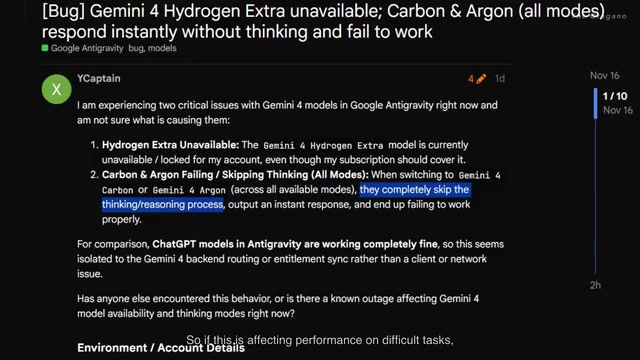
But there are concerns. Multiple users noticed that the Gemini for Carbon model often skips its thinking process, even when set to high or ultra-high reasoning levels, directly skipping ahead when facing complex tasks.
Gemini Task Features and Agentic Execution
Gemini's "Tasks" feature is an agentic capability, fundamentally different from traditional Q&A interaction: the model no longer only outputs text but calls external tools and services to complete multi-step operations—for example, reading email context to draft replies, checking calendar availability and creating events, interacting with local businesses through phone interfaces, and calling payment interfaces to complete transactions after authorization. Such features rely on tool-calling protocols, permission sandboxes, and human confirmation mechanisms, and their reliability depends on the model's ability to maintain goal consistency across multi-step planning. The article mentions that the Carbon model still skips its thinking process at high reasoning levels, reflecting a typical risk in agentic scenarios—the model omits intermediate reasoning in pursuit of response speed, leading to goal drift or missing steps in complex tasks.
Microsoft, Anthropic, and Perplexity: Substantive Progress at the Tool Layer
Microsoft announced 7 new AI models at Ignite. MAI Code R and Code R Flash are already available in GitHub Copilot—the former focuses on debugging, refactoring, and cross-codebase reasoning, while the latter is optimized for speed and everyday development. The bigger surprise is MAI Image 2.7—reportedly taking first place in AI image editing benchmarks at roughly one-sixth the price of the four models immediately behind it. Image 2.7 Flash's image generation pricing starts at about $10.24 per thousand images, while the standard model is $34.82 per thousand images.
Anthropic launched code mode for its cloud platform, allowing AI agents to write scripts that chain multiple tools together rather than calling tools one at a time, executing in the background while remaining responsive. It also introduced linked billing, so developers no longer need to share cloud API keys with third-party platforms and can pay API fees directly through the cloud platform.
Perplexity CEO Arvind revealed that its annualized revenue has officially surpassed $1 billion, and claimed it reached this milestone spending $500 million less than Anthropic, which is preparing for its IPO.
Code Mode and Tool Orchestration
Anthropic's "code mode" for its cloud platform changes the traditional paradigm of agent tool calling. Previously, agents typically made tool calls one by one, each requiring a model round-trip, resulting in high latency and large context consumption; code mode allows the model to generate a script that chains multiple tool calls and executes in the background, with the model only needing to intervene when the script completes or encounters an exception. This approach significantly reduces round-trips and token overhead, and is closer to how human developers work with SDKs. The accompanying linked billing feature solves the key management problem: developers no longer need to share cloud API keys with third-party platforms but settle API fees directly through the cloud platform, reducing the risk of key leakage and simplifying multi-party billing chains.
NVIDIA's Paradox: Leadership Turmoil and Record Revenue Coexist
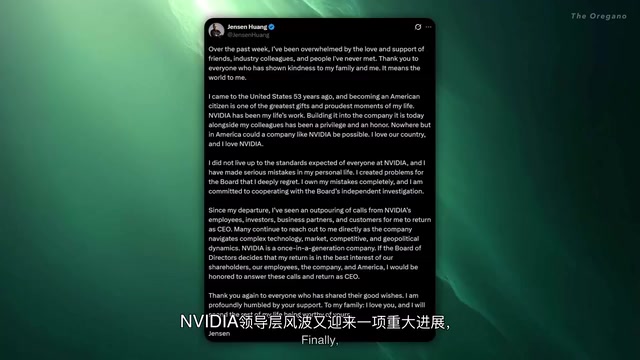
NVIDIA's leadership turmoil has seen new developments. Jason acknowledged on X that he made serious mistakes and took responsibility, expressing willingness to return to NVIDIA as CEO. But according to the earnings call, the chairman stated that the board does not intend to reinstate him as CEO, though it has not completely ruled out the possibility.
In contrast to the turmoil are the business figures: NVIDIA reported first-quarter revenue of $115.8 billion, with the data center segment contributing $107.6 billion and net profit of $65.3 billion; it expects next-quarter revenue of $130 billion and announced a stock buyback plan of up to $150 billion. These numbers show that demand for AI infrastructure remains enormous, and AI is becoming one of the largest infrastructure investment cycles in the tech world.
A Conclusion Worth Remembering
Looking at this round of releases together, the clearest signal is not who won the benchmarks, but that the evaluation system for model capabilities is breaking down. Zio's criticism and the creator's testing can both be self-consistent because they target different workloads. As the video says: the best model is not necessarily the one with the highest benchmark score, but the one that can reliably help you get work done. Before testing it yourself, any "strongest" or "worst" label is worth holding in reserve.
Related articles

Gemini 4 Neon Released: Outperforms Flagship, 40% Cost Reduction — Is Google's RSI Finally Here?
Google officially releases Gemini 4 Neon: 61 on the AA Intelligence Index beating Carbon, No. 1 on Coding Agent, three times faster and 40% cheaper. Four models in two months reignite RSI rumors — this article breaks down the leaderboard data, pricing strategy, and what the release cadence really signals.

Gemini 4 Neon Hands-On Test: Best for Coding but Nearly Twice as Slow — How Do You Account for That?
Overseas reviewers tested Gemini 4 Neon: ranked first on the Coding Agent Index with per-task cost about half of Claude, but nearly twice as slow as the median. We break down third-party cost, speed, and capability data to help you decide if the bill is worth it.

Gemini 4 Neon Hands-On: How Does It Compare to Astra 6.2 for PPT Generation?
Hands-on test of Google Gemini 4 Neon vs Astra 6.2 on the same offline speech PPT task: visuals on par, Neon wins on accuracy and detail and faithfully converts the data source; but revisions return only single pages, and UI and images are easily redrawn. The fast model matches the flagship and is worth using.