Gemini 4 Neon Hands-On: How Does It Compare to Astra 6.2 for PPT Generation?
Gemini 4 Neon matches or slightly beats the flagship Astra 6.2 on PPT generation, but its revision workflow lacks engineering maturity.
Bilibili creator "Lei Ge" compared Gemini 4 Neon with Astra 6.2 on an offline salon PPT creation task. Their visuals were on par, with Neon looking more rounded and concise; Neon won on content accuracy, faithfully turning a 20-item outline into 23 detailed pages, while Astra 6.2 produced content that didn't match the outline. But Neon 4's weakness is revision: after local edits it only returns a single-page PPT, and UI styles and images may be redrawn. As a fast model, Neon 4 matches or slightly outperforms the flagship; the creator considers it worth using but says the current minor flaws must be tolerated.
Google's newly released Gemini 4 Neon model (referred to in the original as "尼昂4" or "NEO4") claims to be "fast and powerful," but how does it actually perform? Bilibili creator "Lei Ge" put it head-to-head with Astra 6.2 on the same task: creating a PPT for an offline salon training session. The results were somewhat surprising: Neon matched the flagship in visual presentation and even had a slight edge in content accuracy and generation detail, but there are clear pain points in the revision process.
The Gap Between Official Benchmarks and Real-World Scenarios
According to the creator, in official benchmarks Gemini 4 Neon surpassed OPUS 5.5 and the sub-flagship models of Astra 6.2 on most metrics. But high benchmark scores don't equal usability—real tasks are the true test.
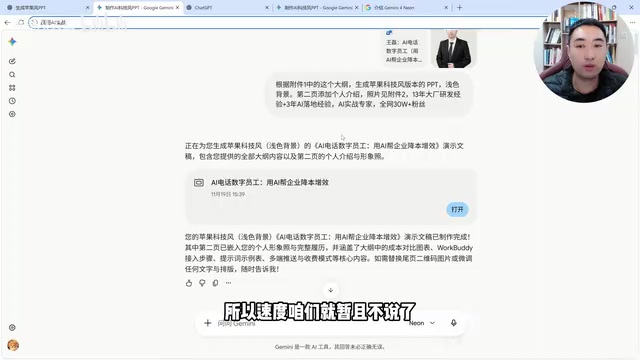
The task the creator gave was very specific: feed a 20-item speech outline with a logical progression, along with a personal photo, to both Astra 6.2 and Neon 4, and ask them to generate a PPT for an offline speech. The prompts and resource files were identical; the only variable was the model.
Astra 6.2 used "advanced reasoning" mode and took over four minutes to generate. Neon 4 didn't show a specific execution time, so speed couldn't be directly compared. But the creator noted that Neon 4's generation speed was "unverifiable," so it could only be judged on output quality.
The Limits of Benchmarks: Official benchmarks usually refer to a model's scores on standardized test sets like MMLU, GSM8K, and HumanEval. These tests measure a model's average performance on specific tasks, not its overall capability in real-world workflows. High benchmark scores only indicate that a model performs well under controlled conditions, but in actual use, tasks often involve multi-step reasoning, long-context understanding, format adherence, and tool calling—complex factors that are hard to capture with a single score. Therefore, a gap between benchmark scores and real experience is common, and same-task comparisons in specific scenarios are needed to judge whether a model is truly "usable."
Visual Presentation: Neon Is More Rounded and Clean; the Two Are on Par
Astra 6.2 generated 16 PPT pages, with page aesthetics noticeably improved over the previous generation—the creator called it "completely beyond expectations." Neon 4 generated 23 pages with a more rounded style, visually "not inferior to 6.2 at all, and it feels more concise and intuitive."
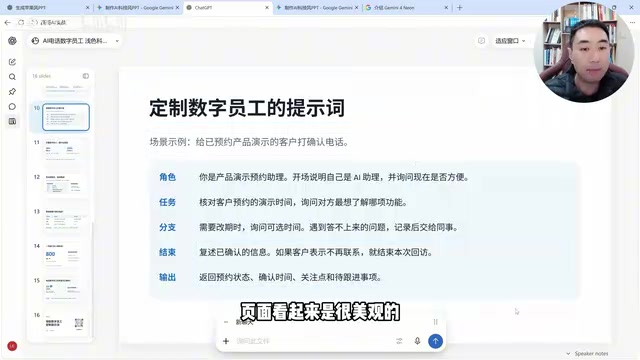
Judging by appearance alone, both are production-ready; choosing between them is mostly a matter of aesthetic preference. But after checking the content page by page, the creator found that the gap opened up in usability.
Content Accuracy: Neon Wins; Astra "Talks Nonsense"
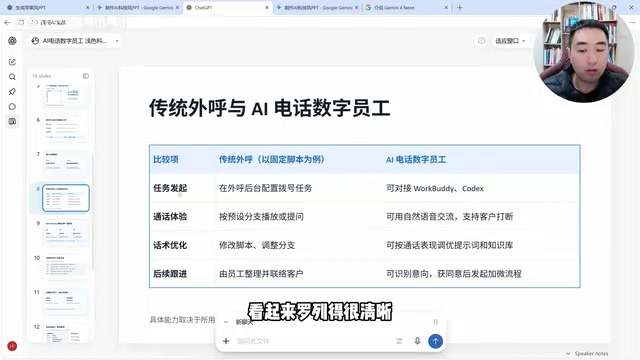
Although Astra 6.2's pages were stunning, the content had major flaws. On the page "The Difference Between AI Digital Employees and Traditional Outbound Calling," the content Astra listed didn't match the outline the creator provided at all. The creator's original intent was to emphasize that AI digital employees can directly connect to agents (such as Vocabuddy or Codex), automatically add WeChat contacts, are truly intelligent and can be tuned and trained, have a human feel, and can be interrupted—but the comparison items Astra generated were "complete nonsense" and couldn't effectively lead into the point when presenting.
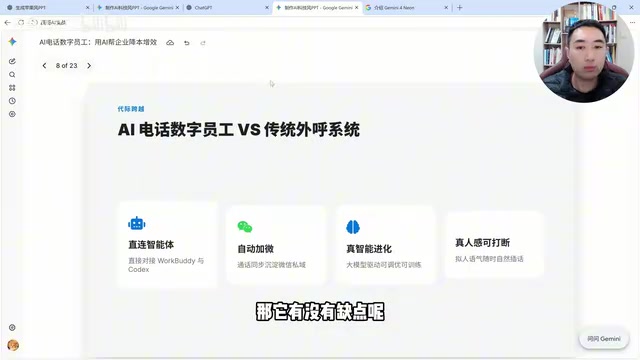
In contrast, Neon 4 clearly presented the key points on the same page—direct agent connection, automatic WeChat adding, true intelligent evolution, tunability and trainability, interruptibility, and human feel—with icons, accurately corresponding to the outline data source. The creator concluded: Neon 4 can truly convert the data source into correct PPT content, generating more detailed output that meets actual requirements.
Hallucination and Instruction Following: Astra 6.2's content on the "Difference Between AI Digital Employees and Traditional Outbound Calling" page, which completely failed to match the outline, is a typical "hallucination" phenomenon—the model generated information that seems plausible but lacks basis. In tasks like PPT generation that require strict fidelity to the data source, hallucinations directly make the content unusable. Neon 4's ability to accurately correspond to outline points shows it is more stable in instruction following and long-text information extraction. When evaluating a model, besides generation quality, it's also important to check whether it stays faithful to the input, which is usually related to alignment strategies during training and the efficiency of context window utilization.
Revision Experience: Neon's Weakness Is in Engineering
Neon 4 is not without its shortcomings. During debugging, the creator made 6 to 7 revisions and found two problems:
First, after making a local edit and asking the model to regenerate, it only returned the PPT of the modified page rather than the complete file, requiring another instruction to get the full version. This adds operational cost in PPT creation that requires repeated iteration.
Second, the UI style may be "redrawn" during revision—only one piece of text was changed, but when exporting, the UI in many places had changed; more troublesome, images had a chance of being damaged in the next version, requiring another prompt to fix them back. The creator considers these to be current minor bugs in Neon 4.
By contrast, exporting directly after revisions in GPT works fine, requiring only local adjustments. Neon 4's engineering maturity still has room for improvement.
Engineering Maturity: This refers to the stability, consistency, and operability of a model product in real usage workflows, including whether local edits only affect the target area, whether the output format is complete, and whether style consistency is maintained after multiple iterations. Neon 4 returning only a single-page PPT after local edits and having UI styles and images redrawn reflects insufficient engineering maturity in its "edit-export" pipeline. By contrast, mature products typically avoid such issues through differential updates, region locking, or version control. Engineering maturity often affects daily usage experience more than the model's own capabilities, and it is one of the key dimensions that separates fast models from flagship models.
Conclusion: The Fast Model Matches the Flagship and Is Worth Using
Overall, as a fast model, Gemini 4 Neon matches or even slightly outperforms the Astra 6.2 flagship on PPT generation tasks: visual quality is sufficient, content is detailed and accurate, and it faithfully converts the data source. Its weaknesses are concentrated in the stability and completeness of the revision-iteration phase. The creator's final assessment: "It shows that J Company didn't disappoint us this time"—its performance is worth using.
For users who need to quickly generate presentation decks, Neon 4 offers a new option that balances speed and quality; but if a lot of repeated revision is involved, you still need to tolerate the current minor flaws.
One-line Summary
Gemini 4 Neon matches or slightly outperforms the flagship Astra 6.2 on PPT generation tasks, but its revision workflow lacks engineering maturity.
Paragraph Summary
Bilibili creator "Lei Ge" compared Gemini 4 Neon with Astra 6.2 on an offline salon PPT creation task. Their visual presentation was on par, with Neon's style being more rounded and concise; on content accuracy, Neon won, faithfully converting a 20-item outline into 23 detailed pages, while Astra 6.2 produced "nonsense" that didn't match the outline. However, Neon 4's weakness is in revision: after local edits it only returns a single-page PPT, and UI styles and images may be redrawn. As a fast model, Neon 4 matches or slightly outperforms the flagship; the creator considers it worth using but says the current minor flaws must be tolerated.
Related articles

Google Gemini 4 Neon Hands-On: 6 3D Works That Impress and Fail
Hands-on with Google Gemini 4 Neon on a 3060 laptop: 6 3D works tested. Sunshower Fishing Harbor and mechanical keyboard impress; soft-body physics and faces fall short.
Gemini 4 Neo Web Novel Writing Test: Faint AI Flavor, Textured Dialogue
Bilibili creator's first-look review of Gemini 4 Neo for Chinese web novel writing: testing a Three Kingdoms transmigration opening with faint AI flavor, emotionally textured dialogue, and strong crisis building, plus comparison of 4A/4H/4C models and full workflow demos.
Gemini 4 Neon Released, Anthropic IPO Priced at $83 in Focus
Google releases Gemini 4 Neon on its API and Anthropic prices its IPO at $83 on Nasdaq. This AI daily roundup covers OpenAI agent data, Tencent and SenseTime updates, and open-source model safety benchmarks.