Claude Fable 5 Performance Degradation: Elevated Error Rates, Official Investigation Underway

Claude Fable 5 experienced elevated API error rates at 19:49 UTC on October 21; officials are investigating, and developers should prepare retry and fallback measures.
This article reports that Claude Fable 5 experienced elevated request error rates at 19:49 UTC on October 21. The official status page has marked the incident as Investigating, indicating that the technical team is working to identify the root cause and remediation has not yet begun; specific error types, affected regions, and user proportions have not been disclosed. The article analyzes common causes of elevated error rates, including infrastructure resource bottlenecks, failures in dependent components such as inference gateways or storage layers, sudden traffic spikes exceeding capacity planning, and unexpected behavior introduced by model updates or configuration changes. For production environments that depend on this model, the article recommends that developers strengthen monitoring and alerting, configure degradation strategies with backup models or cache fallback, implement exponential backoff retries for transient errors, and subscribe to status page notifications to track recovery progress via Monitoring or Resolved status.
Event Overview
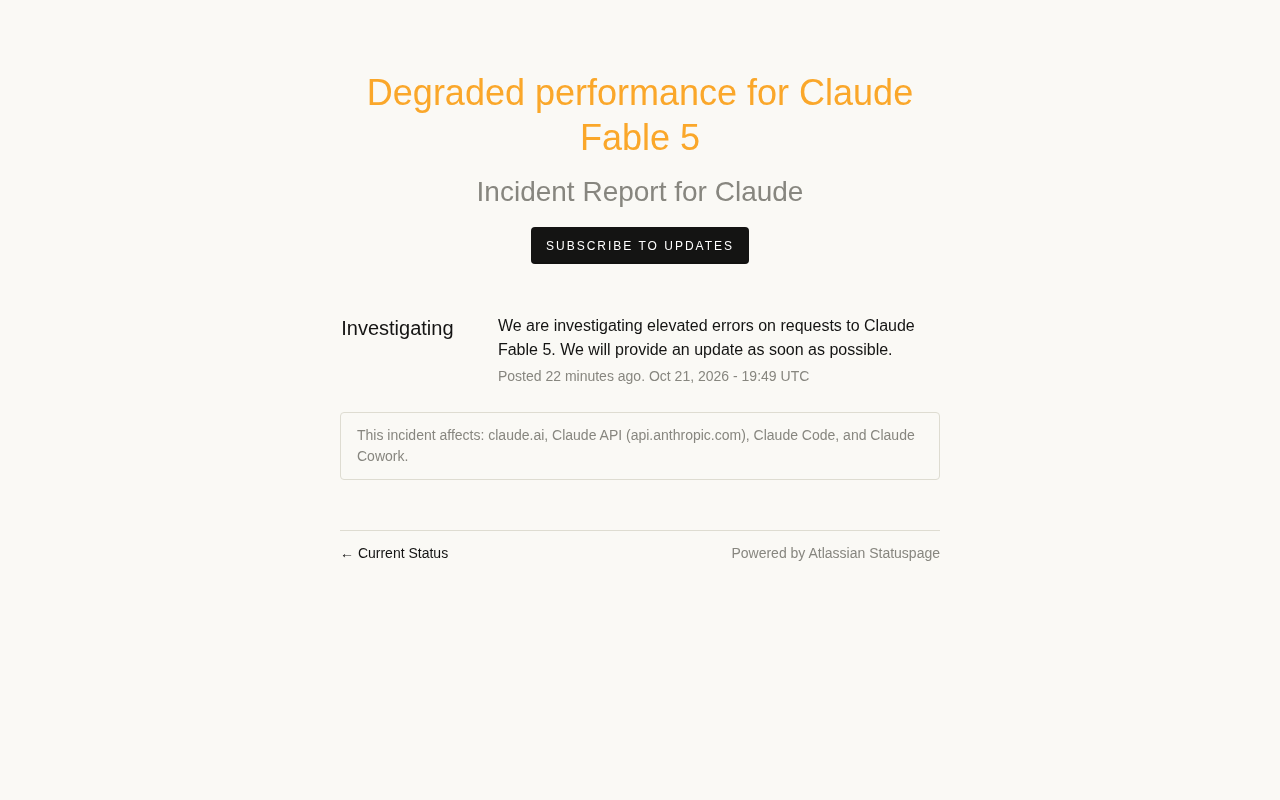
According to the official status page, Claude Fable 5 experienced elevated request error rates at 19:49 UTC on October 21. The team is currently in the Investigating phase and has committed to providing updates as soon as possible.
Scope of Impact and Current Status
This performance degradation primarily affects API requests to Claude Fable 5, manifesting as elevated errors. The official team has not yet disclosed the specific error types, affected regions, or proportion of users impacted. The status page marks the current incident as "Investigating," meaning the technical team is working to identify the root cause and remediation measures have not yet begun.
For production environments that depend on this model, it is recommended to temporarily add retry logic or switch to a backup model to minimize impact on end users.
Elevated API request error rates is a status description commonly used on cloud service status pages, typically referring to the proportion of requests returning non-2xx status codes within a given time window being significantly higher than the baseline level. For LLM services, error sources may include rate limiting (429), gateway or inference backend timeouts (5xx), authentication or quota issues (4xx), and model inference failures. Status pages generally only disclose overall error rate trends without distinguishing specific error codes, so developers cannot determine from the status page alone whether the issue is insufficient capacity, dependency failure, or a localized network problem. During actual troubleshooting, it is recommended to correlate your own request logs, status code distribution, and latency metrics with the status page timeline to distinguish platform-side failures from client-side configuration issues.
Possible Cause Analysis
Although officials have not disclosed details, based on similar past incidents, elevated error rates typically stem from several factors: infrastructure-level resource bottlenecks (such as excessive GPU cluster load), failures in components that model services depend on (such as inference gateways or storage layers), or sudden traffic spikes exceeding capacity planning. Additionally, recent seamless model updates or configuration changes may also introduce unexpected behavior.
Before officials publish a root cause analysis, any speculation should be treated with caution. For developers, following subsequent updates on the status page is the most direct information channel.
An inference gateway is an intermediary layer between clients and model inference clusters, responsible for request routing, authentication, rate limiting, load balancing, and retries, often deployed decoupled from model services. When the gateway layer experiences configuration errors, connection pool exhaustion, or abnormal upstream health checks, even if the GPU cluster itself is functioning normally, it will manifest as elevated overall error rates. Similarly, failures in the storage layer (such as model weight loading, KV cache, or object storage that log writing depends on) can also cause inference request failures. Understanding this layered architecture helps developers determine whether errors are global (gateway or storage layer) or localized (specific region or specific model version), and thus decide whether to switch regions, switch models, or simply increase retries.
Recommendations for Developers
- Monitoring and Alerting: Check whether existing monitoring covers Claude Fable 5's request success rate and latency to ensure timely detection of anomalies.
- Degradation Strategy: Configure backup models or cache fallback options for critical business flows to avoid single points of dependency.
- Retry and Backoff: Implement exponential backoff retries for transient errors, but be careful not to exacerbate server-side pressure.
- Follow Official Updates: The "Monitoring" or "Resolved" status on the status page will indicate recovery progress; it is recommended to set up subscription notifications.
Exponential backoff retry is a strategy that progressively increases retry intervals when encountering transient errors, typically used in conjunction with random jitter to avoid a "retry storm" where large numbers of clients retry at the same moment, further overwhelming an already overloaded server. A typical implementation waits base × 2^n plus a random number of milliseconds for the nth retry, with a maximum retry count and total timeout limit. For LLM APIs, it is also necessary to distinguish retryable errors (such as 429, 5xx, timeouts) from non-retryable errors (such as 400 parameter errors, 401 authentication failures), and only enable backoff retries for the former; otherwise, it will waste quota and prolong failure detection time.
Follow-up
This incident is another reminder that even mature large model services require architectures designed for uncertainty. We will continue to track official updates and supplement our analysis as more information becomes available.
(This article is based on public status page information; the incident is still developing.)
Related articles

Selective Auditing: Making AI Decisions Both Reliable and Labor-Efficient
New research on AI decision reliability: a selective auditing algorithm minimizes human audit frequency while keeping unaudited error rates below a threshold, with experiments showing major labor savings.

Low-Cost Abstention Strategy: How LLM Ticket Classification Reduces Misrouting Costs
Cost-aware abstention framework cuts ticket routing costs by 38.1%, reduces misrouting from 15.3% to 3.5% on 47,837 IT tickets, outperforming LLMs.

METTA: Memory-Enhanced Meta-Reinforcement Learning for Test-Time Adaptation
METTA proposes dual-timescale memory decomposition for efficient test-time adaptation in meta-RL with linear complexity, exceeding 50% success on Meta-World ML10/45 and outperforming Transformer baselines on PointMaze.