Claude Fixes More Firefox Security Bugs in One Month Than the Previous 15 Months Combined — AI Code Auditing Delivers Stunning Results

Claude AI helps Firefox fix more vulnerabilities in one month than the prior 15 months combined
The Firefox team used Anthropic's Claude Mythos Preview model to fix more security vulnerabilities in April 2025 than in the entire previous 15 months, marking AI code auditing's leap from supplementary tool to core productivity driver. With deep code auditing, large-scale codebase navigation, and contextual correlation analysis, the model effectively fills gaps left by traditional fuzzing, clears long-accumulated security debt, and opens a new paradigm for open-source project security maintenance.
A Jaw-Dropping Security Fix Record
Recently, a social media post caught widespread attention in the tech community: using Anthropic's Claude Mythos Preview model, the Firefox team fixed more security vulnerabilities in April 2025 than in the entire previous 15 months combined.
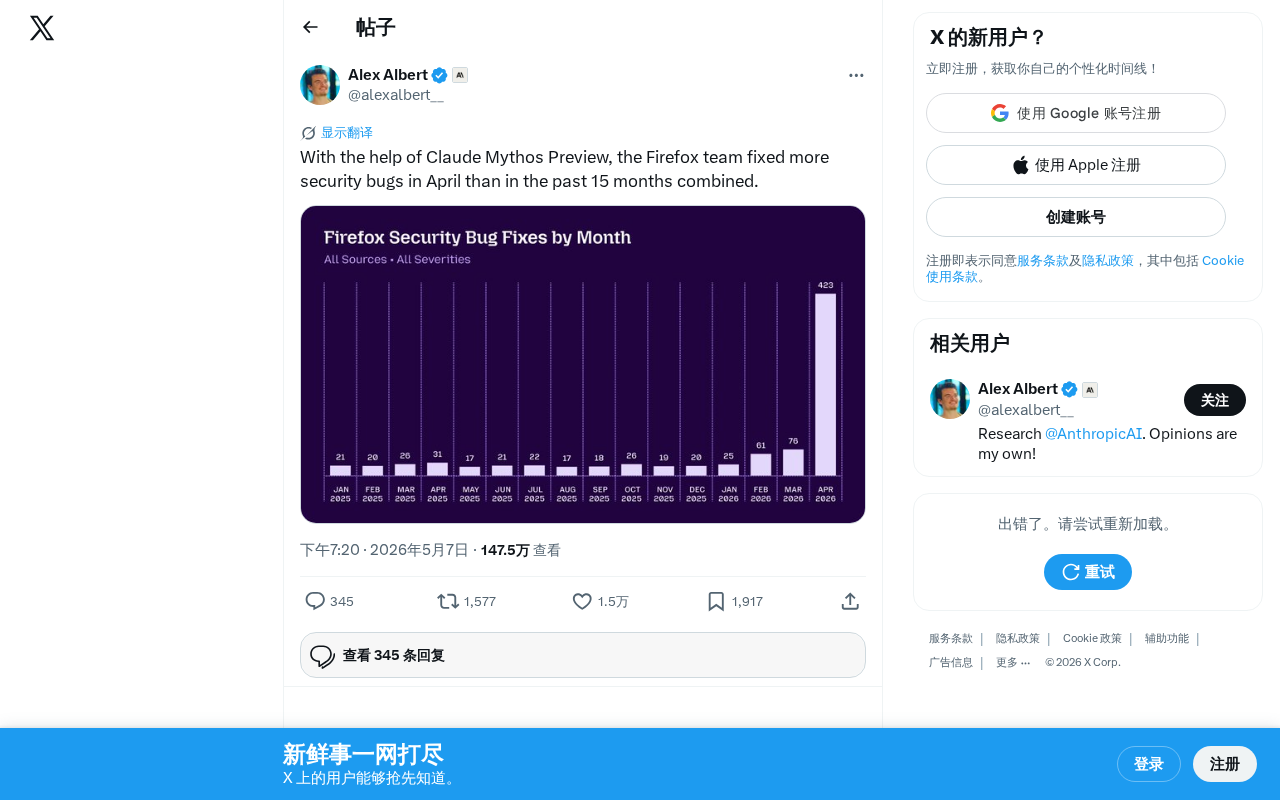
This isn't an incremental efficiency improvement — it's an order-of-magnitude leap. It means AI code auditing has evolved from a "supplementary tool" to a "core productivity driver" in the security maintenance of large open-source projects.
What Is Claude Mythos Preview? Why Can It Dramatically Boost Vulnerability Fix Rates?
Claude Mythos Preview is a model version from Anthropic focused on code comprehension and security analysis. Compared to the general-purpose Claude model, it demonstrates three core advantages in security auditing scenarios:
- Deep code auditing capability: It can understand complex C/C++ codebases and precisely identify common security risks such as memory safety issues, type confusion, and race conditions
- Large-scale codebase navigation: Firefox has tens of millions of lines of code, making traditional manual auditing extremely inefficient. AI can systematically scan the entire codebase without missing any corner
- Contextual correlation analysis: It can not only find point vulnerabilities but also trace data flows across modules to uncover more subtle security issues
Notably, the most common types of security vulnerabilities in browser engines — memory safety bugs (such as buffer overflows and use-after-free/UAF), type confusion vulnerabilities, and race conditions — are especially prevalent in C/C++ codebases. Firefox's Gecko rendering engine and SpiderMonkey JavaScript engine are both written extensively in C++, making manual detection of these vulnerabilities extremely time-consuming. Claude Mythos Preview's deep understanding of these known vulnerability patterns is the technical foundation behind its efficiency breakthrough.
The introduction of this model fundamentally changed how security teams work — shifting from "humans hunting for bugs" to "AI discovers bugs, humans verify and fix."
Why This Matters
Browser Security Is the Cornerstone of Internet Security
As one of the world's major browsers, Firefox's security directly affects the data safety of hundreds of millions of users. Browser engine code is extraordinarily complex, spanning rendering engines, JavaScript engines, network protocol stacks, and other critical modules. Any single security vulnerability could be exploited by attackers to execute remote code or steal user data.
Traditional security auditing relies on manual code review and fuzzing — an automated testing technique that feeds large amounts of random or semi-random data into programs to trigger crashes and thereby discover vulnerabilities. Mozilla has long participated in Google's oss-fuzz project and has accumulated extensive fuzzing experience. However, fuzzing has inherent limitations: it primarily finds vulnerabilities that can trigger program crashes, but has severely insufficient coverage for logic bugs, information disclosure issues, and subtle defects that require specific contexts to trigger. This causes a large number of "low-priority" but equally dangerous vulnerabilities to accumulate over time, gradually forming difficult-to-repay security debt.
Security debt is a concept analogous to technical debt, referring to the accumulation of known or potential security issues in a software project that are deferred due to resource constraints. Like technical debt, security debt compounds as the codebase grows — every unpatched vulnerability can become an entry point for larger future exploits, eventually leading to uncontrollable security incidents.
15 Months vs. 1 Month: The Efficiency Revolution of AI Code Auditing
The data point "one month exceeding 15 months" reflects not just a speed improvement but a qualitative change in coverage. AI can tirelessly review every line of code and every branch path, whereas human engineers inevitably have blind spots when facing tens of millions of lines of code.
This also implies that before AI intervention, Firefox's codebase actually contained a large number of undiscovered security issues of known types. The introduction of Claude Mythos Preview was essentially a comprehensive "security health check" for the entire codebase, clearing out long-accumulated security debt in one concentrated effort.
A New Paradigm for Open-Source Project Security Maintenance
Open-source projects have long faced a common dilemma: code volume keeps growing, but security maintenance resources remain limited. This isn't an exaggeration — the Log4Shell vulnerability that shocked the industry in 2021, and the XZ Utils backdoor incident in 2024 that nearly caused a major supply chain attack, both revealed the structural fragility of open-source infrastructure in terms of security maintenance: many critical open-source projects that underpin the global internet are actually maintained by only a handful of volunteers, with severely inadequate security auditing resources. As a nonprofit organization, Mozilla faces the same reality of constrained resources.
The introduction of AI security auditing tools provides a practical solution to this long-standing challenge. If the success of Claude Mythos Preview on Firefox can be replicated for other critical open-source projects like Chromium, the Linux kernel, and OpenSSL, the security level of the entire internet infrastructure will be significantly elevated, and the industry pain point of open-source software supply chain security could see systematic improvement.
Limitations and Future Outlook of AI Security Auditing
Of course, we need to view these results rationally. Vulnerabilities discovered by AI still require human engineers to verify their authenticity and severity, and fix proposals need human oversight to ensure they don't introduce new problems. Additionally, AI is currently better at finding vulnerabilities matching known patterns — for entirely new types of attack vectors, the creative thinking of human security researchers remains irreplaceable.
But the trend is abundantly clear: AI is becoming the most powerful force multiplier in the software security field. Future security teams will be hybrid "AI + human" formations — AI handles large-scale scanning and initial filtering, while humans handle deep analysis and strategic decisions.
The Firefox team's practice has set a benchmark worth referencing for the entire industry. When Claude can accomplish in one month what previously took over a year of security fix work, we have every reason to believe that the "AI era" of software security has truly arrived.
Key Takeaways
- The Firefox team, using Claude Mythos Preview, fixed more security vulnerabilities in April 2025 than in the previous 15 months combined
- Claude Mythos Preview offers deep code auditing and large-scale codebase navigation capabilities, transforming how security teams operate
- Traditional fuzzing has insufficient coverage for logic bugs and information disclosure issues — AI auditing effectively fills this blind spot
- AI security auditing addresses the long-standing problems of accumulated security debt and insufficient maintenance resources in open-source projects
- AI-discovered vulnerabilities still require human verification and fixing; the future will see hybrid AI + human security team models
- This practice sets a benchmark for AI-assisted security auditing across the software industry, with far-reaching implications for open-source supply chain security
Related articles
Meta Muse Hits 900K Downloads in Six D…
Meta Muse Hits 900K Downloads in Six Days: The AI Agent Era Has Officially Arrived
Meta's AI agent Muse hit 902K downloads in 6 days, topping US App Store and Google Play charts above ChatGPT and Claude. A deep dive into Muse's capabilities and the AI Agent race.
 Industry Insights
IRS Fully Embraces Claude AI, Accelerating Federal Government's AI Adoption
The IRS is recruiting staff with 24/7 Claude AI access, marking Anthropic's breakthrough into the federal government. Explore the strategic implications and tax use cases.
 Industry Insights
The IRS Mobile App Debate: A Trust Crisis in Government Digital Transformation
The IRS's proposed mobile app has sparked heated debate. This article analyzes the core arguments, exploring data security, privacy, and the trust crisis in government digital transformation.