Claude Hackathon Reflections: Building a Good Product and Winning a Hackathon Are Two Different Things

A Claude hackathon reveals that perceived functionality and demo skills matter far more than real engineering quality.
A software engineer shared on Reddit his experience at the Claude OC Impact Lab hackathon: 29 of 31 teams chose the same medical referral intake challenge, and the winning teams' differentiating highlight was merely adding a Spanish interface. He observed that judges used Claude to analyze codebases but had under two hours to evaluate about 35 teams, with scoring focused on "Day One Impact," usability, and demo clarity. He distilled hackathon unwritten rules: perceived functionality beats actual functionality, demos and networking are crucial, and easy-but-visually-prominent features offer extremely high ROI. The article asks whether hackathon judging needs redesign to recognize true engineering excellence in the age of AI-accelerated development.
A Claude Hackathon That Brought Cognitive Upheaval
Recently, a software engineer shared on Reddit his experience at the Claude OC Impact Lab hackathon, saying the event completely changed his view of hackathons. He had assumed these competitions were like science fairs, where judges scored based on usefulness, correctness, and problem-solving. Reality hit him hard: 29 of 31 teams chose the same challenge — building a referral intake system to help coordinators quickly review 15 to 35 pages of medical documents and determine whether patients qualify for rehabilitation care.
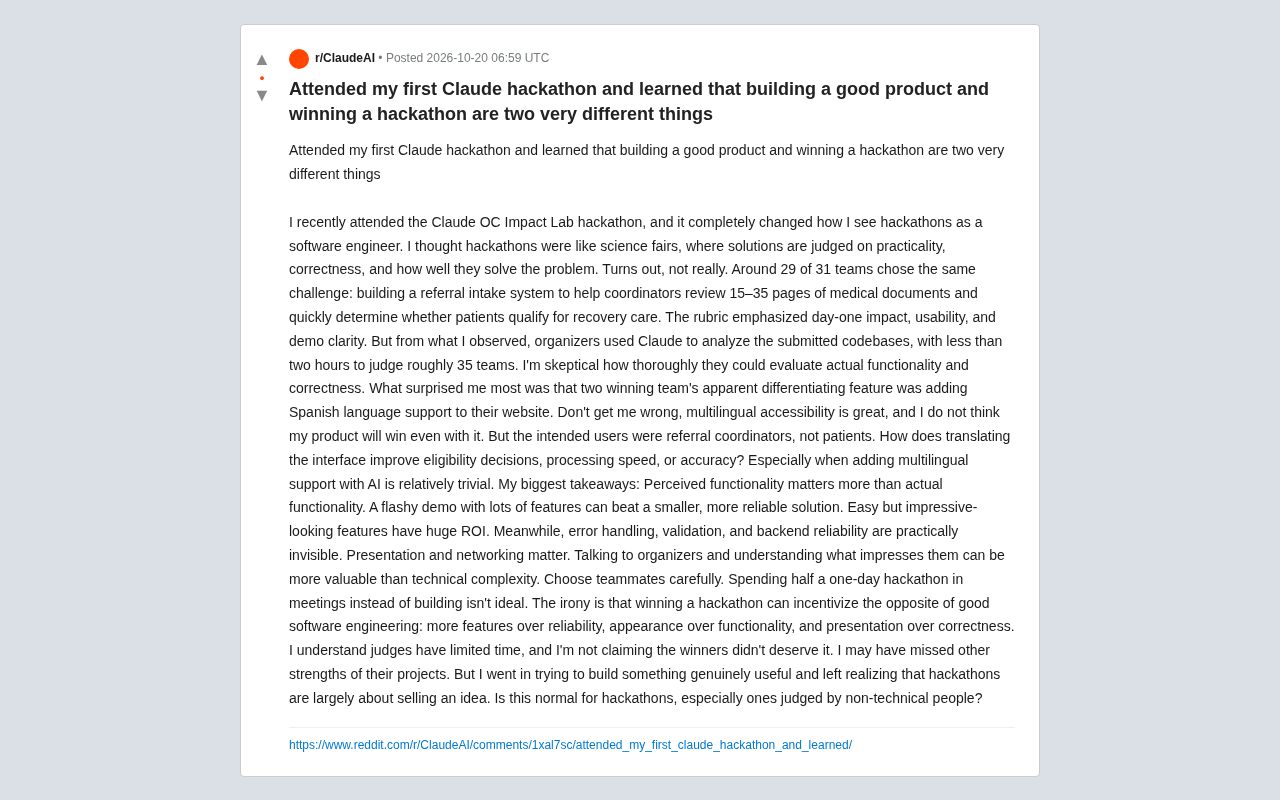
The judging criteria emphasized "Day One Impact," usability, and demo clarity. But according to his observation, the organizers used Claude to analyze submitted codebases yet had less than two hours to judge around 35 teams. He doubted this: how could actual functionality and correctness be thoroughly evaluated in such a short time?
This case reveals a broader issue: when AI tools drastically accelerate development, has hackathon judging kept pace?
Claude OC Impact Lab is an offline hackathon series held by Anthropic's Claude community in Orange County, California, part of its global community events. These Impact Labs typically focus on "AI for good" or social impact themes, encouraging participants to build applications for healthcare, education, and public welfare using Claude and its API. The competition period is usually short (often one to two days), emphasizing rapid prototyping and live demos, so judging often relies on pitches rather than deep code review.
The referral intake system mentioned corresponds to the "referral coordination" process in medical rehabilitation care: hospitals or clinics refer patients needing rehabilitation care to specialized institutions, and the receiving coordinator must review medical records, assessment reports, and insurance materials page by page to determine eligibility for admission. This process involves large volumes of documents and high specialization, making it a typical use case for LLM-assisted summarization and information extraction — which also explains why most teams converged on the same topic.
Why the Winning "Differentiating Feature" Was Confusing
What surprised him most was that the obvious differentiating feature of the two winning teams was adding Spanish language support to their websites. He did not deny the value of multilingual accessibility, but raised a sharp question: the target users are referral coordinators, not patients. How does a translated interface improve eligibility determination, processing speed, or accuracy?
Especially considering that adding multilingual support with AI is relatively easy. According to the engineer's observation, while this feature was easy to implement and visually prominent, it did almost nothing to address the core problem — helping coordinators make faster and more accurate eligibility decisions. This led to his deeper reflection on hackathon judging logic.
The Unwritten Rules of Hackathons: Perceived Functionality Over Actual Functionality
The engineer summarized several key takeaways. The first: perceived functionality matters more than actual functionality. A product with many features and a flashy demo can beat a smaller but more reliable solution. Features that are easy to implement but look impressive offer extremely high ROI. Meanwhile, error handling, data validation, and backend reliability are nearly invisible in demos.
The second: demos and networking are crucial. Talking with organizers and understanding what impresses them may be more valuable than technical complexity. The third: choose teammates carefully. Spending half a day in meetings instead of building is clearly not ideal.
These observations point to a paradox: winning a hackathon may incentivize behaviors contrary to good software engineering — prioritizing feature count over reliability, appearance over functionality, and demos over correctness. The engineer acknowledged that judges have limited time and did not deny that winners might have other advantages, but admitted: "I went in wanting to build something truly useful, and left realizing that a hackathon is largely about selling an idea."
Is This Normal for Hackathons?
The engineer ended with a question: is this normal for hackathons, especially those judged by non-technical people?
From community discussions, this phenomenon is not rare. A hackathon is essentially a time-limited creative showcase, and judges must make decisions in a very short time, naturally favoring projects with impressive demos and clear storylines. But this does not mean participants should abandon engineering quality — rather, they need to understand the rules of the game: within limited time, build reliable core functionality while also learning to "translate" technical value into demo language that judges can quickly perceive.
In today's world of increasingly prevalent AI-assisted development, this case raises a question worth pondering: as adding multilingual support and generating beautiful interfaces becomes easier, do hackathon judging criteria need to be redesigned to identify true engineering excellence? Perhaps the next generation of hackathons needs longer judging periods, more technical judges, or scoring dimensions that emphasize code quality and maintainability.
Structural bias in hackathon judging has been discussed in both academic and engineering communities. Because judging time is extremely short and judges are often non-technical sponsors or organizers, scoring naturally favors high-"visibility" signals: whether the demo flows, whether the interface is complete, whether the story is compelling. This misaligns with the actual value distribution of software engineering — reliability, maintainability, security, and correctness often only become apparent after weeks or months of use and cannot be demonstrated in a five-minute pitch.
In contrast, some technically oriented hackathons adopt split-track judging: technical judges review code repositories, test coverage, and architecture, while product judges evaluate demos and user value, with longer judging windows (e.g., half a day or more) and explicit code quality scoring items. Some events also introduce "reproducibility" requirements, where judges re-run projects on-site according to submitted instructions to filter out solutions that rely solely on demo videos. These mechanisms are targeted corrections for the aforementioned bias.
Background Notes
"Day One Impact" is a common judging dimension in hackathons and corporate innovation competitions, referring to a project's ability to deliver perceptible value to real users on its first day of use, rather than remaining a long-term vision. It is usually scored alongside "usability," "demo clarity," and "innovation," favoring solutions that work now and can be clearly explained, rather than infrastructure or reliability engineering that requires long-term refinement. This standard itself systematically downweights "invisible" engineering dimensions such as code quality and error handling.
Using Claude to analyze submitted codebases typically means judges feed each team's GitHub repository into an LLM to automatically generate project summaries, tech stack identification, or preliminary quality assessments as an aid to human review. This approach can expand judging coverage, but LLMs have limited ability to judge runtime behavior, edge-case handling, and true correctness, and can hardly replace actual execution and testing. When judging time is compressed to two hours and the number of teams exceeds thirty, automated analysis is more likely to degenerate into "reading READMEs and directory structures," which precisely explains the author's skepticism.
One-line Summary
A Claude hackathon reveals: perceived functionality and demo skills matter far more than real engineering quality in determining victory.
Paragraph Summary
A software engineer shared on Reddit his experience at the Claude OC Impact Lab hackathon: 29 of 31 teams chose the same medical referral intake system challenge, and the differentiating highlight of the two winning teams was merely adding a Spanish interface. He observed that judges used Claude to analyze codebases but had less than two hours to evaluate about 35 teams, with scoring criteria focused on "Day One Impact," usability, and demo clarity. From this he distilled the unwritten rules of hackathons: perceived functionality beats actual functionality, demos and networking are crucial, and features that are easy to implement but visually prominent offer extremely high ROI. The article further asks whether, with AI drastically accelerating development today, hackathon judging mechanisms need to be redesigned to recognize true engineering excellence.
Related articles

Chain of Thought Isn't Just for AI: How Humans Can Use CoT to Improve Thinking Quality
Chain of Thought isn't just a prompt trick for large models. Starting from a Hacker News discussion, this article analyzes why CoT works for human thinking too, breaks down actionable ways to transfer it, and highlights the key differences between human CoT and machine CoT.
Cloudflare Teams Up with OpenAI: Closi…
Cloudflare Teams Up with OpenAI: Closing the Loop from Vulnerability Discovery to Defense with AI
Cloudflare uses OpenAI Daybreak to investigate security vulnerabilities and generate reviewable remediation plans, while developers use Codex to boost coding efficiency and quality.

Orca Multi-Agent Orchestration in Practice: A Guide to Parallel Collaboration with Claude and Codex
Orca is Stable AI's free open-source agent workbench supporting 34 agents like Claude Code and Codex in parallel. Learn its Git worktree isolation, multi-model orchestration, and mobile management.