Claude Haiku 4.5 Deep Dive: The Cost-Performance Champion with 2x Speed and 66% Lower Cost

Anthropic launches Claude Haiku 4.5, delivering near-flagship performance at a fraction of the cost.
Anthropic has released Claude Haiku 4.5, delivering nearly 2x speed at one-third the cost of its predecessor ($1 per million input tokens). The model outperforms the flagship Sonnet 4.5 on certain tasks and supports a "brain + hands" multi-agent architecture when paired with Sonnet. It also achieves the lowest false refusal rate in its model family and is available across major cloud platforms.
Anthropic recently launched Claude Haiku 4.5, a lightweight AI model that serves as the streamlined version of the flagship Claude Sonnet 4.5. It achieves comprehensive breakthroughs across three dimensions: efficiency, speed, and cost. For developers and enterprises seeking high-value AI solutions, this release carries significant implications.
Ultimate Cost-Performance: One-Third the Price of Its Predecessor
The most striking feature of Claude Haiku 4.5 is its remarkable cost-performance ratio. While maintaining performance close to the flagship model, it delivers nearly double the speed at just one-third the cost of its predecessor—only $1 per million input tokens and $5 per million output tokens.
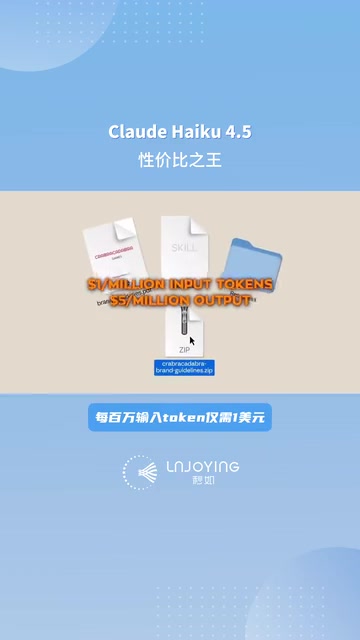
To understand what this pricing means, you first need to grasp the concept of tokens. Tokens are the basic units that large language models use to process text. An English word is typically split into 1-3 tokens, while a Chinese character usually corresponds to 1-2 tokens. AI API pricing charges separately for input and output tokens, with output prices typically higher because generating text requires more computational resources than understanding it. Pricing at $1 per million input tokens is extremely competitive in the current market, maintaining a clear advantage over comparable models like GPT-4o mini.
What does this pricing strategy mean in practice? For an enterprise application processing millions of requests daily, API call costs alone can be reduced by over 60%. In the current landscape of large-scale AI deployment, cost is often the decisive factor in whether a project can move from prototype to production. For high-frequency use cases like customer service and content generation, token costs are among the largest variables in operational expenditure, and cost differences get amplified hundreds of times over. Haiku 4.5 effectively lowers the barrier to AI commercialization.
No Performance Compromise: Outperforms the Flagship on Some Tasks
Lightweight doesn't mean performance compromise. Claude Haiku 4.5 performs excellently across multiple benchmarks and even surpasses the larger Sonnet 4.5 on certain computer use tasks, demonstrating strong real-world application capabilities.
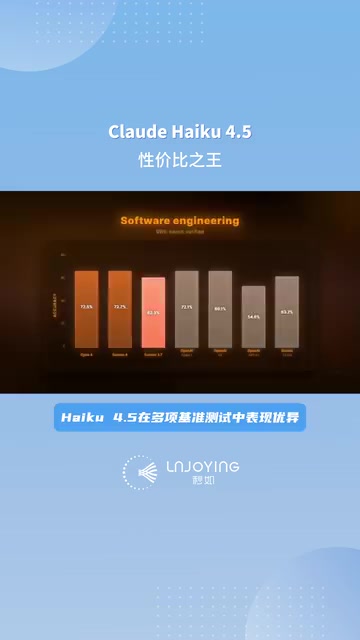
AI model benchmarks are standardized evaluation methods for measuring model capabilities, covering dimensions including coding ability (e.g., HumanEval, SWE-bench), mathematical reasoning (e.g., MATH, GSM8K), and general knowledge (e.g., MMLU). The "computer use tasks" mentioned here represent a capability direction Anthropic has been actively advancing—referring to the model's ability to directly control computer interfaces to complete practical tasks like browsing web pages, filling out forms, and operating software. Haiku 4.5 outperforming Sonnet 4.5 on these tasks demonstrates that optimizing lightweight models for specific tasks can compensate for the gap in parameter scale—reflecting the maturity of "distillation" techniques in model training, which efficiently compress knowledge from large models into smaller ones.
The model excels particularly in the following scenarios:
- Coding assistance: Rapid code generation and debugging with extremely low latency
- Real-time Q&A: Quick comprehension and response to user queries
- Customer service: Maintains stable response quality under high-concurrency scenarios
Particularly interesting is that Haiku 4.5's low-latency performance makes it naturally suited for chatbots, intelligent assistants, automated workflows, and other applications with strict response speed requirements. For products requiring real-time interaction, the improvement in user experience is immediately apparent.
Multi-Agent Collaboration: The New "Brain Plus Hands" Paradigm
Anthropic has proposed a forward-looking hybrid calling strategy: Sonnet 4.5 handles complex reasoning and task decomposition, then delegates to multiple Haiku 4.5 instances executing subtasks in parallel for efficient collaboration.

Multi-Agent Systems are a cutting-edge direction in current AI architecture design, with core concepts rooted in distributed computing and microservices architecture. In traditional single-model calling patterns, one request is processed end-to-end by one model; in multi-agent mode, tasks are decomposed into multiple subtasks completed collaboratively by different AI agents. OpenAI's Swarm framework, Microsoft's AutoGen, and LangChain's Agent module are all exploring similar directions. The unique advantage of Anthropic's Sonnet+Haiku combination strategy is that it leverages API compatibility within the same model family, dramatically reducing the engineering complexity of multi-agent orchestration.
This "brain plus hands" architecture is becoming the design paradigm for next-generation AI systems. Specifically:
- Sonnet 4.5 serves as the "brain": Responsible for understanding complex intent, formulating execution plans, and performing deep reasoning
- Multiple Haiku 4.5 instances serve as the "hands": Executing specific tasks in parallel, such as data retrieval, text generation, and code writing
The advantage of this multi-agent orchestration pattern is that it preserves reasoning quality for complex tasks while dramatically improving overall execution efficiency through parallelization, all while keeping costs within reasonable bounds. Technical challenges of this architecture include accuracy of task decomposition, communication protocol design between agents, and result aggregation and conflict resolution—but Anthropic effectively mitigates these issues through a unified model family ecosystem. This isn't a simple model swap; it's an innovative approach at the system architecture level.
Safety and Transparency: One of the Safest Models to Date
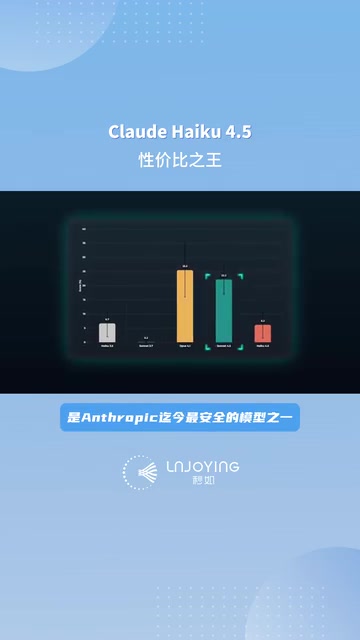
On the safety front, Haiku 4.5 has undergone comprehensive alignment testing, with a false refusal rate lower than both Sonnet 4.5 and Opus 4.1, making it one of Anthropic's safest models to date.
Alignment is a core concept in AI safety, referring to ensuring that AI systems' behavior remains consistent with human intent and values. The false refusal rate is a key metric for measuring alignment quality—it indicates the proportion of reasonable requests that the model incorrectly refuses to answer. Early alignment methods were often overly conservative, causing models to frequently refuse answers to sensitive but legitimate questions about medicine, law, and safety, severely impacting user experience. Reducing false refusal rates while maintaining the ability to block genuinely harmful requests requires fine-tuning techniques like RLHF (Reinforcement Learning from Human Feedback) and Constitutional AI (Anthropic's unique alignment approach). Haiku 4.5's breakthrough in this area means it blocks harmful requests while avoiding excessive refusal of normal user needs, achieving a better balance between safety and usability.
Additionally, Anthropic has published a detailed System Card covering training data sources, prompt engineering strategies, and complete test results on benchmarks like AIMTerminal Bench. System Cards are technical documents accompanying AI model releases—a practice initially driven by Google's Model Cards and Microsoft's Datasheets for Datasets, which has now become an industry standard for responsible AI releases. Anthropic's publication of System Cards aligns closely with transparency requirements in regulatory frameworks like the EU AI Act and provides critical reference material for downstream developers evaluating model suitability. This level of transparency is uncommon in the industry and reflects Anthropic's long-term commitment to trustworthy AI.
Available Across All Platforms: Seamless Migration, Ready to Use
Claude Haiku 4.5 is now fully available across multiple major platforms, allowing developers to choose flexibly based on their tech stack:
- Claude API: Direct access, ideal for custom applications
- Claude Code: A coding assistance tool for developers
- Amazon Bedrock: Seamless integration within the AWS ecosystem
- Google Cloud Vertex AI: A convenient option for GCP users
Amazon Bedrock and Google Cloud Vertex AI are currently two major Model-as-a-Service (MaaS) platforms. Bedrock is a fully managed AI service launched by AWS in 2023, allowing enterprises to access foundation models from multiple providers including Anthropic, Meta, and Mistral through a unified API, while offering enterprise-grade features like fine-tuning and RAG (Retrieval-Augmented Generation). Vertex AI is Google Cloud's corresponding product, deeply integrated with Google's search and data analytics capabilities. The strategy of launching across multiple cloud platforms simultaneously means enterprises don't need to worry about vendor lock-in and can flexibly choose deployment methods based on existing infrastructure.
For developers already using the Claude model family, migration costs are minimal—simply switch the API endpoint to quickly move to Haiku 4.5 without modifying any business logic code.
Conclusion: An Important Step Toward AI Democratization
The release of Claude Haiku 4.5 represents an important trend in the AI industry: top-tier AI capabilities are becoming faster, cheaper, and more accessible. It's not just a high-performing lightweight model—it's a critical piece in Anthropic's puzzle of building an efficient, safe, and collaborative AI ecosystem.
For developers and enterprise decision-makers, Haiku 4.5 offers an extremely attractive option: dramatically reducing AI application operating costs without significantly sacrificing performance. Combined with multi-agent orchestration strategies, it has the potential to drive more AI applications from the experimental stage to large-scale production deployment.
Key Takeaways
- Claude Haiku 4.5 delivers nearly 2x speed improvement at one-third the cost of its predecessor, with input tokens priced at just $1 per million
- Outperforms the larger flagship model Sonnet 4.5 on certain computer use task benchmarks
- Anthropic proposes a Sonnet+Haiku multi-agent orchestration strategy, forming a new "brain plus hands" AI system architecture
- After comprehensive alignment testing, it has the lowest false refusal rate among models in its family, making it one of Anthropic's safest models to date
- Fully available across Claude API, Amazon Bedrock, Google Cloud Vertex AI, and other major platforms with support for rapid migration
Related articles
 Tech Frontiers
A Rare Quiet Day in AI: Recursive Self-Improvement Stirs Beneath the Surface
A rare quiet day in AI sees multiple sources go silent simultaneously. Behind the calm, Recursive Self-Improvement (RSI) research continues. What this means for the industry.
 Tech Frontiers
Reve 2 vs. Ideogram 4: A Deep Dive into Layout Control in AI Image Generation
A deep comparison of Reve 2 and Ideogram 4's layout control capabilities, covering technical approaches, real-world use cases, and industry trends for designers and creators.
 Tech Frontiers
In the Weights: Check Your Influence Score in the AI World
In the Weights is an AI influence search engine that quantifies your presence in the AI world with a score. Explore how it evaluates practitioners and what it means for digital identity.