Claude Haiku 4.5 Frontend Benchmark: One-Third the Price, Better Than GPT-5?

Claude Haiku 4.5 matches flagship models at one-third the price in frontend code generation tests.
This article benchmarks Claude Haiku 4.5, Sonnet 4.0, Gemini 2.5 Pro, and GPT-5 across three frontend scenarios: a SaaS landing page, an interactive 3D Rubik's cube, and a weather app with CSS animations. Haiku 4.5 matched or exceeded Sonnet 4.0 in most tasks at one-third the cost and fastest speed, while GPT-5 performed worst overall. The gap between lightweight and flagship models is closing fast.
Anthropic recently released Claude Haiku 4.5, positioning it as "the fastest and most intelligent lightweight model." It's priced at just one-third of the Sonnet series — but how does it actually perform? This article puts Haiku 4.5, Sonnet 4.0, Gemini 2.5 Pro, and GPT-5 head-to-head across three real-world frontend development scenarios.
Claude Haiku 4.5 Pricing: One-Third the Cost of Sonnet
Claude Haiku 4.5 comes with an aggressively competitive pricing strategy. Here's how it compares:
- Claude Sonnet 4/4.5: $3/million input tokens, $15/million output tokens
- Claude Haiku 4.5: $1/million input tokens, $5/million output tokens
That means Haiku 4.5 costs just one-third of the Sonnet series.
A quick note on token pricing: tokens are the basic units LLMs use to process text — roughly equivalent to three-quarters of an English word or one Chinese character. Model APIs charge separately for input tokens (the prompts you send) and output tokens (the model's responses), with output typically priced 3–5× higher due to the greater computational cost of generation. In high-frequency production environments, token costs accumulate quickly, making lightweight models especially cost-effective at scale.
Haiku 4.5 supports both text and image inputs and features a 200K context window — specs that are far from lightweight. A context window is the maximum number of tokens a model can "remember" and process in a single conversation. At 200K tokens, that's roughly equivalent to a 300,000-character Chinese novel, meaning developers can feed in large codebases and design documents in a single pass. Early models had context windows of just 4K–8K tokens; only in the past couple of years have they expanded to the 128K–200K range. Larger context windows allow models to understand more complete project structures and reduce code generation errors caused by information truncation.
But cheap is only valuable if the output is good. Let's look at the actual results.
Test Methodology: Four Models, Identical Conditions
This evaluation used a consistent methodology: three frontend projects, each prompted identically across four models (Claude Haiku 4.5, Claude Sonnet 4.0, Gemini 2.5 Pro, and GPT-5). Only first-generation results were evaluated, across four dimensions: whether the code runs, whether it completes the task, generation speed, and visual quality.
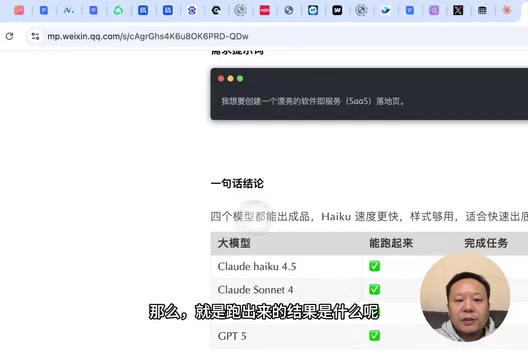
Scenario 1: SaaS Landing Page — All Four Models Pass
The first test used a simple one-line prompt to generate a SaaS product landing page. All four models completed the task, but Haiku 4.5 was noticeably faster.
In terms of visual output:
- Haiku 4.5: Clean layout and structure, with minor imperfections in the lower section
- Sonnet 4.0: Excellent page structure, very similar style to Haiku
- Gemini 2.5 Pro: A completely different UI style — simpler overall, but with clickable interactive elements
- GPT-5: A more tech-forward aesthetic, also with interactive elements
Overall, Haiku 4.5 and Sonnet 4.0 delivered the most complete pages, while Gemini and GPT-5 took different design directions — each with its own merits.
Scenario 2: Interactive 3D Rubik's Cube — GPT-5 Fails Hard
The second test raised the difficulty significantly: generate a fully interactive 3D Rubik's cube. This scenario demands both strong code logic and an understanding of 3D rendering.
Building an interactive 3D Rubik's cube in the browser involves multiple technical challenges: constructing a 3D cube grid using CSS 3D Transforms or WebGL/Three.js; handling complex rotation matrix calculations to ensure rotating one layer doesn't corrupt the state of others; and implementing touch/mouse gesture recognition to distinguish between rotating the entire cube versus turning a single row or column. This is a rigorous test of spatial geometry understanding, state management logic, and event handling.
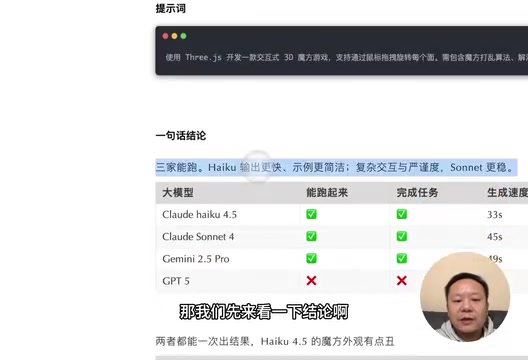
The verdict: three models completed the task; GPT-5 performed worst.
- Haiku 4.5: Fully playable after two minor refinements, with a solid user experience
- Sonnet 4.0: Simpler visually, but functionally complete with no issues
- Gemini 2.5 Pro: Only supports dragging the entire cube — individual row/column rotation is missing, making it functionally incomplete
- GPT-5: The cube deforms completely upon interaction, rendering it unusable
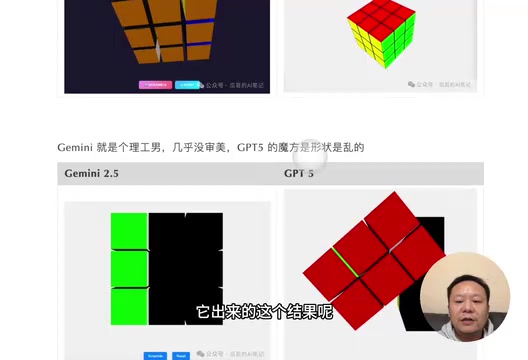
Interestingly, Haiku 4.5's first-generation output looked less polished than Sonnet 4.0's, but both reached a usable standard functionally. GPT-5's output in this scenario was a disappointment — the cube was essentially broken.
Scenario 3: Weather App Animations — Haiku 4.5 Overtakes Sonnet
The third test focused on HTML/CSS layout and dynamic visual effects, requiring all code to be contained in a single file. The emphasis was on layout capability and CSS animation quality.
CSS animations use pure style code to create dynamic visual effects — including @keyframes animations, transition effects, and transform transformations. High-quality weather animations — like falling raindrops, drifting snowflakes, moving clouds, and lightning flashes — require precise control over animation timing, Bézier easing functions, multi-layer element compositing, and GPU-accelerated rendering. This type of task tests not only a model's mastery of CSS specifications, but also its aesthetic sensibility and ability to simulate physical motion — making it an effective differentiator for frontend code generation quality.
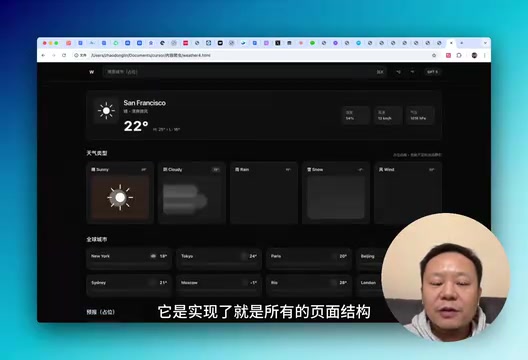
The results here were surprising:
- Haiku 4.5: Presented different weather types as cards, each with detailed CSS animations — overall visual quality was high
- Sonnet 4.0: Similar card-based structure to Haiku with animations, but the card design was less refined
- Gemini 2.5 Pro: Also used a card layout with animations on par with Haiku 4.5, though the final section was weaker
- GPT-5: Produced a complete page structure, but completely failed to implement the dynamic effects specified in the prompt
This was unexpected — Haiku 4.5, the lightweight model, actually outperformed Sonnet 4.0 on CSS animation detail, and held its own against Gemini 2.5 Pro.
Overall Scores and Model Selection Guide
Based on the three test scenarios, here's a summary:
| Model | Landing Page | 3D Cube | Weather Animations | Speed | Cost |
|---|---|---|---|---|---|
| Haiku 4.5 | ★★★★ | ★★★★ | ★★★★★ | Fastest | Lowest |
| Sonnet 4.0 | ★★★★★ | ★★★★★ | ★★★★ | Fast | Medium |
| Gemini 2.5 Pro | ★★★ | ★★★ | ★★★★ | Medium | Medium |
| GPT-5 | ★★★★ | ★ | ★★ | Slowest | Higher |
When to Use Haiku 4.5
- Teams and individual developers focused on cost efficiency
- Rapid prototyping or educational demos
- Scenarios with basic code quality requirements, not extreme precision
- High-frequency, fast-iteration workflows
When to Stick with a Flagship Model
- Applications with complex interaction logic
- Production environments with high code quality requirements
- Projects requiring precise implementation of complex business logic
For these use cases, Sonnet 4.5 or Gemini 2.5 Pro remains the safer choice.
Conclusion: Lightweight Models Are Reshaping AI Coding
The release of Claude Haiku 4.5 reinforces a clear trend: lightweight models are rapidly closing the gap with flagship models.
The core difference between lightweight and flagship models lies in parameter count and training strategy. Flagship models typically have hundreds of billions to trillions of parameters, enabling them to capture more complex language patterns and reasoning chains. Lightweight models use techniques like knowledge distillation, pruning, and quantization to dramatically reduce parameter count while preserving core capabilities. In recent years, companies like Anthropic and Google have also adopted more efficient training data curation and curriculum learning strategies, allowing lightweight models to approach — and in some tasks surpass — flagship performance. This is the technical foundation that enables Haiku 4.5 to reach near-Sonnet quality at one-third the cost.
In this benchmark, Haiku 4.5 delivered near-Sonnet 4.0 performance across most scenarios at one-third the price — and even outperformed it in certain details.
GPT-5, meanwhile, underperformed in this frontend code generation benchmark — particularly in 3D interaction and CSS animations. That said, this reflects only one dimension of model capability. Different models excel at different tasks, and model selection should always be based on your specific use case.
Key Takeaways
- Claude Haiku 4.5 costs just one-third of the Sonnet series ($1/million input tokens, $5/million output tokens) and is the fastest model tested
- Across three frontend scenarios, Haiku 4.5 matched or partially exceeded Sonnet 4.0 in most tasks, offering outstanding value
- GPT-5 performed worst in this frontend code generation benchmark — the 3D cube was unusable and weather animations were entirely absent
- Haiku 4.5 is ideal for rapid prototyping and cost-sensitive use cases; complex interactions still favor Sonnet 4.5 or Gemini 2.5 Pro
- The capability gap between lightweight and flagship models is narrowing fast — model selection increasingly requires fine-grained scenario matching
Related articles
 Product Reviews
The Programmer's Desk Setup Guide: Building a Workspace That Feels Like Home
Discover how programmers build productive, comfortable workspaces. From multi-monitor setups to ergonomic design, explore the desk philosophy that drives focus and flow.
 Product Reviews
Qoder vs Cursor Real-World Comparison: Which $20/Month AI IDE Is Better?
Hands-on comparison of Qoder vs Cursor AI IDEs: Agent autonomy, human interaction count, and architecture decisions. Qoder needed only 2 interactions vs Cursor's 8.
 Product Reviews
Cursor Cloud Agent Demo: Eliminating Bottlenecks Across the Entire Software Development Lifecycle
Deep analysis of Cursor's Cloud Agent demo showing how cloud VMs, automated test artifacts, and a full-chain control plane systematically eliminate human bottlenecks across the software development lifecycle.