Claude Haiku 4.5 In-Depth Review: One-Third the Cost, Coding Performance Rivaling Sonnet 4

Claude Haiku 4.5 delivers flagship-level coding at one-third the cost, ushering in efficient low-cost AI programming.
Anthropic's Claude Haiku 4.5 matches the previous flagship Sonnet 4 in coding capability while costing just one-third as much and running twice as fast. A developer built a browser-based macOS system for only 28 cents, showcasing its powerful code generation abilities. The model's low cost also makes multi-agent collaboration systems economically viable, marking a shift in AI competition from "who's more powerful" to "who's more efficient" and validating the "small model renaissance" trend.
Anthropic's recently released Claude Haiku 4.5 model is redefining the capability boundaries of small AI models. Known for its speed and efficiency, this model now rivals the previous-generation flagship Sonnet 4 in coding performance—at just one-third the cost and double the speed. For developers and enterprise users, this signals the arrival of a more efficient and economical era of AI-assisted programming.
Claude Haiku 4.5 Performance Leap: Big Power from a Small Model
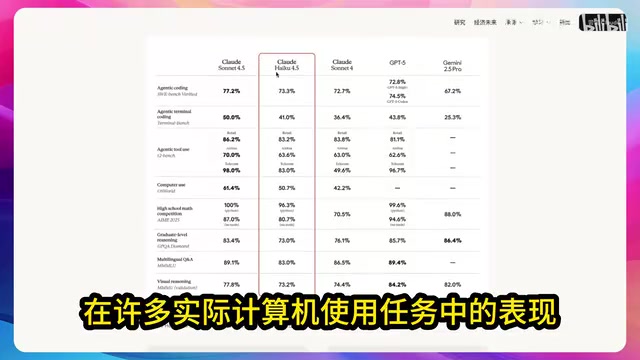
Just five months ago, Claude Sonnet 4 was the industry benchmark in Anthropic's product lineup. Now, Haiku 4.5—positioned as a "lightweight" model—has matched or even surpassed Sonnet 4's performance across multiple benchmarks.
It's worth noting that Anthropic's Claude model family uses a poetic three-tier naming system: Opus (most powerful), Sonnet (balanced), and Haiku (lightweight). The naming draws inspiration from poetry forms—Haiku is known for its extreme brevity, typically just 17 syllables, aptly suggesting the model's design philosophy of pursuing ultimate simplicity and efficiency. The version number (e.g., 4.5) represents the iteration generation of the underlying architecture. This tiered strategy allows users to flexibly choose the most suitable model based on task complexity and budget.
Specifically, Claude Haiku 4.5's core advantages manifest across three dimensions:
- Coding capability: On par with Sonnet 4 in code generation and comprehension tasks
- Cost efficiency: API call costs are approximately one-third of Sonnet 4
- Response speed: Inference speed is twice that of Sonnet 4
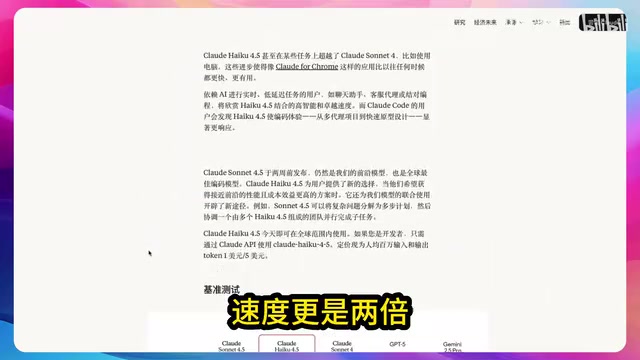
Regarding the cost structure, some explanation is warranted. LLM API pricing is typically token-based, split into input tokens and output tokens. A token is the smallest unit of text the model processes—one English word usually corresponds to 1-2 tokens, and one Chinese character typically maps to 1-2 tokens. Taking Claude Haiku 4.5 as an example, its input price is $1 per million tokens and output price is $5 per million tokens, while Sonnet 4's input and output prices are $3 and $15 respectively. This order-of-magnitude difference creates enormous cost gaps in high-volume call scenarios, which is precisely the source of Haiku 4.5's one-third cost advantage.
This combination of "no performance compromise with dramatically reduced costs" makes Haiku 4.5 ideal for everyday real-time tasks—whether chat assistants, customer service agents, or pair programming scenarios, all can benefit from high-quality AI assistance at minimal cost.
Real-World Case Study: Building Browser-Based macOS with Haiku 4.5 for 28 Cents
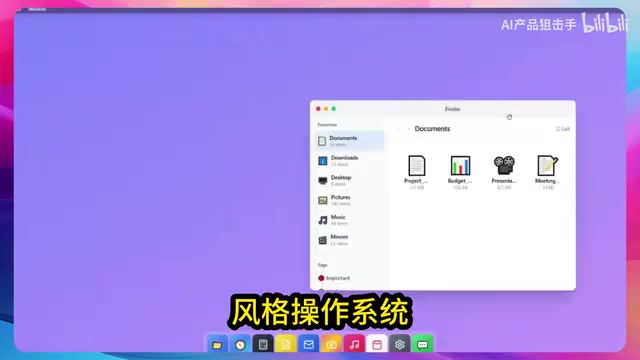
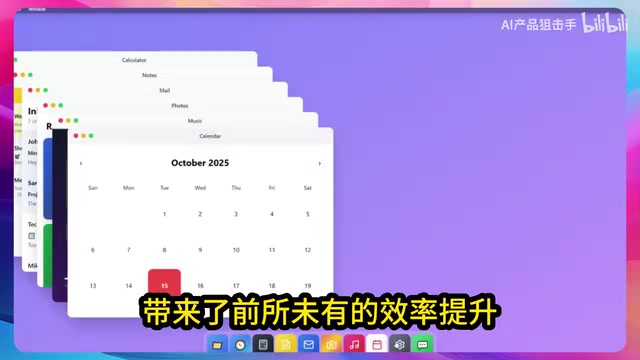
The most compelling demonstration of Claude Haiku 4.5's capabilities is a stunning case that went viral in the developer community. A developer used Haiku 4.5 to successfully create a fully functional macOS-style operating system in the browser for just 28 cents (approximately 2 Chinese yuan).
The project includes multiple functional applications:
- Finder file manager
- Safari browser interface
- Calculator, Notes
- Mail, Calendar, Messages, and other common apps
From a technical implementation perspective, building a macOS-style operating system in the browser is a fairly complex front-end engineering project, typically involving HTML5, CSS3, and JavaScript (or TypeScript) web technology stacks. Developers need to implement a complete window management system (including drag, resize, and stacking), application state management, file system simulation, and pixel-perfect recreation of macOS's visual design language—such as frosted glass effects (backdrop-filter), rounded windows, Dock bar animations, and more. Such projects typically involve thousands to tens of thousands of lines of code, extensive DOM manipulation, and event handling logic, placing high demands on the AI model's long-context understanding and code architecture design capabilities. The fact that Haiku 4.5 can generate such a complete project in a single or few interactions fully demonstrates the maturity of its code generation capabilities.
The entire system perfectly simulates macOS's user interface and interaction logic, achieving a remarkably high level of completion from visual design to functional implementation. If built from scratch by human developers, such a project might take days or even weeks, yet Haiku 4.5 completed all the work in an extremely short time.
The significance of this case lies not only in the technical demonstration but also in the important trend it reveals: the economic barrier to AI-assisted development is dropping precipitously. When a complex front-end project can have its prototype built for less than 2 yuan, the approach to rapid prototyping and product validation will be fundamentally transformed.
Multi-Agent Collaboration: Haiku 4.5 Enables a New Low-Cost Paradigm
Beyond excellent single-task performance, Claude Haiku 4.5's low cost and high speed also unlock another important application direction—multi-agent collaboration.
A Multi-Agent System refers to an architectural pattern where multiple AI agents work collaboratively, each with designated responsibilities. Each agent has independent role definitions, tool-calling capabilities, and memory context, coordinating through message passing or shared state. Typical multi-agent frameworks in the industry include LangGraph, CrewAI, and AutoGen. The core challenge of this architecture is that each round of thinking by each agent requires one or more LLM calls, and a complete multi-agent workflow may involve dozens or even hundreds of calls. Therefore, the per-call cost of the underlying model directly determines the economic viability of the entire system.
In traditional AI workflows, using large models for multi-agent parallel tasks often faces prohibitive cost pressures. Each agent call incurs fees, and when multiple agents run simultaneously with frequent interactions, costs escalate rapidly. Haiku 4.5 compresses per-call costs to extremely low levels, making it economically viable to build complex multi-agent systems.
Consider this scenario: one agent handles requirements analysis, another generates code, one performs test validation, and another writes documentation—all working in parallel, coordinating with each other to complete a software project. Under Haiku 4.5's cost structure, this workflow is no longer a proof-of-concept in the lab but a practical solution ready for production environments. For a workflow with 4 agents, each averaging 20 interaction rounds, using Sonnet 4 might cost tens of dollars, while switching to Haiku 4.5 could reduce costs to single-digit dollars—a gap significant enough to change enterprise technology decisions.
What Claude Haiku 4.5 Means for Developers
The release of Haiku 4.5 has profound implications for the entire AI application ecosystem:
For independent developers: Low costs mean personal projects and startup teams can now afford high-quality AI coding capabilities, dramatically lowering the barrier to innovation. AI call costs for a weekend hackathon project might only be a few dollars, making "validating ideas quickly with AI" a near-zero-cost experiment.
For enterprise users: In high-frequency call scenarios like customer service, content generation, and data processing, cost savings are substantial. With an average of 100,000 daily calls, switching to Haiku 4.5 could mean saving thousands of dollars per month.
For the AI industry: Haiku 4.5 proves the technical viability of "small models doing big things." The AI industry has long held faith in "Scaling Laws"—the belief that more parameters and more training data lead to better performance. However, since 2024, small models represented by Mistral, Phi, Gemma, and others have approached or even surpassed models many times their size on specific tasks through more refined data curation, knowledge distillation ("compressing" large model capabilities into smaller models), and training strategy optimization. This trend is called the "small model renaissance," with the core insight that a model's effective capability depends not only on parameter scale but also on training data quality and the sophistication of training methods. Haiku 4.5 is strong evidence of this trend, forming a sharp contrast with the industry's pursuit of ever-larger parameter counts and pointing the way toward model optimization and efficiency improvement.
Conclusion and Outlook
The emergence of Claude Haiku 4.5 marks a shift in AI model competition from simply "who's more powerful" to "who's more efficient." In practical applications, a model that's low-cost, fast, and capable enough is often more valuable than one that's expensive but marginally stronger.
As small language model capabilities continue to improve, we have good reason to expect that in the near future, AI-assisted development will truly become a standard tool for every developer, rather than an exclusive privilege for the few. Claude Haiku 4.5 may be just the beginning of this efficiency revolution.
Related articles
 Product Reviews
The Programmer's Desk Setup Guide: Building a Workspace That Feels Like Home
Discover how programmers build productive, comfortable workspaces. From multi-monitor setups to ergonomic design, explore the desk philosophy that drives focus and flow.
 Product Reviews
Qoder vs Cursor Real-World Comparison: Which $20/Month AI IDE Is Better?
Hands-on comparison of Qoder vs Cursor AI IDEs: Agent autonomy, human interaction count, and architecture decisions. Qoder needed only 2 interactions vs Cursor's 8.
 Product Reviews
Cursor Cloud Agent Demo: Eliminating Bottlenecks Across the Entire Software Development Lifecycle
Deep analysis of Cursor's Cloud Agent demo showing how cloud VMs, automated test artifacts, and a full-chain control plane systematically eliminate human bottlenecks across the software development lifecycle.