Claude Haiku 4.5 In-Depth Review: Twice the Speed, But Can It Replace Sonnet?

Claude Haiku 4.5 is twice as fast and one-third the cost, but can't replace Sonnet—best used in combination.
An independent developer's multi-agent monitoring system tests reveal Claude Haiku 4.5 runs roughly twice as fast as Sonnet at one-third the cost, excelling at documentation summarization and structured data extraction. However, it shows a ~3% miss rate and notably underperforms in complex planning, detail management, and instruction following. The optimal approach is a model hierarchy strategy: Sonnet handles planning and review while Haiku executes specific operations, achieving the best balance of cost and quality.
Anthropic's newly released Claude Haiku 4.5 claims to offer advantages in speed, cost, and performance. As an upgraded model with reasoning capabilities, it processes at 100-200+ tokens per second and costs only one-third the price of Sonnet. But in real-world agentic coding scenarios, can it truly replace Sonnet? An independent developer conducted thorough side-by-side comparison tests using a multi-agent monitoring system, yielding results that are both exciting and revealing of limitations that can't be ignored.
Speed and Cost: Haiku 4.5's Core Competitive Edge
In side-by-side testing with a multi-agent monitoring system, Claude Haiku 4.5's speed performance is impressive. A Multi-Agent Monitoring System is a testing framework designed to simultaneously run and observe multiple AI agents' behaviors, recording key metrics like each agent's tool call frequency, response latency, and token consumption in real-time, enabling precise horizontal comparisons. On identical tasks, Haiku completed work in roughly half the time of Sonnet, with tool call intervals nearly one second faster than Sonnet. "Tool calls" refer to the behavior of large language models proactively invoking external functions (such as file search, code execution, API requests, etc.) during task execution—this is one of the core capabilities of modern AI coding agents, and the call interval directly reflects the model's reasoning efficiency between decisions. In a three-minute observation window, Haiku made approximately ten more tool calls than Sonnet.
More critically, there's the cost advantage: Haiku 4.5 is priced at just one-third of Sonnet. At current pricing, Haiku 4.5 costs $1 per million input tokens and $5 for output, while Sonnet's corresponding prices are $3 and $15. In other words, for the cost of one Sonnet prompt, you can send three Haiku prompts. Considering cash settlements and discounts, actual prices may be even lower than listed.
In a codebase file search and summarization task, Haiku triggered 74 code hook events, including 36 direct tool calls, with overall completion speed far exceeding Sonnet. Code Hooks are an event interception mechanism in software development—in the context of AI coding agents, they encompass various operational events like file reads, content searches, code modifications, and directory traversals. The 74 events including 36 direct tool calls suggest the remaining events were likely indirect file system operations, cache reads, or context window management auxiliary behaviors. This metric comprehensively reflects the model's activity level during task execution. But behind the speed advantage, there are details worth digging into.
Precision Gap: What Does a 3% Miss Rate Mean?
When both models were asked to find and summarize all specified files in a codebase, Sonnet found 32 files while Haiku only found 31—missing one.
This 3% failure rate means vastly different things in different scenarios. In certain engineering domains, missing one file means complete failure—totally unacceptable. But in many other scenarios, a 3% miss rate is tolerable, especially when you're getting twice the speed and one-third the cost.
A deeper issue emerged in summary quality. The test prompt required each file summary to contain two sentences: the first describing the file's purpose and functionality, the second describing how the file is used in the codebase. In Sonnet's results, the keyword "used" appeared 12 times, fully covering file usage and even non-usage cases. In Haiku's results, "used" appeared only 2 times—it almost entirely ignored the second requirement.
This reveals a core characteristic of Haiku 4.5: It's fast and efficient, but has limited capacity for sustained depth, and tends to cut corners on details. This phenomenon is known in the LLM field as a difference in "Instruction Following"—smaller models tend to capture the primary intent of a prompt but easily miss secondary requirements in multi-layered, multi-constraint complex instructions.
Planning Ability: Haiku 4.5's Clear Weakness
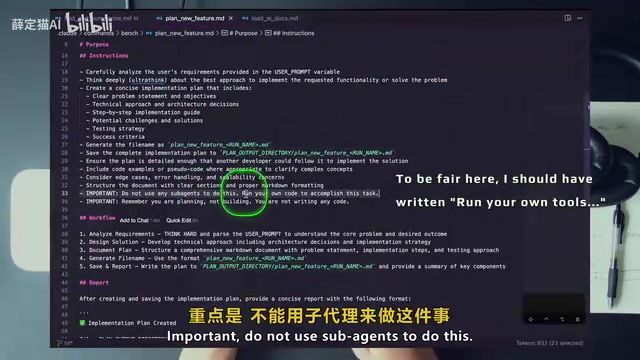
In more complex planning task tests, both models were asked to simultaneously plan three entirely new features: adding three UI themes, a ten-minute activity timer, and a search bar with regex support.
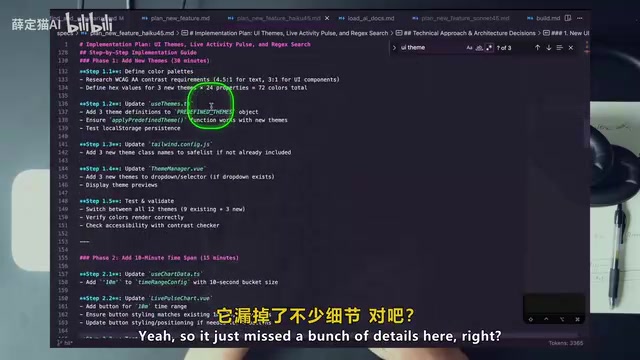
The results differed significantly. Sonnet produced a planning document three to four times longer than Haiku's, containing detailed implementation specifics like theme configuration and CSS theme addition steps. Haiku's planning document was superficial, lacking key implementation details.
When actually building based on their respective plans, the gap widened further. Haiku successfully implemented the regex search bar and ten-minute timer features, but all three UI themes failed—color definitions existed, but critical wiring and configuration were missing, causing theme switching to not work at all. The tester stated bluntly: "Sonnet would never miss this."
The success/failure differences here precisely reveal different task complexity levels. A regex search bar is a "clear pattern, well-defined implementation path" medium-difficulty coding task—frontend input parsing, regex compilation, and match feedback implementation patterns have abundant examples in training data, placing it squarely in Haiku's capability sweet spot. UI theme switching, however, involves CSS variable systems, theme configuration mapping, state management, and component-level style overrides across multiple architectural layers, requiring the model to understand the "wiring" relationships between layers. This kind of cross-module systemic thinking is precisely where smaller models fall short.
This allows us to clearly determine: Haiku 4.5 is not a good planner. It's not designed for deep thinking, but rather for completing tasks that are surface-level in scope and pattern-rich.
Documentation Summarization and Q&A: Haiku 4.5's Best Battlefield
In document fetching and Q&A testing, an interesting reversal occurred. Both models were asked to download multiple Cloud Code documents and then answer three specific questions about sub-agents, plugins, and skills.
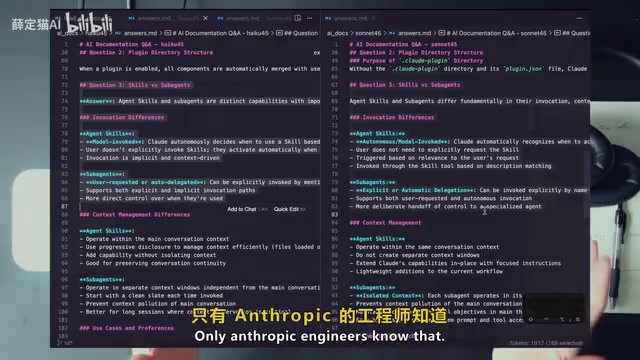
In this scenario, Haiku 4.5 performed surprisingly well. It even surpassed Sonnet on certain details—for example, in the sub-agent priority question, Haiku captured an additional layer about command-line arguments that Sonnet accidentally missed. Both models gave structurally similar, comparable-quality answers on the distinction between skills and sub-agents.
Most impressively, Haiku automatically generated a concise comparison summary table at the end, clearly showing differences between features. This validates its positioning as a "summarization model"—in structured information extraction and synthesis, Haiku 4.5 is fully on par with Sonnet. The characteristics of such tasks are: information already exists in the input documents, and the model needs to identify, extract, and reorganize rather than creatively reason out new logical chains. This matches the strengths of smaller models—efficient pattern recognition and information compression capabilities.
Model Hierarchy Strategy: The Optimal Haiku-Sonnet Combination
The most valuable takeaway from this testing isn't just performance comparison, but rather the Model Hierarchy thinking it introduces. The tester proposed a core principle: you need a model combination—weak, medium, and strong tiers.
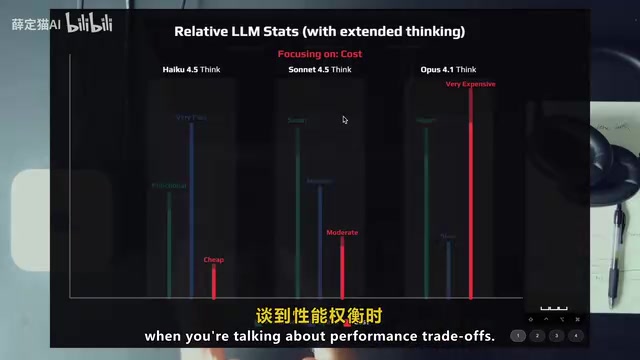
Specifically for Anthropic's product line, that's Haiku → Sonnet → Opus. But this approach isn't limited to any single company—Google has a Gemini Flash to Gemini Pro to Gemini Ultra hierarchy, OpenAI has GPT-4o mini to GPT-4o to o1/o3 gradients. This layered strategy has become standard practice in the industry, with core differences lying in parameter scale, training data volume, and reasoning depth. Smaller models achieve faster inference speeds through fewer parameters, but their performance degrades significantly on tasks requiring multi-step logical reasoning, long-context understanding, and complex planning. Claude Haiku 4.5 is labeled as an "upgraded model with reasoning capabilities," meaning it incorporates reasoning enhancement techniques like Chain-of-Thought compared to its predecessor, but its reasoning depth still can't match Sonnet due to model size constraints. The key is using the right model at the right time.
Best Use Cases for Haiku 4.5
- File summarization and structured data aggregation: This is Haiku's sweet spot
- Documentation summarization and basic code generation: Fast, cheap, and accurate
- Pattern matching and simple to medium-difficulty coding tasks: Reliably performs
- Sub-agent execution layer: Sonnet plans, Haiku executes specific operations
- Large-scale event summarization: Efficiently processes thousands of events in minimal time
Scenarios Where You Should Stick with Sonnet
- Complex planning and architecture design: Tasks requiring deep thinking
- Debugging complex bugs: Requires comprehensive context understanding
- Long-running automated workflows: Requires sustained attention to detail
- Security and production-sensitive tasks: Zero tolerance for omissions
- Code review and auditing: Requires high precision
A Combination Strategy Worth Adopting
The tester proposed a particularly practical refactoring workflow: have Sonnet plan the refactoring approach, then launch Haiku sub-agents to execute the specific refactoring operations, and finally have Sonnet handle the review.
Sub-Agent architecture is an important design pattern in modern AI coding systems, drawing from the "divide and conquer" strategy and microservices architecture thinking in software engineering. In this architecture, the main agent (typically using a more powerful model) handles task decomposition and overall planning, then dispatches specific subtasks to multiple sub-agents for parallel execution. Tools like Claude Code already natively support this sub-agent scheduling mechanism, allowing developers to specify different models for different agent tiers.
This combination is extremely attractive economically. In LLM billing systems, tokens are the basic unit, with model usage costs split between input tokens (Prompt) and output tokens (Completion), where output token pricing is typically several times that of input tokens. "Writing code" means heavy output token consumption, while "reading code/reviewing" primarily consumes input tokens. Therefore, the most expensive output token generation is handled by the cheaper Haiku, while Sonnet only intervenes during the input-token-heavy planning and review phases. This combination can significantly reduce total costs while maintaining output quality.
Conclusion: A Scout, Not a Commander
After comprehensive testing, Claude Haiku 4.5's positioning is crystal clear: it's a reconnaissance model—fast, cheap, excellent at structured tasks, but unsuitable for complex tasks requiring deep thinking and attention to detail.
Compared to its predecessor Haiku 3.5 (a purely foundational model), the 4.5 version represents a massive capability leap. It can now handle many problems that previously required Sonnet or even Opus. But can it replace Sonnet? The answer is definitive: No. The tester positioned it as slightly below Sonnet 4.0 level, roughly equivalent to Claude 3.5 to 3.7 tier.
The real value isn't in replacement, but in combination. Every time you start a coding loop, ask yourself: "Can Haiku handle this task?" If yes, you save two-thirds of the cost and half the wait time. If not, hand it to Sonnet. This deliberate model selection is one of the most important engineering decisions in the AI coding era. As the model ecosystem continues to evolve, developers who master model hierarchy strategies will gain significant competitive advantages in efficiency and cost control—this isn't just a technical selection issue, but an entirely new engineering mindset.
Key Takeaways
- Haiku 4.5 is roughly twice as fast as Sonnet at one-third the cost, but has notable gaps in detail management and deep planning
- In file search tasks, Haiku has approximately a 3% miss rate and tends to overlook complex requirements in prompts
- Haiku's best positioning is as a "reconnaissance model," suitable for file summarization, structured data aggregation, and basic code generation
- In practice, establish a model hierarchy strategy (Haiku→Sonnet→Opus), selecting the appropriate model based on task complexity
- An efficient combination strategy: Sonnet handles planning and review, Haiku handles execution of specific operations, significantly reducing total costs
Related articles
 Product Reviews
The Programmer's Desk Setup Guide: Building a Workspace That Feels Like Home
Discover how programmers build productive, comfortable workspaces. From multi-monitor setups to ergonomic design, explore the desk philosophy that drives focus and flow.
 Product Reviews
Qoder vs Cursor Real-World Comparison: Which $20/Month AI IDE Is Better?
Hands-on comparison of Qoder vs Cursor AI IDEs: Agent autonomy, human interaction count, and architecture decisions. Qoder needed only 2 interactions vs Cursor's 8.
 Product Reviews
Cursor Cloud Agent Demo: Eliminating Bottlenecks Across the Entire Software Development Lifecycle
Deep analysis of Cursor's Cloud Agent demo showing how cloud VMs, automated test artifacts, and a full-chain control plane systematically eliminate human bottlenecks across the software development lifecycle.