Claude Haiku 4.5 Review: Sonnet 4-Level Coding at 1% of the Cost

Claude Haiku 4.5 delivers Sonnet 4-level code performance at 1% cost, redefining AI value.
Anthropic released Claude Haiku 4.5, scoring 73.3% on SWE-bench with code performance rivaling Sonnet 4 at roughly 1% of the cost and 2x the speed. Priced at $1 per million input tokens, it excels in agentic coding and computer use. Anthropic recommends a collaborative architecture with Sonnet 4.5 for planning and multiple Haiku 4.5 instances for parallel execution, ideal for large-scale deployment and real-time tasks.
Anthropic recently officially launched Claude Haiku 4.5, a major upgrade to their fastest and most cost-effective model to date. Remarkably, just 5 months ago, Claude Sonnet 4 was a state-of-the-art frontier model, yet Haiku 4.5 now matches Sonnet 4 in code performance at roughly 1% of the cost and 2x the speed. This release is redefining the ceiling for AI model cost-effectiveness.
Performance Benchmarks: Haiku 4.5's Major Breakthrough on SWE-bench
In Anthropic's officially published benchmarks, Claude Haiku 4.5's performance is remarkable. On SWE-bench (Software Engineering Benchmark), Haiku 4.5 scored 73.3%, even outperforming Sonnet 4 on real-world software engineering tasks.
SWE-bench is an industry-authoritative benchmark developed by a Princeton University research team. It extracts thousands of real bug-fix tasks from actual open-source GitHub projects (such as Django, scikit-learn, sympy, etc.). Unlike traditional code generation benchmarks (like HumanEval) that only test isolated function writing, SWE-bench evaluates a model's ability to perform end-to-end software engineering in large codebases—including understanding issue descriptions, locating relevant files in the codebase, and generating correct patches to fix bugs. A 73.3% score means the model can independently solve nearly three-quarters of real software engineering problems, something unimaginable just a year ago.
The breakdown of specific capabilities is even more noteworthy:
- Agentic Coding: Surpasses all competing models in the same tier
- Agentic Tool Use: On par with OpenAI models, only slightly behind Claude Sonnet 4.5
- Computer Use: Performance even exceeds Sonnet 4
- Math Reasoning & Multilingual QA: Comparable to top-tier models like GPT-5 and Gemini 2.5 Pro
- Visual Reasoning: Excellent performance, reaching frontier levels
In the critical area of agentic coding, Haiku 4.5's performance is particularly outstanding. Agentic coding refers to AI models no longer passively responding to one-off code generation requests, but instead acting like autonomous software engineers—independently planning task steps, calling tools (such as file read/write, terminal command execution, code search), dynamically adjusting strategies based on execution results, and completing complex programming tasks across multiple interaction rounds. The core of this capability lies in the model's "tool use" and "multi-step reasoning" abilities—the model needs to determine when to read files, when to run tests, when to backtrack and modify, with the entire process potentially involving dozens or even hundreds of tool calls. Haiku 4.5 performs comparably to Sonnet 4 in this area, slightly behind GPT-5 but far ahead of Gemini 2.5 Pro. Given its extremely low price point, this level of performance is nothing short of stunning.
It's worth specifically highlighting the Computer Use capability. This is a groundbreaking feature pioneered by Anthropic that allows AI models to operate computers like humans—by observing screenshots, moving the mouse, clicking buttons, and typing text to complete tasks. Traditional AI automation requires developing dedicated API interfaces for each application, but Computer Use lets AI directly use human graphical interfaces, vastly expanding the applicability of AI automation. For the RPA (Robotic Process Automation) industry, this represents a disruptive technological direction, meaning AI can automatically complete virtually any computer-based workflow. The fact that Haiku 4.5 surpasses the higher-tier Sonnet 4 in this capability is particularly noteworthy.
Claude Haiku 4.5 Pricing Breakdown: Just $1 Per Million Tokens
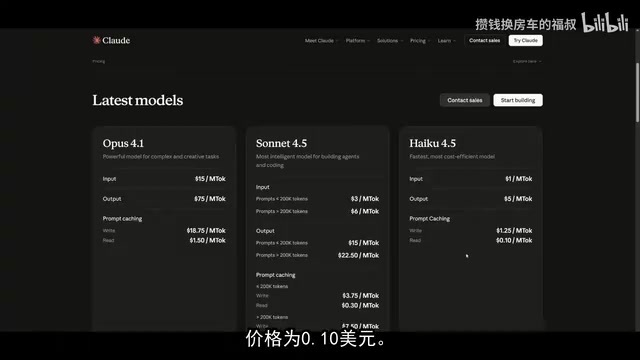
Haiku 4.5's pricing structure is as follows:
- Input Price: $1 per million tokens
- Output Price: $5 per million tokens
- Cached Input: $1.25 per million tokens
- Batch Processing: $0.10 per million tokens
To understand what these numbers mean, you first need to understand the concept of tokens. A token is the basic unit of text processing for large language models, roughly equivalent to three-quarters of an English word or one Chinese character. The "$1 per million tokens" pricing means processing approximately 750,000 English words (equivalent to about 10 average books) of input content costs just $1. Output prices are typically higher than input prices because generating text requires more computational resources than understanding it.
Prompt Caching in the pricing plan is an important cost optimization technique that allows developers to cache frequently used system prompts or context, avoiding redundant computation and thus reducing costs. Batch Processing allows users to submit large volumes of non-real-time requests that the system processes uniformly during off-peak periods, enabling lower prices—Haiku 4.5's batch processing price is as low as $0.10 per million tokens, making the cost of large-scale data processing tasks extremely affordable.
Compared to the previous Haiku version, prices have risen slightly, but considering the significant performance improvements, the overall value proposition is actually better. Compared to Sonnet 4.5, Haiku 4.5 is faster on computer use tasks and costs roughly one-third as much.
A concrete comparison: for the same task of creating a landing page, Haiku 4.5 completed it in 2 minutes at a cost of 4 cents, while Sonnet 4.5 took 3 minutes and cost 14 cents. This cost difference produces enormous economic benefits at scale.
Hands-On Testing: Code Generation & Agentic Capabilities
Browser-Based MacOS System Recreation
Using the KiloCode agent platform, testers asked Haiku 4.5 to create a browser-based MacOS-style operating system with all applications functioning properly. The model successfully completed this complex task at a total cost of just 28 cents.
While the generated system doesn't perfectly replicate real MacOS, the overall result is quite impressive. Finder can browse file categories normally, Safari actually loads web pages, and Calculator, Notes, Mail, Camera, Music, and Calendar apps all function. In terms of front-end fidelity, Haiku 4.5's output is impressive.
SVG Graphic Code Generation Test
Testers asked the model to generate SVG code for a butterfly to evaluate its ability to produce high-quality graphic code.
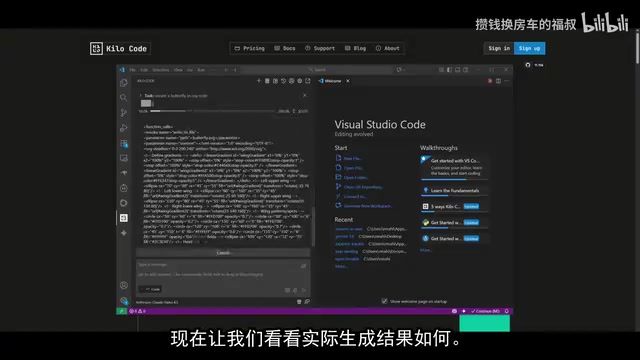
SVG (Scalable Vector Graphics) is an XML-based vector graphics format. Unlike pixel-based images, SVG describes shapes, paths, and colors through mathematical formulas, allowing infinite scaling without quality loss. Generating SVG graphics from pure code is an extremely challenging task for AI models because it requires simultaneous spatial reasoning ability (understanding shape relationships in a 2D coordinate system), aesthetic judgment (color schemes and proportions), and precise mathematical computation (exact positioning of Bézier curve control points). This test is widely adopted precisely because it intuitively demonstrates a model's capability boundaries in abstract thinking and visual-spatial reasoning.
The first butterfly generation had basic symmetry and structure but looked somewhat odd—roughly a 5.5 out of 10. After a second optimized prompt, the result improved—larger size and better color scheme—but overall quality still had room for improvement. This shows that Haiku 4.5 still has certain limitations in graphic generation.
SaaS Landing Page Generation
In a test creating a SaaS landing page on the KiloCode platform, Haiku 4.5 completed the task at a cost of just $0.09.
The generated page features a modern, streamlined design with good responsiveness, includes all typical SaaS landing page components, and incorporates animations, user testimonial sections, and a footer. While relatively basic without anything particularly stunning, it's perfectly adequate as a rapid prototyping tool.
Financial Literacy & Personalized Response Test
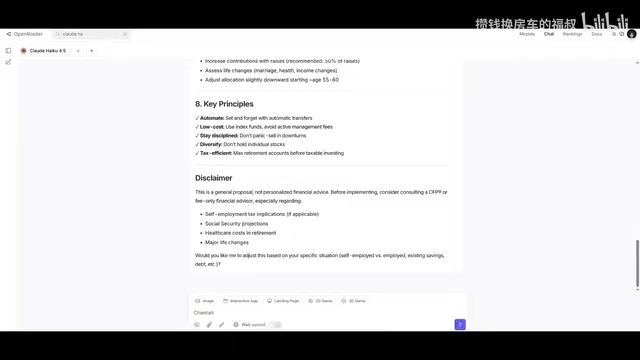
In a financial consultation test, the tester posed as a truck driver (earning $65,000 annually, planning to retire in 30 years) and requested an investment portfolio management plan. Haiku 4.5 demonstrated excellent contextual understanding and personalization capabilities, generating a clearly structured and actionable financial planning proposal tailored to the user's professional background and income level, with quantitative reasoning analysis.
Sonnet 4.5 + Haiku 4.5 Dual-Model Collaboration Strategy
Anthropic has proposed a noteworthy usage paradigm: the Sonnet 4.5 + Haiku 4.5 collaborative workflow. Specifically:
- Sonnet 4.5 handles planning multi-step projects and processing complex tasks requiring deep reasoning
- Multiple Haiku 4.5 instances execute specific tasks in parallel, serving as an efficient execution layer
This "planner + executor" architecture is essentially a Hierarchical Agent Architecture, drawing design inspiration from layered system design in software engineering and organizational division of labor in enterprise management. In this architecture, a high-capability but high-cost model (Sonnet 4.5) serves as the "Orchestrator," responsible for task decomposition, strategy planning, and quality control; while multiple low-cost but high-speed model instances (Haiku 4.5) serve as "Workers," executing specific subtasks in parallel.
The economic advantage of this pattern is clear: complex reasoning only consumes expensive computational resources during the planning phase, while the execution phase—which constitutes the bulk of the work—is completed using inexpensive models. Similar architectural thinking appears in OpenAI's Swarm framework and LangChain's multi-agent orchestration systems, and is becoming the mainstream paradigm for AI application development.
For real-time task scenarios—such as chat assistants, customer service agents, and pair programming—Haiku 4.5's combination of high intelligence with significant speed is particularly well-suited.
How to Start Using Claude Haiku 4.5
There are currently several ways to experience Haiku 4.5:
- Claude Official Platform: Chat with Haiku 4.5 through the free plan
- Anthropic API: Suitable for developers integrating into their own applications
- Third-Party Platforms: Such as Helicone and other AI agent platforms, some offering free credits
- OpenRouter: Can be used as an API relay, also supports direct chat
Competitive Landscape & Future Outlook
Haiku 4.5 is undoubtedly one of the most cost-effective AI models currently available, but competition never stops. Based on available information, Google's upcoming Gemini 3.0 (particularly the Flash version) could significantly disrupt the existing landscape. According to test data, Gemini 3.0 is faster than Sonnet 4.5 on computer use tasks at one-third the price.
However, this precisely demonstrates that healthy competition in the AI industry is accelerating both technological progress and cost reduction. From a broader perspective, AI model development is following a clear "performance trickle-down" path—today's frontier model capabilities appear in lower-priced model tiers just months later. Haiku 4.5 is the perfect example of this trend: coding capabilities that required a top-tier model six months ago can now be achieved on a model costing just 1% as much.
For developers and enterprise users, now is the ideal time to build applications leveraging these high-value models. The recommendation is to fully utilize Haiku 4.5's capabilities in the coming weeks while closely monitoring Gemini 3.0's release.
Regardless of how the competitive landscape evolves, the trend represented by Haiku 4.5 is crystal clear: frontier-level AI capabilities are advancing toward lower costs and higher efficiency at an unprecedented pace. For the entire AI application ecosystem, this is undoubtedly a major positive development.
Key Takeaways
- Claude Haiku 4.5 matches Sonnet 4 in code performance at ~1% of the cost and 2x the speed
- Scored 73.3% on SWE-bench, with agentic coding surpassing all competing models in the same tier
- Priced at $1 per million input tokens and $5 per million output tokens, ideal for large-scale deployment
- Recommended architecture: Sonnet 4.5 for planning + multiple Haiku 4.5 instances for parallel execution
- Faces upcoming competition from Gemini 3.0, but remains one of the best value options currently available
Related articles
 Product Reviews
The Programmer's Desk Setup Guide: Building a Workspace That Feels Like Home
Discover how programmers build productive, comfortable workspaces. From multi-monitor setups to ergonomic design, explore the desk philosophy that drives focus and flow.
 Product Reviews
Qoder vs Cursor Real-World Comparison: Which $20/Month AI IDE Is Better?
Hands-on comparison of Qoder vs Cursor AI IDEs: Agent autonomy, human interaction count, and architecture decisions. Qoder needed only 2 interactions vs Cursor's 8.
 Product Reviews
Cursor Cloud Agent Demo: Eliminating Bottlenecks Across the Entire Software Development Lifecycle
Deep analysis of Cursor's Cloud Agent demo showing how cloud VMs, automated test artifacts, and a full-chain control plane systematically eliminate human bottlenecks across the software development lifecycle.