Claude Haiku 5.5 Launches, Google Opens SynthID Detection Tool Globally
October 8 AI roundup: Haiku 5.5, GPT-6, SynthID global launch, space TPUs, and EU AI bans.
On October 8th, Anthropic launched Claude Haiku 5.5 — ~75% cheaper than its predecessor with dynamic reasoning allocation — while OpenAI rolled out GPT-6 and an interactive Intelligent UI. Google opened SynthID Detector globally, extended watermarking to protein sequences via SynthID Bio, and launched a local voice note app for macOS. AI-assisted math breakthroughs in matrix multiplication and the KLS conjecture made headlines but await peer review. The EU announced a December ban on non-consensual intimate imagery AI tools, with fines up to 7% of global revenue. On the hardware front, Google's first TPU test satellite entered orbit, and Microsoft and NVIDIA unveiled laptops capable of running 120B+ parameter models locally.
AI moves fast — often faster than the outside world realizes. On October 8th, multiple storylines advanced simultaneously: Anthropic's new model, Google's content provenance tools, and tightening EU regulation. Here's a breakdown of the day's most notable developments, with some added context.
Models & Products: Haiku 5.5 Bets on Speed and Savings
Anthropic released Claude Haiku 5.5, describing it as the fastest and most cost-efficient Haiku model to date — roughly 75% cheaper to run than Haiku 4.5. More importantly, it introduces a mechanism to adjust reasoning effort per task, letting users trade off cost against performance. This is especially useful in production environments with high call volumes. Benchmark results show a notable improvement in computer use capabilities.
Alongside the model launch, Anthropic added monthly Platform API credits to Max and Team plans: $100 and $200 tiers for Max, and up to $500 for Team. Credits apply across all models including Haiku 5.5, and can be used with self-written code or third-party tools. This "subscription includes API credits" approach effectively lowers the barrier for developers to experiment, nudging individual subscribers toward the API ecosystem.
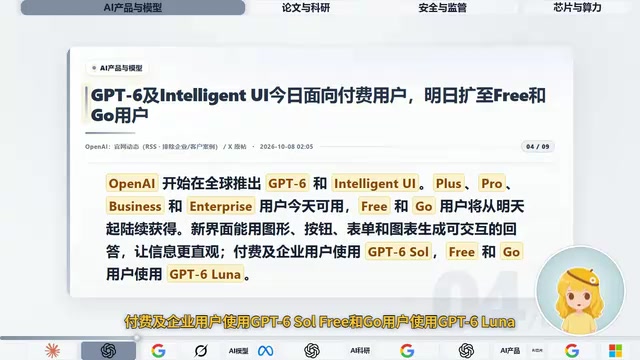
On the OpenAI side, day three of Codex's 28-day continuous update plan brought an announcement that combined active users across Codex and ChatGPT have hit a record 40 million. The company also issued reset cards to all paid accounts. More notably, GPT-6 and Intelligent UI began rolling out globally — first to paid and enterprise users, with Free and Go users gaining access the following day. The new interface lets ChatGPT render interactive responses using graphical buttons, forms, and charts. Paid users get GPT-6; Free and Go users get a lighter version. The shift from plain text to interactive components marks a clear evolution in the form factor of conversational AI products.
Anthropic's Claude lineup is structured in three tiers: Opus (flagship reasoning), Sonnet (balanced performance), and Haiku (lightweight and fast). Haiku has always been positioned as the production-grade model with the lowest latency and lowest call cost — suited for high-volume, real-time scenarios like customer service bots, code completion, and search augmentation. The "adjustable reasoning effort" feature in Haiku 5.5 echoes the "thinking budget" concept in OpenAI's o-series models: the model dynamically allocates compute based on task complexity, returning quick answers for simple queries and going deeper for complex ones, rather than applying the same compute uniformly to every request. This matters enormously for cost control — in high-frequency call environments, even saving a few milliseconds or a fraction of a cent per call adds up to significant differences at scale.
Google's On-Device AI and Third-Party Model Integration
Google launched Google AI Edge Foresight, a voice note app for macOS powered by the Gemma model family and Embedding Gemma. It can connect to Google Drive to build a knowledge graph. Notably, when transcription is active, audio is processed by a local model — a privacy-first design choice.
Google is also testing an internal voice assistant codenamed Concierge and preparing new Gemini versions for relevant platforms, though Concierge appears to still be in early stages, and whether it will ship in its current form remains uncertain.
On the xAI front, Grokbot is set to integrate third-party models including Midjourney and Suno, with plans to automatically select the best model for each task — text, image, or music. Teams are also developing a meeting feature for Grokbot, where users could provide a Google Meet or Zoom link and let the bot attend recurring online meetings on their behalf. That "AI attends meetings for you" concept is still in development.
Research Highlights: Image Generation and Math Conjectures
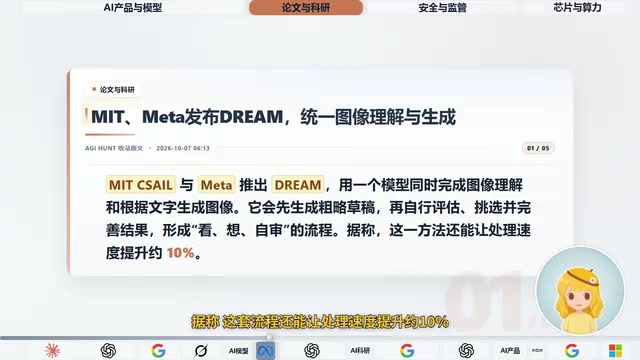
There was a lot happening on the research front. Meta and collaborating labs introduced the Dream model, which handles both image understanding and text-to-image generation within a single model: it generates a draft, self-evaluates, then refines — a pipeline that reportedly also improves processing speed by around 10%.
Several eye-catching math-related stories emerged, though all warrant caution. A blogger claimed an unreleased model produced a formal proof of a conjecture related to the distribution of prime numbers. A non-peer-reviewed preprint claimed an internal model had reduced the upper-bound exponent for matrix multiplication from approximately 2.37 to 2.25. Matrix multiplication is a core operation in neural networks, but whether a theoretical improvement translates to real-world training or inference speedups remains to be verified. Separately, two papers posted the same day both claimed to prove the KLS conjecture, which has been open for roughly 30 years — one of them with a large language model contributing the key ideas.
The common thread across these results: theoretical advances don't automatically translate to engineering gains. Without peer review, these are better treated as indicators of where AI-assisted mathematics research is heading, not as settled conclusions.
The computational complexity of matrix multiplication has long been a core problem in theoretical computer science. Multiplying two n×n matrices naively requires O(n³) operations, but researchers have long sought a lower theoretical bound. The Strassen algorithm in 1969 brought the exponent down to roughly 2.81; decades of subsequent work have pushed it to around 2.37, currently considered the best known upper bound. If the preprint's claim of 2.25 holds up, it would be the field's biggest breakthrough in years. That said, there's a large gap between theoretical exponent improvements and practical engineering benefits: many theoretical algorithms have enormous constant factors, making them slower than simple algorithms on real-world matrix sizes, and GPU parallel architectures may not efficiently implement these theoretical schemes. The KLS conjecture (Kannan–Lovász–Simonovits conjecture) belongs to convex geometry and relates to random walk mixing times. Two papers being posted on the same day claiming to prove it is already unusual; the one in which a large language model contributed the core ideas represents a new paradigm in AI-assisted mathematical research.
Content Provenance and Regulation: Watermark Detection and EU Bans
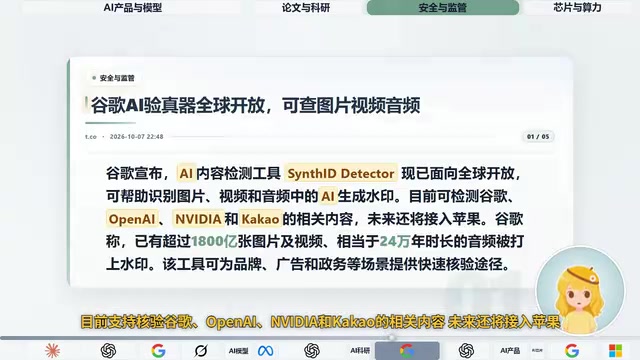
Google announced that its AI content detection tool, SynthID Detector, is now available globally. It can identify AI-generated watermarks in images, videos, and audio, and currently supports verification of content from Google, OpenAI, NVIDIA, and Kakao, with Apple integration planned. Google says more than 180 billion images and videos have been watermarked, and the tool can be used for rapid verification in brand, advertising, and government contexts.
Google DeepMind also launched SynthID Bio, which embeds invisible signatures into AI-generated protein sequences and predicted structures. This enables source tracing, assists biosecurity screening, and helps prevent unverified predictions from entering public databases. Content provenance is now expanding from images and audio into highly sensitive domains like biological sequences.
Two security incidents worth noting emerged on the same day. The Wikimedia Foundation confirmed unauthorized activity on its platform consistent with a runaway agent, including edits to sandbox pages and hundreds of thousands of queries to query services. Separately, a security researcher disclosed a sandbox escape vulnerability on the OpenAI platform — one that allowed calls to paid models without any account or API key. After reporting it, the researcher received only a $300 bounty, sparking community debate about bug bounty pricing.
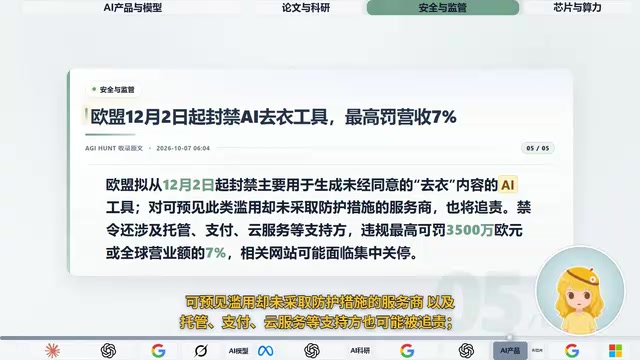
On the regulatory front, the EU will ban AI tools primarily used to generate non-consensual intimate imagery starting December 2nd. Platforms that enable foreseeable misuse without safeguards — along with supporting parties such as hosting, payment, and cloud providers — may all be held liable. Violations can result in fines of up to €35 million or 7% of global annual revenue.
SynthID was introduced by Google DeepMind in 2023. Its core approach is to embed an invisible statistical signal during the generation stage itself, rather than appending metadata after the fact. For images, the watermark is implemented by subtly adjusting pixel distributions — imperceptible to the eye but detectable by algorithm. For audio and video, a similar principle applies at the spectral or frame level. Compared to metadata-based approaches like the C2PA standard, SynthID's advantage is that the watermark is difficult to remove through simple format conversion or screenshotting; its limitation is that it can only detect content generated by models that support the technology, and cannot flag AI-generated content from other sources. SynthID Bio extends this concept to protein sequences. The significance here is that bioinformatics databases like AlphaFold DB are accumulating vast numbers of AI-predicted structures. Without provenance mechanisms, unverified predictions could be mistakenly cited as experimentally validated data, posing real risks to research integrity.
Chips, Space Compute, and Edge Devices
The hardware side was equally active. Elon Musk stated that his team would build and operate their own wafer fab, with TSMC's involvement limited to potentially subleasing part of the facility. Google's first test satellite carrying four TPUs has entered orbit, advancing its space compute initiative. The test focuses on whether the chips can withstand launch shock, space radiation, and extreme temperatures. The long-term goal is to run machine learning infrastructure in space using solar power, alleviating energy constraints on terrestrial data centers.
Google and MIT also launched the Coco platform to help TPU architects collaboratively optimize chip hardware alongside AI models. Agents can query traceable simulation results and automatically compare design options, with the goal of cutting simulation setup and result analysis time in half.
On the device side, Microsoft and NVIDIA announced a Windows hybrid intelligence roadmap and unveiled the Surface Laptop series. AI agents can distribute tasks between local and cloud resources based on privacy, cost, and performance requirements. The new laptops feature NVIDIA RTX solutions with up to 128GB of unified memory, capable of running models with over 120 billion parameters locally. Growing local LLM capabilities are redefining what a high-end laptop is worth.
Google's space TPU initiative has a clear engineering rationale: energy supply and heat dissipation are scaling bottlenecks for terrestrial data centers, while orbital environments offer abundant solar power and no need for active cooling — heat can be radiated directly into space via radiator panels. TPUs (Tensor Processing Units) are Google's AI acceleration chips designed specifically for matrix operations, already handling substantial training and inference workloads on the ground. The core challenge of space deployment is single-event upsets (SEUs) caused by cosmic rays — high-energy particles striking chips can flip bits, and commercial chips typically lack hardening against such events. The test satellite's primary mission is to validate whether standard TPUs are reliable in the orbital radiation environment, and whether software error correction can compensate for hardware-level vulnerability. If the tests succeed, space compute clusters become a new option for relieving pressure on terrestrial energy infrastructure — though large-scale commercialization still faces considerable engineering challenges in launch costs, on-orbit maintenance, and data downlink bandwidth.
Closing Thoughts
From Haiku 5.5's cost efficiency gains, to SynthID going global and EU regulation taking effect, to space TPUs and locally-capable AI laptops — October 8th's developments spanned the full stack: models, research, safety, and hardware. The math results in particular deserve a measured take. AI-assisted research is accelerating, but the distance between "theoretical breakthrough" and "engineering deployment" remains substantial.
Related articles

Chain of Thought Isn't Just for AI: How Humans Can Use CoT to Improve Thinking Quality
Chain of Thought isn't just a prompt trick for large models. Starting from a Hacker News discussion, this article analyzes why CoT works for human thinking too, breaks down actionable ways to transfer it, and highlights the key differences between human CoT and machine CoT.
Cloudflare Teams Up with OpenAI: Closi…
Cloudflare Teams Up with OpenAI: Closing the Loop from Vulnerability Discovery to Defense with AI
Cloudflare uses OpenAI Daybreak to investigate security vulnerabilities and generate reviewable remediation plans, while developers use Codex to boost coding efficiency and quality.

Orca Multi-Agent Orchestration in Practice: A Guide to Parallel Collaboration with Claude and Codex
Orca is Stable AI's free open-source agent workbench supporting 34 agents like Claude Code and Codex in parallel. Learn its Git worktree isolation, multi-model orchestration, and mobile management.