Claude Haiku 5.5 Launches on Devin: Outperforms Sonnet 5 at One-Eighth the Cost

Claude Haiku 5.5 arrives on Devin, outperforming larger models at lower cost.
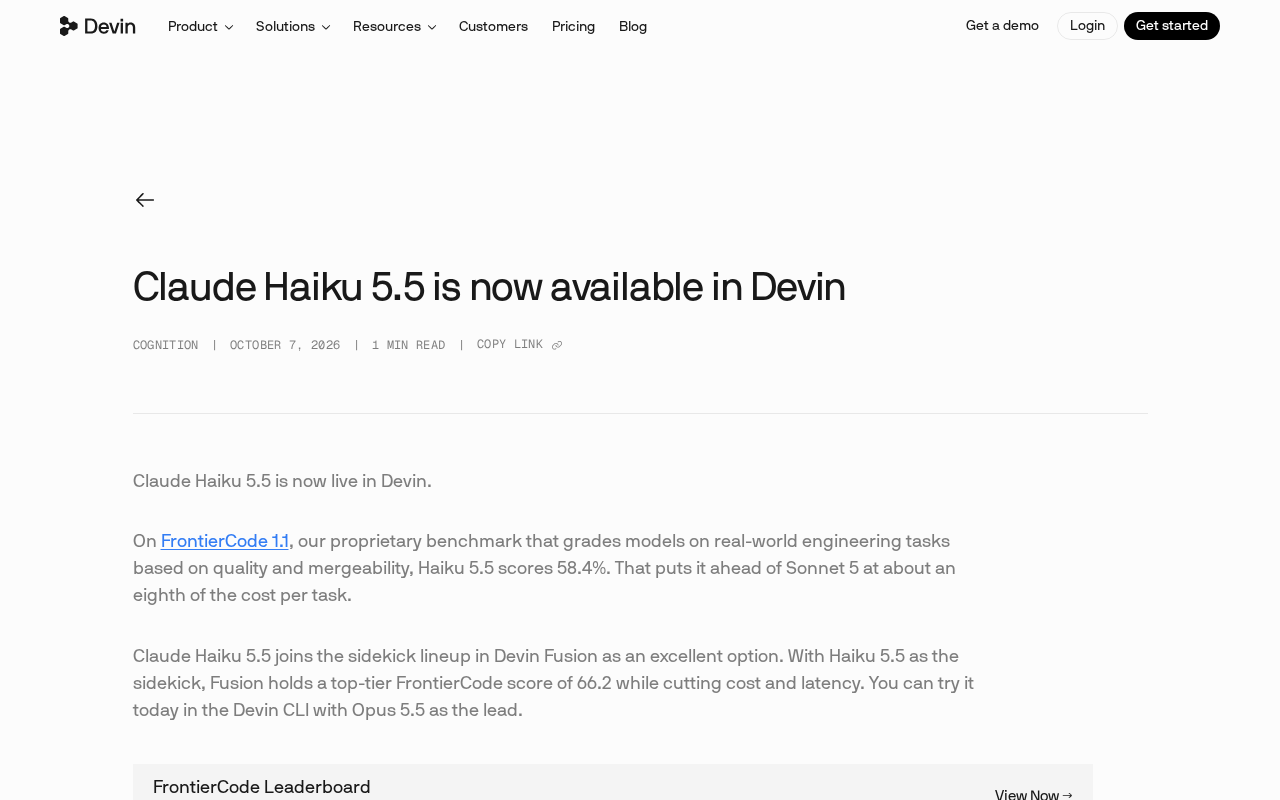
Claude Haiku 5.5 is now fully available on Devin, scoring 58.4% on FrontierCode 1.1—surpassing Sonnet 5 at roughly one-eighth the per-task cost. It also joins Devin Fusion's sidekick lineup for high-frequency auxiliary tasks like rapid execution and code completion. This update reflects coding agents shifting from performance-only to optimal performance-cost balance, as real workflows contain many repetitive tasks that don't need the strongest model, and a single agentic task may trigger dozens of calls that rapidly amplify costs. For developers, this means more flexible model selection, with task-based dynamic "routing" becoming the norm.
AI coding assistant Devin's model lineup has received a significant update. Claude Haiku 5.5 is now officially integrated into Devin, demonstrating competitive advantages over larger models across multiple benchmarks and cost metrics.
Devin Welcomes Claude Haiku 5.5
According to Devin's official announcement, Claude Haiku 5.5 is now fully available on the platform. For developers who routinely use Devin for coding tasks, this means they can now choose a significantly lower-cost model without sacrificing too much performance.
As an AI agent product focused on autonomous coding capabilities, Devin's model selection strategy has always revolved around balancing task types and cost-effectiveness. The introduction of Haiku 5.5 essentially reinforces the model lineup along the "fast, cheap, good enough" dimension.
FrontierCode 1.1 Benchmark: What Does 58.4% Mean?
One of the key metrics for measuring a model's coding ability is the FrontierCode 1.1 benchmark. Claude Haiku 5.5 scored 58.4% on this evaluation.
What's more striking is the comparison: this result surpasses Sonnet 5, whose per-task cost is approximately eight times that of Haiku 5.5. In other words, developers can get a model that performs better on FrontierCode 1.1 with just one-eighth of the budget.
This phenomenon of "small models outperforming larger ones" is not new. With continued advances in model distillation, training data curation, and inference efficiency optimization, lightweight models are rapidly approaching—and even surpassing—previous-generation mid-tier models on specific tasks. Haiku 5.5's performance is another strong validation of this trend in the coding domain.
FrontierCode is one of the more influential coding benchmarks in the industry today. Its problems are typically drawn from real code repositories—bug fixes, cross-file refactoring, and algorithm implementation tasks—rather than isolated code snippet questions. The evaluation uses end-to-end execution verification: a model's patch must pass hidden test cases to score, making it difficult to game through pattern matching or memorization. Version 1.1 builds on its predecessor with enhanced multilingual coverage and long-context dependency question types. Under this design, 58.4% represents an upper-mid-tier level, meaning the model can reliably solve more than half of real engineering problems. It's worth noting that results from different versions and different sampling strategies (such as pass@1 vs. pass@k) cannot be directly compared, and there may still be a gap between benchmark scores and actual experience in specific projects.
Joining the Devin Fusion Sidekick Lineup
Beyond serving as a standalone model option, Claude Haiku 5.5 has also joined the sidekick lineup in Devin Fusion. Devin Fusion is Devin's multi-model collaboration framework, allowing different types of models to divide work and collaborate on tasks—for example, stronger models handling planning and complex reasoning, while efficient models like Haiku 5.5 take on rapid execution, code completion, or subtask processing.
Including Haiku 5.5 in a sidekick role indicates that the Devin team recognizes its advantages in response speed and cost efficiency, making it well-suited for high-frequency, low-latency auxiliary work.
The term "sidekick" refers to a secondary model that plays a supporting role in an agent workflow, forming a layered structure with the primary model. The rationale behind this design lies in the highly uneven distribution of calls in agentic tasks: planning, debugging, and cross-module reasoning are few in number but high in difficulty, while reading/writing files, generating patches, and formatting code are numerous but low in difficulty. If all were handled by the same powerful model, costs and latency would be driven up by the high-frequency, low-difficulty steps. By routing the latter to lightweight models, the quality of the strong model at critical decision points is preserved while long-tail overhead is compressed. The trade-off is the introduction of additional routing judgment and context-passing overhead—if the routing strategy is poor, it may actually cause rework due to misjudgments by the smaller model. Therefore, sidekick selection criteria typically prioritize low latency, stable instruction following, and controllable unit cost, rather than raw scores alone.
Why Low-Cost Models Are Rising in Coding Scenarios
From Devin's update, a broader trend can be observed: coding agents are shifting from a "performance-only" mindset to an "optimal balance of performance and cost."
On one hand, a large portion of tasks in real development workflows are repetitive and pattern-based—generating boilerplate code, fixing simple syntax errors, writing test cases, etc. These tasks don't require the strongest model, and a highly cost-effective lightweight model can actually improve overall throughput.
On the other hand, the rise of agentic coding means a single task may trigger dozens of model calls, rapidly amplifying cumulative costs. In this scenario, allocating some calls to models like Haiku 5.5 can significantly reduce the average cost per task.
Devin's decision to introduce Haiku 5.5 as both a standalone option and a Fusion sidekick is a direct response to this trend.
Practical Impact on Developers
For Devin users, the most immediate benefit in the short term is greater model selection flexibility. For simple tasks, choosing Haiku 5.5 saves costs; for complex tasks, users can still switch to a stronger model or rely on Fusion's collaborative mechanisms.
In the long run, this is also driving a new usage habit: developers no longer focus solely on "which model is strongest," but dynamically match models based on task nature. This "model routing" mindset may become standard practice for AI coding tools.
Claude Haiku 5.5's launch on Devin may appear to be a routine model update on the surface, but behind it lies a triple evolution in performance, cost, and collaborative architecture for AI coding tools.
Related articles

How Big Can Stars Really Get? The Physical Limits of the Largest Stars
Red supergiants are the largest stars by volume, with radii up to 2,000 times the Sun, engulfing the inner solar system. But there is no precise upper limit on stellar size—models predict up to 15,000 solar radii. The most massive blue stars are far smaller than red supergiants—biggest and heaviest are two different things.

Apple HomeView Smart Display Full Feature Breakdown: Wall-Mount or Desktop, $299
Apple launches HomeView, a $299 smart display with wall-mount and desktop options, 12MP camera for facial recognition, smart home control, music playback, and recipe step-by-step cooking. Full breakdown of watch faces, apps, privacy, and cooking integration.

Where Did the Promised New Studio Go? Craft Computing Answers After Five Years
Craft Computing's host responds to viewer questions: the new studio promised five years ago was shelved as construction costs soared from $30,000 to $75,000, and was replaced by a 168-square-foot garage conversion.