Claude Haiku 5.5 Released: 75% Cheaper Small Model Hides a Token Cost Trap

Claude Haiku 5.5 cuts costs 75% and doubles its intelligence score, but high token consumption can undermine the savings.
Anthropic launched Claude Haiku 5.5, claiming ~75% lower costs than its predecessor and clear benchmark wins over GPT-6 Luna on GDPVal and Terminal-Bench. Its Intelligence Index score jumped from 17 to 43, and Anthropic recommends pairing it as a sub-agent with an Opus 5.5 orchestrator for optimal efficiency. However, significant hidden cost risks exist: tiered pricing kicks in above 100K tokens and exceeds Luna's rates, and in Max mode the model consumes roughly 3x Luna's tokens — leading some users to report real-world costs over 12x higher. Haiku 5.5 is competitive for lightweight interactions and sub-agent tasks, but its cost advantage largely disappears under heavy independent reasoning workloads.
Anthropic Keeps the Momentum: Haiku Series Finally Gets a Major Upgrade
Anthropic's release cadence has been nothing short of remarkable lately. After the Opus and Sonnet series received successive updates, a small model that had been overlooked for months finally gets its turn — Claude Haiku 5.5. According to the official announcement, this is their "cheapest, fastest, and most capable" small model to date, with an average running cost roughly 75% lower than the previous Haiku 4.5.
The trend is worth noting: every Anthropic model update is getting smarter while prices keep falling. Competition from open-weight models and OpenAI is clearly pushing Anthropic to proactively cut costs. For users who have been following the Haiku series, this is unambiguously good news.
Benchmarks: Purpose-Built to Take On GPT-6 Luna
The benchmark numbers show a generational leap from Haiku 4.5 to 5.5. On the GDPVal benchmark — which measures knowledge work capability — Haiku 5.5 scores 1620 compared to the old 4.5's 735, nearly doubling the score.
More telling is the choice of competitor: this model appears almost purpose-built to go head-to-head with GPT-6 Luna. GPT-6 Luna scores 1437 on the same benchmark, while Haiku 5.5 clearly pulls ahead. On Terminal-Bench 4.0, which evaluates agentic coding, Haiku 5.5 scores 39.2 against GPT-6 Luna's 16.4 — an even wider gap.
That said, these numbers deserve some perspective: Haiku 5.5 isn't designed to challenge the flagship positioning of Sonnet 5.5 or Opus 5.5. Its target is "high-volume, cost-sensitive" task scenarios — an important distinction.
Across the various charts, Haiku 5.5 generally outscores GPT-6 Luna at comparable price points. Interestingly, at lower thinking levels, even Sonnet 5.5 underperforms Haiku 5.5 in some areas. But in certain domains like Agentic Computer Use GDP Value, GPT-6 Luna claws back the lead. Overall, it's a mixed picture with wins on both sides.
GDPVal (General Domain Performance Valuation) is a comprehensive knowledge-work benchmark developed by Artificial Analysis, covering reasoning, coding, math, writing, and more. It uses weighted scores to measure a model's overall performance in "real-world work substitution" scenarios — scores can be loosely interpreted as the value of knowledge work a model is capable of handling. Terminal-Bench specifically evaluates a model's ability to autonomously complete development tasks in a command-line environment, including code debugging, script execution, and system interaction, making it a specialized benchmark for agentic coding capability. The two benchmarks emphasize different things: GDPVal leans toward breadth across general knowledge work, while Terminal-Bench focuses on deep execution ability requiring real interaction with a computing environment. When interpreting benchmarks like these, keep in mind that a high score doesn't automatically translate to a great user experience — token consumption, latency, and pricing structure are equally necessary dimensions of any comprehensive evaluation.
Recommended Use: As a Sub-Agent, Not an Orchestrator
Anthropic officially recommends using Haiku 5.5 as a sub-agent rather than a standalone primary model.
In the official egg-drop test demo, running Opus 5.5 alone took longer and cost more; whereas a configuration of "Opus 5.5 as orchestrator + 10 Haiku 5.5 sub-agents" ran noticeably faster and further reduced costs.
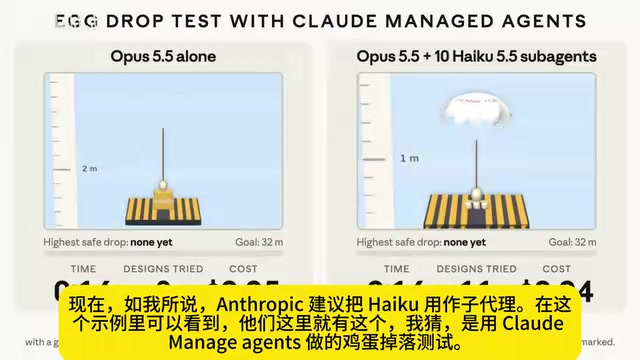
The logic is clear: let Opus 5.5 handle planning and orchestration, then hand off the actual execution to the lower-cost Haiku 5.5. With a solid plan backing it up, Haiku 5.5 is a remarkably capable executor. If you're just having casual conversations with AI on a budget, Haiku 5.5 works perfectly well on its own — but for heavy-duty coding work, you should still reach for Opus or Sonnet.
The "orchestrator–sub-agent" architecture is a common design pattern in multi-agent systems. The orchestrator handles task decomposition, scheduling, and result aggregation — essentially acting as a project manager — while sub-agents focus on executing specific atomic tasks such as web searches, code execution, or file operations. The core value of this division of labor is that high-level planning demands greater model intelligence, while the many execution steps only require "good enough" comprehension. Using a flagship model for orchestration and a lightweight model for execution can dramatically cut costs without sacrificing overall quality. Both Anthropic's Claude SDK and Amazon Bedrock natively support this kind of multi-agent topology, allowing developers to use tool calls (Tool Use) to have Opus/Sonnet dynamically spin up multiple Haiku instances for parallel sub-task processing.
The Hidden Token Trap: Tiered Pricing and High Consumption
The most important thing to watch out for with this model is its pricing structure and token consumption.
First, the tiered pricing. Below 100K tokens, Haiku 5.5 and GPT-6 Luna are identically priced: $0.10 input and $0.50 output per million tokens. But once you cross 100K tokens, the price jumps — $0.50 input and $2.50 output — making it actually more expensive than GPT-6 Luna.

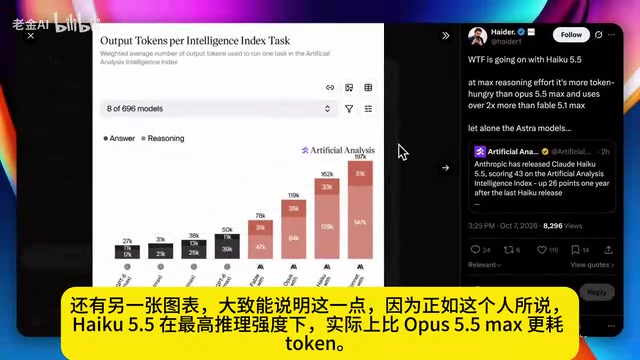
The real problem is that Anthropic's models have long had a reputation for being "token hungry," and Haiku 5.5 is no exception. Artificial Analysis noted the model consumed 162,000 output tokens running the Intelligence Index test in Max mode — roughly 3x GPT-6 Luna. At maximum reasoning intensity, it consumes even more tokens than Opus 5.5 Max, and about twice as many as Fable 5.1 Max.
This explains the mixed reactions in the community. One user complained: building the same 3D animated pagoda island cost $24.96 with Haiku 5.5 on OpenRouter, versus just $1.91 with GPT-6 Luna — a 12x difference. Given that their base API prices are identical, this gap is almost entirely explained by crossing the 100K token threshold into the high-price tier, compounded by the model's inherently high token consumption. In other words, the "cheap" label on paper can be completely misleading for high-intensity standalone tasks.
Tiered pricing is not unusual in large model APIs — it typically ties into extended context windows or high reasoning intensity. Anthropic's two-tier pricing for Haiku 5.5, using 100K output tokens as the dividing line, is essentially designed to encourage lightweight calls while charging a premium for long-chain reasoning tasks. The fundamental reason for elevated token consumption is often "chain-of-thought expansion" — the model generates extensive internal reasoning steps before outputting a final answer, and all of those steps count toward billable tokens. In Max mode, the model expands its reasoning as much as possible, causing output token counts to multiply. For cost-sensitive scenarios, capping the maximum reasoning budget (e.g., via the
thinking.budget_tokensparameter) or disabling extended thinking mode will often control actual spending far more effectively than simply comparing base unit prices.
Intelligence Index Leaps Forward, But Weaknesses Remain
On the Artificial Analysis Intelligence Index, Haiku 4.5 sat at just 17 points, while Haiku 5.5 jumps to 43 — right behind Kimi K3 at 44. For a small model, that's a massive improvement, clearly surpassing Gemini 3.8 Flash and DeepSeekAd 4.1, which significantly boosts its competitive standing as a Flash-tier or sub-agent model.
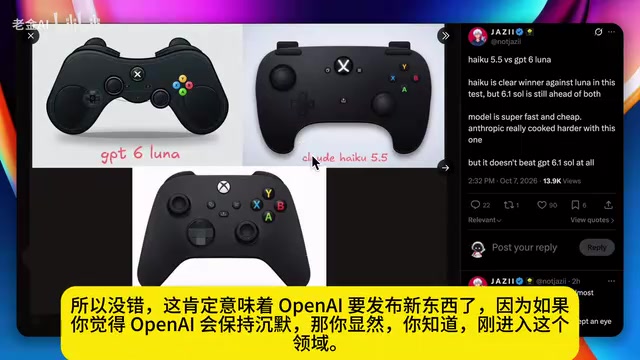
Real-world output quality comparisons yield mixed results. Against Grok 4.7, Haiku 5.5 took about 27 minutes and cost roughly 8 cents, while Grok took 35 minutes and cost $4 — a crushing cost advantage. In generation comparisons against GPT-6 Luna, GPT-6 Sol, and others, Haiku 5.5 was considered a clear winner in some tests but lost out in others.
The conclusion is fairly clear: Haiku 5.5 is a capable performer as a simple interaction model and sub-agent executor, but don't expect it to independently handle heavy reasoning tasks — that's not what it was designed for, and in those scenarios its cost advantage evaporates entirely.
An Easily Missed Perk, and OpenAI's Silence
Anthropic also quietly shipped a small update today that many people missed: Max and Team subscribers now receive between $100 and $500 per month in API credits for testing. Note that these credits don't roll over — they expire at the end of each month. If you hold one of these subscriptions, now is the time to start using them.
Overall, this has been a strong day for Anthropic. The real suspense now falls on OpenAI — they've been quiet for a while, sitting on a 28-day Codex update. Haiku 5.5's pricing is on par with or even undercuts the GPT-6 lineup, which is essentially a dare for OpenAI to ship something new. The competition continues, and ultimately users are the ones who benefit.
Related articles

Chain of Thought Isn't Just for AI: How Humans Can Use CoT to Improve Thinking Quality
Chain of Thought isn't just a prompt trick for large models. Starting from a Hacker News discussion, this article analyzes why CoT works for human thinking too, breaks down actionable ways to transfer it, and highlights the key differences between human CoT and machine CoT.
Cloudflare Teams Up with OpenAI: Closi…
Cloudflare Teams Up with OpenAI: Closing the Loop from Vulnerability Discovery to Defense with AI
Cloudflare uses OpenAI Daybreak to investigate security vulnerabilities and generate reviewable remediation plans, while developers use Codex to boost coding efficiency and quality.

Orca Multi-Agent Orchestration in Practice: A Guide to Parallel Collaboration with Claude and Codex
Orca is Stable AI's free open-source agent workbench supporting 34 agents like Claude Code and Codex in parallel. Learn its Git worktree isolation, multi-model orchestration, and mobile management.