Claude Haiku 5.5 Released: The Most Capable Small Model at 75% Lower Cost

Claude Haiku 5.5 cuts costs by 75%, adds adjustable effort, and targets high-frequency and sub-agent use cases.
Anthropic has launched Claude Haiku 5.5, a small model built for high-frequency, cost-sensitive workloads. Per-token costs for tasks under 100K tokens are 90% lower than Haiku 4.5, with an overall average cost reduction of ~75%. The model is the first Haiku to support adjustable effort settings, letting developers tune reasoning depth per task without switching models. Haiku 5.5 can also serve as a sub-agent alongside Opus 5.5 and Sonnet 5.5 for coding workflows. Sonnet 5.5 cache read prices were also halved simultaneously. The model is available on AWS, Google Cloud, and Azure.
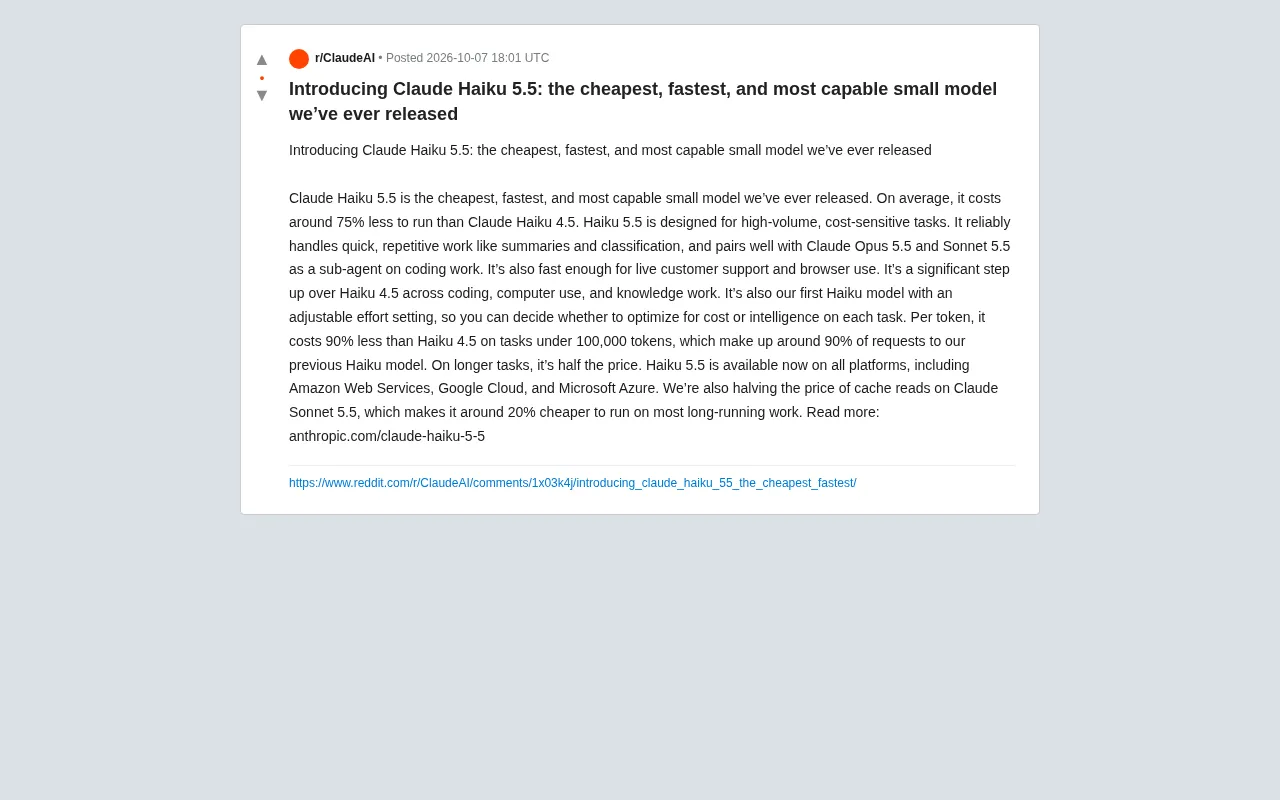
Anthropic has launched Claude Haiku 5.5, officially described as its cheapest, fastest, and most capable small model to date. Compared to its predecessor Claude Haiku 4.5, running costs have dropped by an average of roughly 75%, while delivering meaningful capability improvements in coding, computer use, and knowledge tasks. For developers and enterprises that rely on high-volume, high-frequency model calls, this is an update worth paying attention to.
Pricing Strategy: Pushing Costs to the Limit
Haiku 5.5's most immediate selling point is its price. Anthropic has released a fairly specific set of cost figures: for tasks under 100,000 tokens, the per-token cost is 90% lower than Haiku 4.5. This threshold isn't arbitrary — official data shows that roughly 90% of Haiku requests fall within this length range. In other words, the vast majority of real-world use cases will directly benefit from close to a 90% price reduction.
For longer tasks exceeding 100,000 tokens, the cost advantage narrows, but pricing still comes in at just half of the previous generation. Averaged across workloads, the overall running cost drops by approximately 75%. This tiered pricing logic based on task length reflects Anthropic's clear understanding of actual usage distribution, and ensures that the price cut lands where it matters most — on high-frequency, everyday scenarios.
Alongside Haiku, Anthropic has also quietly adjusted Sonnet 5.5's cache read pricing, cutting it in half. For long-running workloads, this translates to an additional ~20% reduction in Sonnet 5.5's overall operating cost. The simultaneous price cuts across two product lines send a clear signal: lowering the barrier for enterprise-scale AI deployment.
Positioning: High-Frequency, Low-Cost, and Sub-Agent Ready
Haiku 5.5 is designed for high-concurrency, cost-sensitive tasks. It excels at fast, repetitive workloads like content summarization and text classification — tasks that typically involve massive call volumes and extreme sensitivity to per-unit cost, making them the natural home turf for small models.
More interesting is its role in multi-model collaboration. Anthropic explicitly notes that Haiku 5.5 can serve as a sub-agent, working alongside Claude Opus 5.5 and Sonnet 5.5 on coding tasks. In this architecture, the more powerful large models handle planning and complex reasoning, while Haiku takes on the bulk of lightweight execution work — maintaining quality while keeping overall costs down. This aligns well with the current engineering trend toward "tiered model scheduling" in agent systems.
Haiku 5.5's response speed also makes it viable for real-time customer support and browser use scenarios. The combination of low latency and low cost positions it as a strong candidate for building real-time, user-facing AI applications.
What is a sub-agent architecture? The sub-agent pattern is a common approach in modern LLM engineering. The core idea is to decompose complex tasks and distribute them across multiple models working in concert: a more capable "orchestrator" model handles overall planning, task decomposition, and result synthesis, while individual "sub-agents" each execute specific assigned subtasks. The benefit of this layered scheduling is that the orchestrator is called relatively infrequently, while sub-agents are invoked at high frequency — using cheap, fast small models for heavy execution work dramatically reduces total cost while preserving overall output quality. In a typical coding workflow, Opus or Sonnet might interpret requirements and devise a plan, while Haiku handles batch generation of boilerplate code, running unit tests, or fetching documentation snippets, with the orchestrator integrating the final output. This pattern places high demands on Haiku's throughput and latency — which is exactly why low cost and fast response are both non-negotiable for a sub-agent role.
New Feature: Adjustable "Effort" Levels for the First Time
Haiku 5.5 is the first Haiku model to support adjustable effort settings. Developers can now decide on a per-task basis whether to optimize for cost or prioritize intelligence and reasoning quality.
The value of this design lies in returning control to the developer. Not every task requires the model to run at full capacity — a simple classification task can run at lower effort to save money, while a task requiring deeper reasoning can be dialed up accordingly. Compared to simply switching between different models, this fine-grained, per-task control makes balancing cost and performance far more flexible. As model inference costs become an increasingly significant line item in enterprise AI budgets, this kind of granular control is growing in importance.
What is adjustable effort? Adjustable effort is essentially a control knob for model reasoning depth. In models that support this feature, developers can pass an
effortparameter in the API call (typicallylow/medium/highor a corresponding numeric value), and the model will decide how much compute to invest in its internal "thinking" — for example, whether to perform multi-step reasoning or to self-reflect and revise its answer. Higher effort generally increases latency and token consumption but improves accuracy and reasoning quality; lower effort does the opposite. This concept is related to Extended Thinking and Chain-of-Thought, but differs in that effort is a dynamic knob controlled by the caller at runtime, rather than a fixed model behavior. For a single application, simple intent classification or labeling tasks can be handled quickly at low effort, while tasks requiring complex logical judgment can be bumped up as needed — achieving differentiated cost control within a single model, without constantly switching between multiple models.
Availability and Takeaways
Haiku 5.5 is now live across all platforms, including Amazon Web Services, Google Cloud, and Microsoft Azure. Multi-cloud coverage means enterprises can integrate without changing their existing infrastructure, keeping migration costs low.
Overall, this update continues the broader AI industry trend of "rising capability, falling prices." Rather than focusing on flagship model breakthroughs, Anthropic has invested in sharpening the price-to-performance ratio of its small model — which is arguably the most critical variable during the large-scale deployment phase. As model calls move from experimentation into production at scale, per-call cost increasingly determines whether an AI application can sustain a viable business model. Haiku 5.5's improvements in coding, computer use, and knowledge work over its predecessor, combined with a steep price cut, make it a model that developers building cost-sensitive applications need to seriously reassess.
One caveat: the performance and cost comparisons cited above are based on Anthropic's official figures. Real-world performance still awaits independent third-party benchmarks and validation in actual production environments.
Related articles

WorkBuddy Full Guide: How an AI Coworker Takes Over Workplace Automation
What is WorkBuddy? This article analyzes the core capabilities of this full-scenario AI agent: autonomous execution with deliverable results, local file processing, multi-agent parallelism, and workplace automation workflows, helping you judge its essential difference from ordinary AI chat tools.

The Truth About AI Agents: A Hundred Lines of Code + an LLM, Deconstructing the Agent's Underlying Logic
AI agents aren't a new AI species—just a language model plus tools, a loop, and a goal. Here's the underlying logic: how 100 lines of Python hit a 75% fix rate, why the harness beats the model, and Gartner's "agent washing."

AI Agent Deployment: Three Things Developers Should Do
AI Agent deployment doesn't require rushing into multi-agent systems. This article outlines an actionable deployment path and engineering acceptance thresholds for developers, covering human baselines, bounded single-agent scope, and a controlled code-modification loop.