claude-howto: A 42K-Star Practical Guide to Claude Code

claude-howto fills the Claude Code learning gap with an example-driven approach, confirmed by its high star count.
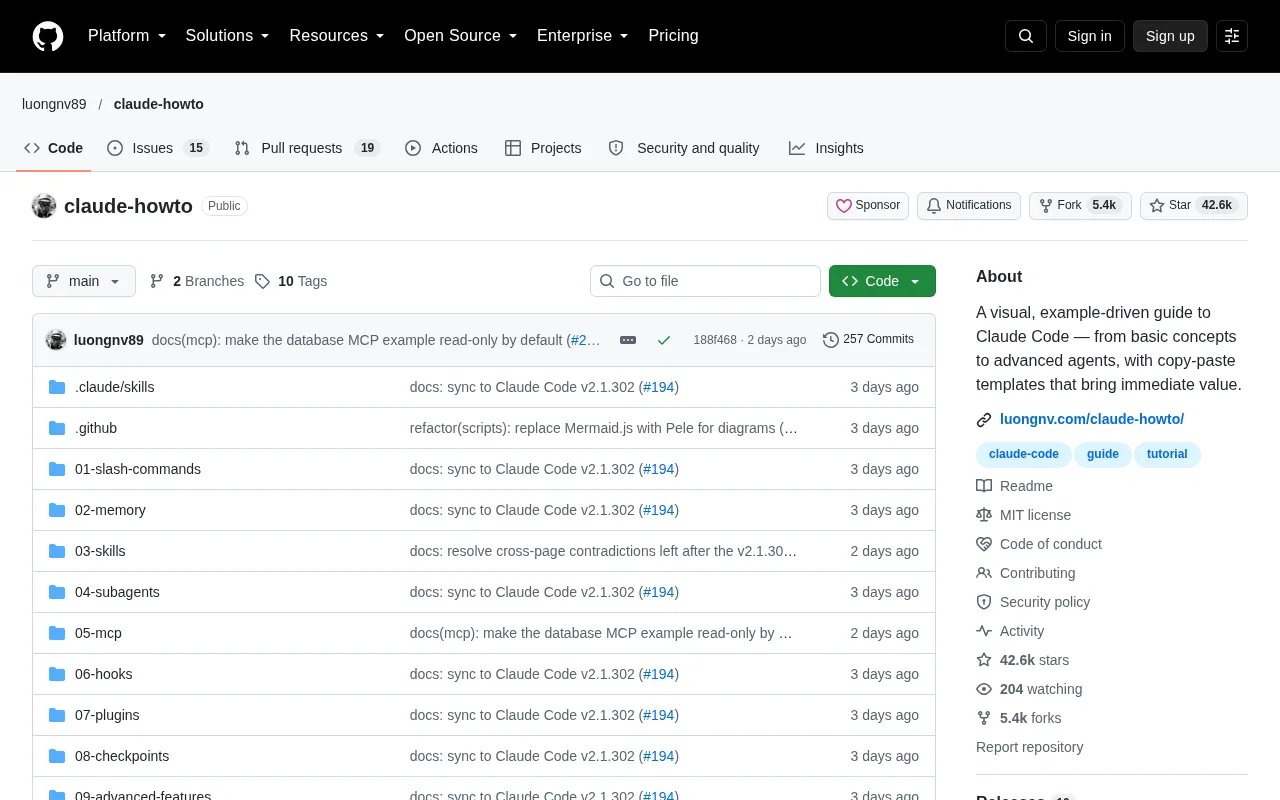
The GitHub project luongnv89/claude-howto uses an example-driven approach to fill the gap between Claude Code's official documentation and scattered tutorials, offering a complete path from basics to advanced agent orchestration with directly copyable templates. It uses Python as a teaching vehicle and emphasizes the immediate value of "tweak a template and use it." With 42,603 stars and 428 new stars in a day, the community clearly endorses the examples-first format. The article notes the layered path benefits both beginners and experienced engineers, but also cautions that chapter depth isn't disclosed, and complex multi-agent scenarios still require official docs and hands-on validation.
Claude Code is evolving from "a chat window that can write code" into an orchestratable agent platform, but the official documentation leans heavily toward being a reference manual, and beginners often get stuck at "knowing the feature exists but not knowing where to start." The luongnv89/claude-howto project on GitHub fills this gap with a visualization- and example-driven approach—42,603 stars, 5,348 forks, and 428 new stars in a single day show that it has hit a real pain point in how developers learn.
What problem does this project solve
Most Claude Code tutorials fall into two extremes: either scattered blog tips, or API docs aimed at advanced users. claude-howto positions itself between the two—it is a complete path from basic concepts to advanced agents, and every stage comes with templates you can copy and paste directly.
The project is implemented in Python, but that doesn't mean it's only a tool for Python users. Python here is more like a teaching vehicle: the example code is clearly structured with lightweight dependencies, making it easy for readers to migrate the patterns to their own tech stacks. For a project whose goal is to "explain the concepts clearly," this choice is reasonable.
Why example-driven learning beats documentation
The core difficulty of Claude Code isn't syntax—it's "how to organize a high-quality conversation and task orchestration." Prompt structure, context management, and tool-calling boundaries are hard to internalize through abstract descriptions, but once you see a complete runnable example, the cost of understanding drops sharply.
According to the project description, its templates are designed to "deliver immediate value"—that is, readers don't need to read everything first; they can take a template, tweak it, and use it. This "copy-and-use" design is especially friendly to engineers who want to quickly integrate Claude Code into their daily development workflow.
Context management in Claude Code is the key mechanism that determines output quality: the model can only see a limited token window each time, and the system must decide which file contents, conversation history, and tool results are kept or discarded. Common approaches include reading file fragments on demand, compressing long conversations with summaries, and solidifying conventions through project-level memory files such as CLAUDE.md. Example-driven teaching works precisely because complete examples make implicit decisions—"when to read files, when to compress context, when to call tools"—explicit, so readers can directly observe how context changes as the task progresses.
A learning path from basics to advanced agents
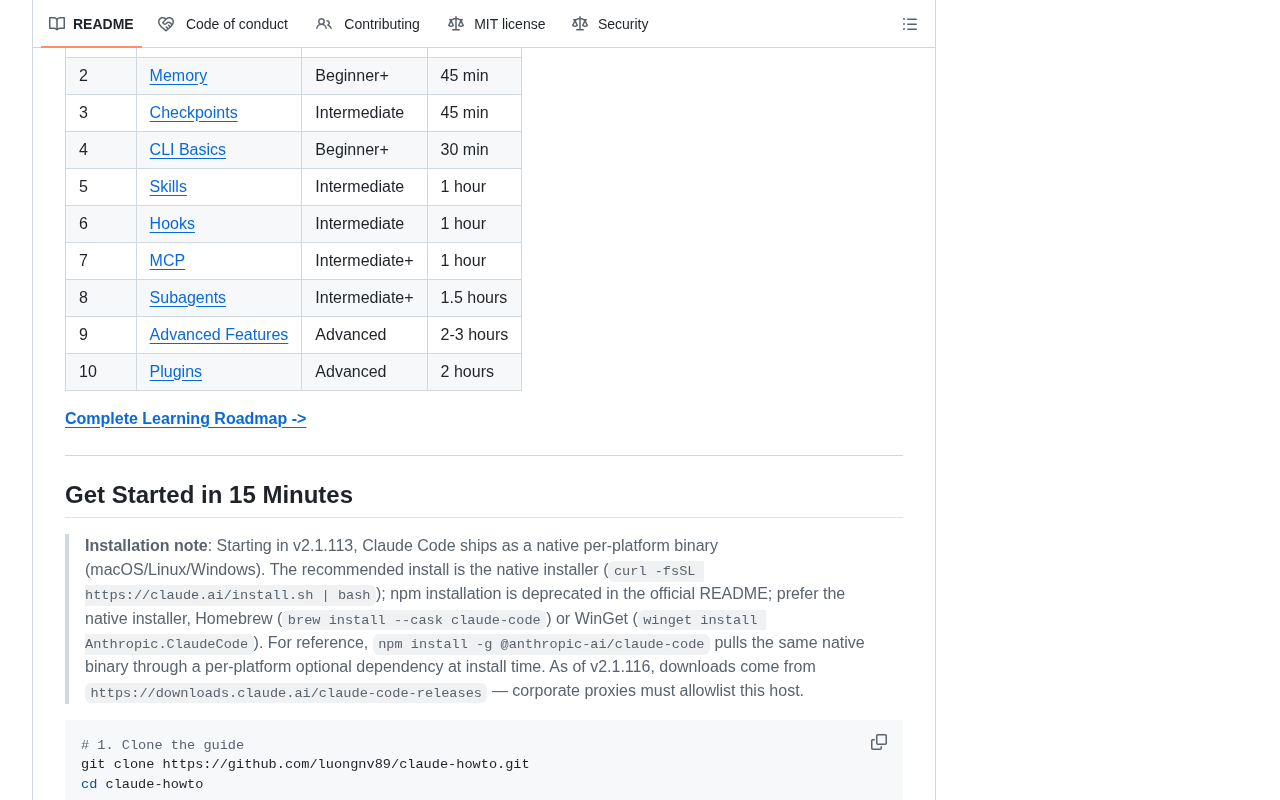
The project's value lies in its layering. The basics cover Claude Code's interaction model and common commands; the advanced section moves into agent orchestration—how to break down tasks, how to keep the model's state across multiple steps, and how to design reliable output constraints. This path aligns with the officially advocated agentic coding direction, but presents it with a lower barrier to entry.
It should be noted objectively that the materials do not disclose the specific depth and code volume of each chapter, so it's impossible to judge whether the advanced agent section is sufficient to support production-grade needs. For complex multi-agent systems, readers still need to combine the official documentation with their own engineering practice.
Agentic Orchestration refers to breaking a complex task into multiple manageable substeps, with the model or an external scheduler deciding which tool to call at each step, what context to pass, and when to terminate. Compared with single-turn conversations, it requires solving engineering problems such as state persistence, error retries, output format constraints, and tool-calling boundaries. Claude Code's officially advocated agentic coding operates within this framework, letting the model autonomously read files, modify code, run tests, and iterate. Understanding the "plan—execute—verify" loop structure is more important than memorizing specific commands, and this is exactly the core content that claude-howto's advanced chapters try to make more accessible through examples.
Who it's for, and how to use it
Developers new to Claude Code can read it chapter by chapter to build a complete mental model; engineers with existing experience are better off treating the repository as a template library and looking up the corresponding example when they encounter a specific scenario. The project's high star count also reflects the community's recognition of the "examples first" format.
A practical tip: don't just read—run it. Claude Code's behavior depends heavily on context and tool configuration. After copying a template, validate it immediately on a real small task to discover any gaps between the template and your own environment.
Summary
claude-howto's popularity is no surprise—it turns the Claude Code learning curve from "read the docs and guess the usage" into "look at the examples and tweak the parameters." 42,603 stars are the community's vote, but tools ultimately have to land in concrete projects. Treat it as a starting point rather than an endpoint, and pair it with the official documentation and actual coding validation—that's the most valuable way to use a guide like this.
One-line Summary
claude-howto fills the Claude Code learning gap with an example-driven approach, and its high star count confirms its value.
Paragraph Summary
The GitHub project luongnv89/claude-howto uses an example-driven approach to fill the learning gap between Claude Code's official documentation and scattered tutorials, providing a complete path from basic concepts to advanced agent orchestration, along with templates you can copy directly. The project uses Python as a teaching vehicle and emphasizes the immediate value of "take a template, tweak it, and use it." 42,603 stars and 428 new stars in a single day reflect the community's recognition of the examples-first format. The article notes that its layered learning path is valuable for both beginners and experienced engineers, but also cautions that the materials do not disclose chapter depth, and complex multi-agent scenarios still require combining official documentation with actual coding validation.
Related articles
Jensen Huang Falls from Grace, Silicon Valley Accelerationism Faces Headwinds
An Economist article, 'Jensen Huang's Fall Is Bad News for Silicon Valley's Accelerationists,' sparked 174 points and 372 comments on Hacker News. This piece analyzes the narrative logic of accelerationism's bet on Nvidia, the divisions in the comment section, and the practical implications for AI practitioners.
NVIDIA Releases Alpamayo 2 Edge: A 2B Reasoning VLA Lands on DRIVE Thor
NVIDIA releases Alpamayo 2 Edge, a 2B-parameter reasoning vision-language-action model that plans driving trajectories on DRIVE AGX Thor with explanations, at 160-190ms pixel-to-trajectory latency. This article analyzes its parameter trade-offs, latency metrics, interpretability value, and production deployment challenges.

Win a Car for Getting Close to 50 Pounds? The Whatnot Marketing Behind a YouTube Challenge
An analysis of the YouTube challenge "Get Close to 50 Pounds and Win a Car," exploring how it drives traffic to livestream platform Whatnot and why weight-guessing content attracts viewers and converts commercially.