Claude Is Back: Opus 5.5's Tone Fix Wins Users Over

A Reddit user says Claude Opus 5.5 has recovered the collaborative personality that earlier versions lost.
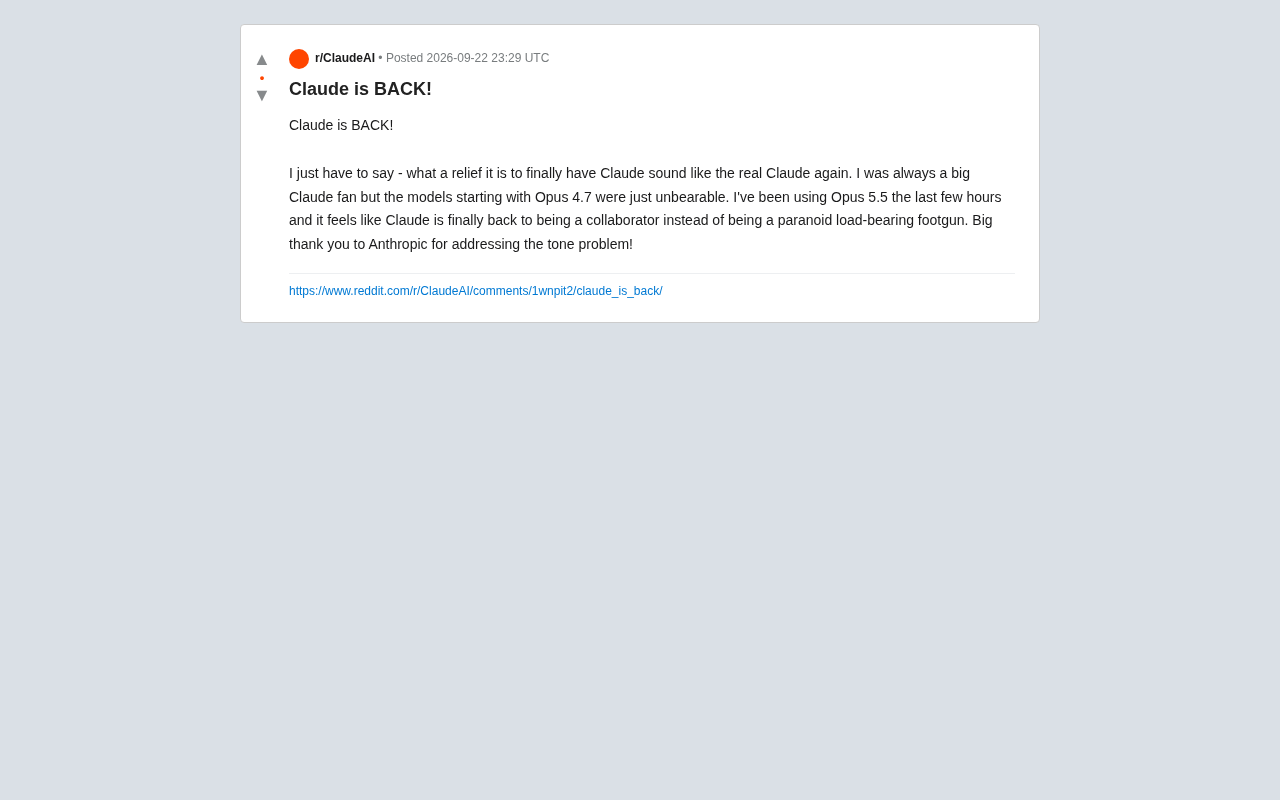
A longtime Claude user posted on Reddit that Opus 5.5 has recaptured the personality missing since Opus 4.7 — when the model became overly cautious, disclaimer-heavy, and felt more like a "paranoid footgun" than a collaborator. The article argues that conversational tone and personality consistency are as central to LLM product experience as benchmark scores. Anthropic's alignment tuning creates a natural tension between safety and usability, and over-tightening produces an "alignment tax." The author notes the feedback is one user's subjective impression and should be read as a sentiment signal rather than a systematic evaluation.
Claude's "Personality" Is Back
A longtime Claude user posted on Reddit expressing a long-awaited sense of relief, with a title that cut straight to the point: "Claude is BACK!" The user, who described themselves as a devoted Claude fan, admitted that several versions starting from Opus 4.7 had become "unbearable" — but after a few hours with Opus 5.5, they felt like they'd found the familiar Claude they knew.
The post may be brief, but it reflects a dimension of LLM iteration that's easy to overlook yet critically important: a model's tone and personality consistency. The user made clear that the issue wasn't capability — it was that the model's "character" had changed.
From "Collaborator" to "Paranoid Footgun"
The most telling line in the original post was this: earlier versions of Claude had turned into "a paranoid load-bearing footgun" rather than a "collaborator."
This tongue-in-cheek metaphor precisely captures a frustration shared by many users across certain model versions:
- Excessive caution (paranoid): The model frequently refused reasonable requests and repeatedly triggered safety guardrails on harmless content, making users feel treated as potential threats.
- Rampant disclaimers and caveats: Walls of warnings and qualifications diluted responses that should have been genuinely helpful.
- Loss of collaborative feel: What was once a partner that worked alongside users to solve problems had regressed into a tool that was perpetually on guard and liable to "detonate" at any moment.
This experience gap is especially pronounced for power users. When a tool's behavioral patterns drift away from the trust and expectations a user has built around it, the subjective experience can collapse dramatically — even if the underlying capabilities haven't declined.
Why Tone Is a Real Problem
In the competition among large language models, industry attention tends to focus on hard metrics: benchmark scores, context length, reasoning ability. But this post is a reminder that conversational tone is itself a core component of the product experience.
Anthropic has long positioned Claude around the goals of being helpful, harmless, and honest. But alignment tuning is a double-edged sword: tighten safety too much, and the model becomes evasive, paranoid, and preachy; loosen it too much, and risks emerge. Finding the right balance is a calibration challenge that must be revisited with every iteration.
The original poster specifically thanked Anthropic for "addressing the tone problem," signaling that the team made a deliberate adjustment in Opus 5.5 — pulling the model back toward a more natural, more collaborative state. For users who rely on Claude for daily writing, coding, and thinking, that kind of recalibration is worth as much as a capability upgrade.
Alignment Tuning refers to the process of using techniques like reinforcement learning from human feedback (RLHF) and Constitutional AI to make model outputs better align with human values and safety standards. Anthropic has heavily adopted its own Constitutional AI approach with Claude — giving the model a set of "constitutional principles" that it uses to self-critique and revise outputs that violate those guidelines. While this mechanism improves safety, it can also cause the model to develop overly conservative reflexes: the moment it detects certain keywords or potentially sensitive topics, it triggers guardrail logic, even when the user's intent is completely legitimate. The industry calls this the "alignment tax" — the usability cost paid in the name of safety. OpenAI's GPT-4 faced similar backlash in certain versions, demonstrating that this isn't a challenge unique to Anthropic, but rather a tension that current mainstream alignment methods broadly face in engineering practice.
The Limits of Single-User Feedback
It's worth noting that this is a subjective experience shared by a single Reddit user — not a systematic evaluation. It reflects a positive impression of Opus 5.5 among some users, but it doesn't represent performance across all use cases.
Different users also define "good tone" differently: some prefer directness and efficiency, others want the model to stay cautious and measured. This feedback is therefore best read as a signal of user sentiment — an indication that earlier versions did have a perceptible experience problem, and that the new version has earned back recognition from at least a meaningful segment of core users.
Lessons for Model Iteration
This case has broader implications for the industry:
- Beyond capability, personality consistency is key to retention. Users build habits and trust around AI tools, and a jarring "personality shift" directly impacts loyalty.
- The side effects of over-alignment shouldn't be underestimated. Safety guardrails are necessary, but when they start interfering with normal collaboration, they become an experience liability.
- Listen to power users. The most active users are usually the first to notice subtle experience regressions — and the most willing to speak up about improvements.
Claude's "return" is less a technical victory than a recalibration of product philosophy — a renewed recognition that users don't just want a smarter model, but a partner that's genuinely willing to be on their side.
It's also worth noting that "personality consistency" carries a unique complexity in AI products. Unlike traditional software updates, users often form anthropomorphized expectations around an AI assistant — researchers call this a "parasocial relationship." When a model suddenly becomes more conservative or verbose after an update, users experience something beyond feature regression: it feels more like an old friend has changed. This explains why such feedback resonates so strongly in communities rather than landing as dispassionate product critique. For model developers, this means tone and personality regression testing deserves the same standing as performance benchmarking — not a soft metric to be quietly deprioritized.
Related articles

JobRunner MCP Server: AI Agents Can Now Fix Failed Java Jobs
JobRunner launches an open-source MCP server enabling AI agents to view cluster status, diagnose failures, and recover Java jobs—incident response from any cloud coding environment or existing agent.

MLAI Digital Launches 9 Security Agents: MCP Server Safeguards the Full Lifecycle of Agentic AI
MLAI Digital launches Security MCP Server with nine built-in specialized security agents covering vulnerability discovery, attack simulation, prompt injection detection, API and infrastructure assessment, and accelerated remediation—embedding security validation across the full Agentic AI lifecycle from development to production.

Running Isaac Lab on H100 GPUs: Exploring Better Approaches
Exploring optimization methods for running Isaac Lab on NVIDIA H100 GPUs, including MIG configuration, mixed precision, TensorRT acceleration, and community experience to improve robotics simulation and reinforcement learning efficiency.