Claude Leads Discovery of Novel Gene-Editing Mechanism: A Milestone for AI Biology

Claude autonomously identified a reverse transcriptase-based molecular machine that may represent a novel gene-editing mechanism.
Anthropic CEO Dario Amodei announced that Claude autonomously read scientific literature and analyzed genomic data to identify a reverse transcriptase (RT)-based molecular machine potentially representing a new gene-editing mechanism, which a human team then experimentally validated. The result's core significance is not the discovery's ultimate value — still unconfirmed — but that AI handled the key intellectual work from literature review to experimental design. An independent Stanford finding of a similar RT system further signals the field may be on the verge of a breakthrough. Amodei draws an analogy to AI's exponential leap in mathematics, positioning this discovery as the first concrete step toward his vision of AI helping cure most diseases within a decade.
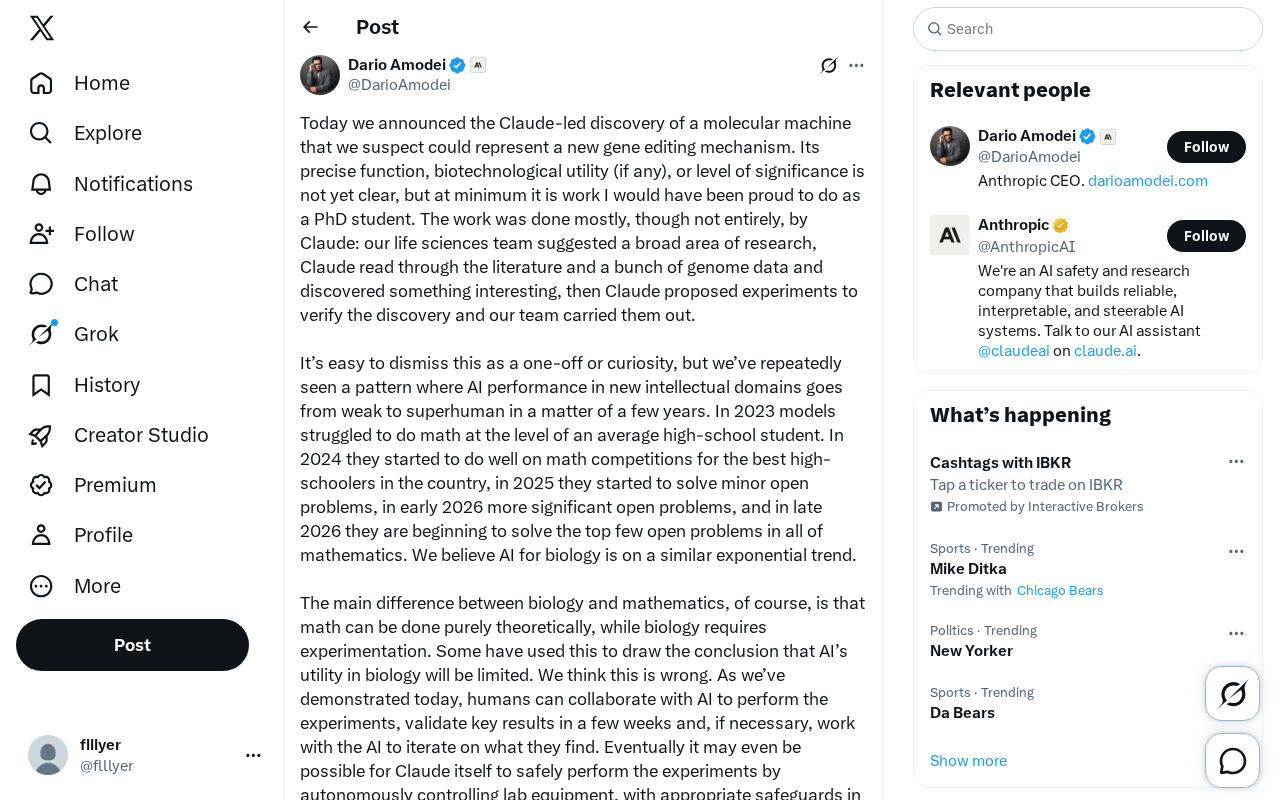
Anthropic CEO Dario Amodei has announced a noteworthy achievement: Claude led the discovery of a molecular machine that the team suspects may represent an entirely new gene-editing mechanism. While its exact function, biotechnology value, and broader significance have yet to be confirmed, Amodei described it as "work I would have been proud of as a PhD student."
The significance of this result lies not only in the discovery itself, but in the role AI played — from reading literature and analyzing genomic data to proposing experimental validation strategies, Claude took on the core intellectual work across the research pipeline, while the human team primarily handled experimental execution.
How AI Made This Discovery
As Amodei described it, the entire research workflow reflects a new paradigm of human-AI collaboration: Anthropic's life sciences team proposed a broad research direction, after which Claude read through the relevant literature and large volumes of genomic data, autonomously identified something "interesting," proposed experimental approaches to validate the finding, and then the human team carried out the experiments.
In other words, AI here was not an assistive tool — it was the primary source of research ideas. This is fundamentally different from AI's past role in scientific research, where it served mainly as a data processing or literature retrieval assistant. The system Claude identified is based on reverse transcriptase (RT) — an enzyme class that has attracted intense attention in the biology community and is central to the replication mechanism of retroviruses such as HIV.
Amodei was also candid about the caveats: the work was "mostly, but not entirely" done by Claude, and the actual value of the discovery still awaits further validation. This measured framing, if anything, makes the result more credible.
Reverse Transcriptase (RT) is an enzyme that synthesizes DNA using RNA as a template — the reverse of the conventional DNA→RNA transcription direction, hence the name. Retroviruses like HIV use this enzyme to integrate their RNA genome into the host cell's genome, enabling infection and replication. In recent years, researchers have discovered a large diversity of non-viral RT systems in bacteria and archaea, some of which resemble CRISPR and are thought to play roles in genome plasticity, immune defense, or gene regulation. These systems have attracted significant interest for their potential applications in gene editing and gene therapy — the success of CRISPR-Cas9 has amply demonstrated that mining unknown nucleic acid manipulation mechanisms from microorganisms can give rise to transformative biotechnology tools. The RT-related system Claude identified fits squarely within this context; if its specific mechanism is validated, it could add entirely new components to the gene-editing toolkit.
From Mathematics to Biology: An Exponential Curve
The most compelling argument in Amodei's account is his retrospective look at the pace of AI capability development. He used mathematics to trace a steep curve: models once struggled with standard high school math problems, then began excelling at elite high school math competitions, then started solving minor open problems, then tackled more significant open problems, and have now begun approaching some of the most challenging unsolved problems in mathematics.
This pattern of "from weak to superhuman in just a few years" is the core basis for Amodei's belief that AI biology will follow a similar exponential trajectory. He suggests that Claude's performance in biological discovery today may be at the very beginning of that curve.
The Experimental Bottleneck Is Not AI's Ceiling
Some argue that the fundamental difference between biology and mathematics is that mathematics can be pursued through pure theoretical reasoning, while biology depends on experimentation — and therefore AI's role in biology is necessarily limited. Amodei explicitly pushed back on this view.
He pointed out that the current results demonstrate precisely this: humans can collaborate with AI to complete experiments and validate key results within weeks, iterating with AI when needed. Looking further ahead, with appropriate safety measures in place, Claude may eventually be able to autonomously control laboratory equipment and safely conduct experiments — though that has not yet been done. He noted specifically that Anthropic's laboratory operates at BSL1/BSL2 biosafety levels and does not work with materials hazardous to humans.
The core logic of this response to the experimental bottleneck argument is that the experimental phase can be dramatically compressed through human-AI collaboration, rather than remaining an insurmountable obstacle.
Accelerating Foundational Discovery to Unlock the Entire Pipeline
Amodei breaks biomedical progress into multiple stages: foundational biological discovery, translational research, drug discovery, clinical trials, and finally delivery of drugs and medical services to patients. Anthropic's interest extends beyond the first stage, but he argues that accelerating even that single stage has the potential to speed up and expand the entire pipeline.
More specifically, deeper biological understanding and sharper tools for biologists can identify new drug targets, uncover new therapeutic approaches, enable more precise measurement, and accelerate experimental cycles — which in turn further accelerates biological understanding, creating a positive feedback loop.
He drew a clear distinction: this will not shorten the duration of clinical trials themselves (latency remains unchanged), but if successful, it can dramatically increase the number of promising candidates entering the pipeline (throughput increases). This is an improvement in "throughput," not "latency."
The "latency vs. throughput" framework Amodei introduces here borrows from classic concepts in computer systems performance analysis. Clinical trials require years to observe a drug's safety and efficacy in humans — this time window is determined by biological reality, and AI cannot compress it. That is what "latency unchanged" means. But if AI can help scientists more quickly identify more promising drug targets and candidate molecules, the number of high-quality candidates entering or completing the pipeline within the same period increases dramatically — that is the meaning of "throughput improvement." The analogy is a factory assembly line: speeding up each step (increasing throughput) significantly boosts overall output even if the time each product spends at the final inspection station (latency) remains the same. This distinction is critically important for accurately assessing AI's actual contribution to pharmaceutical progress, and it guards against both excessive optimism and excessive pessimism about "AI accelerating new drug approvals."
Context and Independent Validation
Claude's discovery did not occur in isolation. Amodei places it within a lineage stretching back decades: from CRISPR systems, to recent discoveries like bridge recombinases and VIPR, to the current wave of intense focus on reverse transcriptase systems.
A notable independent corroboration: a Stanford team independently described a novel RT system featuring associated non-coding arrays — similar in certain respects to the system Claude identified, though the two evolved independently and are distinct systems. When separate teams converge on similar directions independently, it often signals that the field is on the eve of a productive breakthrough. Amodei takes this as evidence that researchers are only just beginning to discover these systems and develop them into powerful biotechnology tools.
CRISPR (Clustered Regularly Interspaced Short Palindromic Repeats) is a bacterial immune system that was repurposed as a gene-editing tool around 2012. Its core protein Cas9 can precisely cleave specific DNA sequences guided by a guide RNA, ushering in a new era of genome editing; the scientists behind it were awarded the Nobel Prize in Chemistry in 2020. Bridge recombinases and VIPR (Virus-like Interspersed Palindromic Repeats) are novel DNA recombination/integration systems discovered in recent metagenomics research, still in early functional characterization but already showing gene-integration capabilities independent of CRISPR. The maturation of metagenomics — the direct sequencing and analysis of all microbial DNA from environmental samples or organisms without culturing individual microbes — has enabled researchers to scan nature for functional enzyme systems at massive scale. This is precisely the technical prerequisite that allows AI to "read large volumes of genomic data" and identify new systems within it. The discovery arc from CRISPR to RT systems is fundamentally driven by the explosion of metagenomics data combined with advances in computational analysis.
The First Step Toward "Curing Most Diseases"
In his earlier essay Machines of Loving Grace, Amodei wrote of AI's potential to "cure most diseases within 5 to 10 years" — a vision that sounds impossible, but which he believes is "just barely possible" if AI is applied to every stage of the pipeline.
He positions today's result as the first step toward that vision: first demonstrating that AI can assist in — and eventually drive — biological discovery. Anthropic says it will expand its life sciences team, collaborate with external scientists to apply this approach to a broader range of problems, and is publicly inviting research collaboration proposals.
Regardless of the ultimate value of this particular finding, a discovery led by AI marks a shift in how science is done: AI is gradually evolving from a tool in the laboratory into an intellectual agent that proposes hypotheses and drives discovery.
Related articles

Kimi K3.1 Hands-On Test: Open-Source Model Nears Opus, Video Generation Steals the Show
Kimi K3.1 completed motion graphics, 3D rendering, mini-games, and video generation in a live test. Analysis of its 2.8T MoE architecture, gap vs Opus/GPT, and hidden video generation.

Sam Altman: Why Life's Biggest Advice Should Still Come from Humans
OpenAI CEO Sam Altman on the limits of AI advice: AI can talk you out of an impulsive email, but life's biggest advice should still come from humans.

"Black October": Did AI Uncover 3% of All Critical Vulnerabilities Ever?
A Reddit post claims 3% of all critical software vulnerabilities ever were found in the past month, dubbed 'Black October.' We break down the statistical issues, how AI-assisted code auditing accelerates discovery, and how developers should respond.