Claude Max vs Ultra: What Are You Really Getting for the Extra $100?

Anthropic renamed Max 5x/20x to Max/Ultra; the extra $100 buys removal of the 5-hour limit, not more usage.
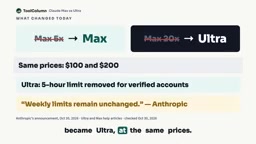
Anthropic renamed Claude's Max 5x and Max 20x subscriptions to Max and Ultra, with prices unchanged. Max costs $100/month for 5x Pro usage, calculated across both 5-hour and weekly windows; Ultra costs $200/month for 10x weekly usage, calculated only on a weekly window. Both offer the same weekly usage per dollar, so Ultra provides no unit-cost discount. The extra $100 buys removal of the 5-hour limit, double the weekly quota, and an extra $100 in API credits. The article notes that API credits cover API and Agent SDK but not interactive cloud code; teams already spending $200/month on the API get an upgrade that's nearly free, while occasional spikes are better handled by buying credits at API rates. New Ultra accounts retain a temporary 5-hour limit until verified, and phone verification does not lift it.
Anthropic made a key adjustment to its Claude subscription lineup: the former Max 5x is now called Max, and Max 20x is now Ultra, with prices unchanged. This means users are no longer facing a simple arithmetic question of "5x or 20x," but a multiple-choice question about "the shape of the limits"—the extra $100 doesn't buy you more usage, it buys you the freedom of being interrupted less.
The Basics of Pricing and Quotas
Let's look at the numbers first. Max costs $100 per month and provides 5x the Pro usage cap, calculated across two windows: per 5 hours and per week. Ultra costs $200 per month and provides 10x Pro usage, but is calculated only on a weekly window. Converted, the "weekly usage per dollar" is exactly the same for both—Ultra does not give you a discount on unit cost.
So what does the extra $100 buy? Three things: removal of the 5-hour limit, double the weekly quota, and an extra $100 in API credits. This is a classic pricing strategy shift: from "selling more volume" to "selling less friction."
The "per 5-hour window" and the "weekly window" are two different rate-limiting mechanisms. The 5-hour window is a rolling rate limit: the system continuously tracks your usage over the most recent 5 hours, and once you hit the cap, you must wait for the window to roll forward and release quota before you can continue. Its characteristic is fast recovery, but it's easy to get interrupted during intensive use. The weekly window accumulates by calendar week (or rolling 7 days), with a larger quota, but once exhausted, recovery time is measured in days. Both usually take effect simultaneously, and whichever is hit first applies. This also explains why removing the 5-hour limit matters so much to heavy users—it turns "hard interruptions within a short cycle" into "smooth consumption over a long cycle."
The Disappearance of the 5-Hour Limit Is the Real Watershed
The most substantive change in Ultra is the removal of the 5-hour cap. Anthropic is rolling out this adjustment gradually, starting with most existing subscribers, and describes the direction of this change as "weekly limits remain unchanged."
What does this limit mean for heavy users? If you frequently hit the 5-hour ceiling during intensive coding or long document processing while still having plenty of weekly quota left, then Ultra solves exactly that pain point. Conversely, if you've never hit the 5-hour limit and only occasionally exhaust your weekly quota, Ultra's value becomes simply double the weekly capacity.
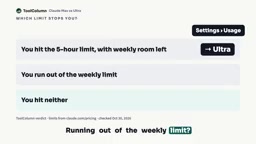
The two limits correspond to two completely different usage profiles, which is why the official recommendation is to observe your own usage curve for a few weeks before deciding.
API Credits: The Easily Overlooked Hidden Discount
Both tiers come with API credits: $100 per month for Max and $200 per month for Ultra. These credits cover API and Agent SDK calls, but do not apply to the interactive cloud code feature—a point that is often misunderstood.
For teams that already have steady API spending, the math gets interesting: if you were already spending $200 per month on the API, then the extra limits of upgrading to Ultra are effectively "free"—the extra $100 comes back to your account in the form of API credits.
For users with occasional usage spikes, there's a cheaper option: purchasing usage credits at API rates. Consider a concrete example—an Opus call with 40,000 input tokens and 2,000 output tokens costs about 20 cents. At that price, $100 buys roughly 500 such calls.
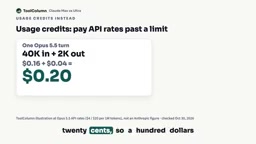
Rather than upgrading your entire subscription tier, buying credits separately for occasional spikes is often the more economical choice.
API and subscription-based products do not use the same billing logic. Subscriptions (such as Pro, Max, Ultra) are a fixed monthly fee in exchange for a certain amount of interactive usage, measured in "message count/usage multiplier"; while the API is a usage-based, pay-per-token model, where input tokens and output tokens have different unit prices, and output is usually more expensive. So-called "API credits" refer to an amount included with the subscription that can be used for API calls, allowing subscribers to spend that budget when going beyond the interactive interface and building applications directly through the API or Agent SDK. Understanding this is crucial: API credits cannot be converted into message counts in the chat interface—the two pricing units are not interchangeable.
Temporary Limits on New Accounts: A Detail to Watch Out For
Ultra does not immediately remove the 5-hour limit for all accounts. Newer Ultra accounts retain a temporary 5-hour limit until Anthropic completes verification. Note in particular that verifying your phone number does not lift this limit.
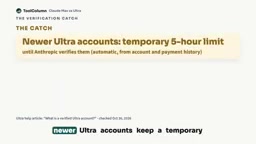
How do you tell whether you've been verified? On the usage page in settings, if the usage bar for the current session is not displayed, it means you've passed verification. This detail directly affects new users' perception of Ultra's value—before verification is complete, you're paying Ultra's price but enjoying an experience that's partly closer to Max.
Why are new accounts "verified"? Service providers typically apply temporary risk controls to newly registered or high-risk accounts to prevent abuse, multi-account sharing, or payment fraud. Before verification is complete, accounts are downgraded to more conservative rate-limiting policies—this is exactly why some new Ultra accounts still retain the 5-hour limit. Phone verification is ineffective because it only proves "you have a number," which is not equivalent to the account having passed the provider's comprehensive risk assessment. Such temporary limits generally lift automatically after a period of normal use or after completing additional verification; the main thing users can do is watch for status notifications on the settings page.
So Which One Should You Choose?
The decision logic boils down to three questions.
Hitting the 5-hour limit but with weekly quota to spare? Ultra is designed exactly for this.
Frequently exhausting your weekly quota? Ultra doubles your weekly capacity.
Hitting neither limit? Stay on Max.
The core principle is: upgrading only makes sense when a limit genuinely impedes your work. Paying an extra $100 for "might need it someday" is not a good deal given that there is no discount on unit usage cost. It's recommended to observe your usage data for a few weeks and let the actual record of limit triggers make the decision for you, rather than predicting by feel.
Related articles

AI Tools Quietly Altering Settings: Postman Silently Installs Plugin, Codex Sharing Option Auto-Resets
AI Daily reports: Postman silently installs a Mac plugin and self-approves startup hooks, logged as auto-existing upgrade; Hacker News developers say Codex data-sharing opt-out flips back. Plus Simon Willison's raw float weight experiment with QEN 3.8-27B.

AI Learns to Rewrite AI: MIT's "Weightspace Programming" Redraws the Path to Recursive Self-Improvement
MIT team proposes weightspace programming: GPT-6 Astra reads and edits AI model weights directly. Math scores jump several-fold, hand-written networks beat trained models. Eight experiments analyzed, plus Anthropic's same-day warning and the real boundaries of recursive self-improvement.

Running Qwen 3.8 on a Laptop to Read Raw Weights: 46 Minutes Per Answer
Simon Willison reproduced weight space programming with Qwen 3.8 27B on a laptop: a 17GB model file, 46 minutes per answer, 43,506 reasoning tokens, Pong over an hour, Freeway failed. Suited for interpretability researchers.