Claude Motion Video Generation: Code-Based Editing and Precise Modifications

Claude Motion writes video as code, letting you make precise fixes by changing a single line without regenerating the entire clip.
The article introduces the Claude Motion video generation solution, whose core is treating video as an editable "recipe": each frame's text, colors, motion, and timing are recorded as code, and the final video is rendered from it. Unlike traditional generative models where changing one word means redoing the whole clip, the code-based approach only requires modifying the corresponding line, keeps the rest unchanged, and produces deterministic output. However, it can only draw text, shapes, charts, and user-provided images—it cannot generate imagery from nothing—making it better suited for explainer videos, data visualizations, and frequently iterated informational videos.
Claude Motion Video Generation: Code-Based Editing and Precise Modifications
Traditional AI video generation tools often leave people with mixed feelings: after generating a video, even if you only want to fix a single typo, you may need to regenerate the entire clip—wasting both time and money. A solution recently shared on a YouTube channel, Claude Motion video generation, offers a completely different approach—writing video as code. According to the video, by writing each frame's text, colors, motion, and timing as code, you can precisely adjust any detail in the video just like editing a program, without starting over.
A New Paradigm for Video Generation: Code as Recipe
The core of Claude Motion lies in the concept of a "recipe." In the video, the author uses a vivid analogy: traditional generation is like ordering a cake—if you find a typo in the frosting, you have to order a whole new cake; whereas Claude Motion gives you the recipe, where every element—text, color, animation timing—is explicitly recorded as code, and the final video is entirely determined by this code.

The biggest benefit of this code-based approach is editing precision. If a line of text in the video is wrong, you only need to have Claude modify the corresponding line of code, leaving the rest unchanged. The video demonstrates this workflow: after changing one line of code, the re-rendered video is identical to the previous one, with only the target text changed.
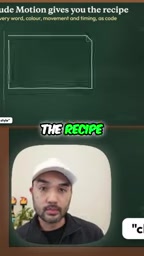
For video projects that require frequent iteration, this re-editable nature significantly reduces the cost of trial and error. Traditional generation models produce random output each time, whereas code-based recipes guarantee determinism—as long as the code stays the same, the output won't change.
Deterministic Rendering vs. Stochastic Generative Models
Traditional text-to-video models (such as Sora, Runway, etc.) are typically based on diffusion models, where each generation starts from random noise sampling, so running the same prompt multiple times yields different results—a property known as stochasticity. A code-based recipe, by contrast, is essentially a rendering pipeline: as long as the code (including timing, coordinates, and color values) and the renderer version remain unchanged, the output is deterministic. This is similar to traditional animation software or LaTeX compilation—identical input files produce pixel-identical output. The direct benefit of determinism is reproducibility, diffability, and rollback capability, which also makes "change one line, change only one thing" possible; the trade-off is that it gives up the generative model's ability to create pixels from nothing, and can only perform procedural drawing on existing assets.
Precise Modifications: Change Only One Line of Code
In practice, Claude Motion's editing experience is very close to software development. The video emphasizes that you can locate the specific problematic line of code and have Claude make targeted modifications. For example, to fix a spelling error, you simply point out the location in the conversation, and Claude generates the corrected code and re-renders the video.
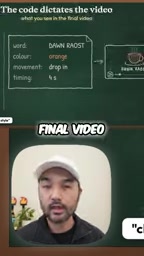
This workflow is especially friendly to content creators. Previously, fixing errors in video subtitles or data charts often required going back to the original project files or regenerating, but Claude Motion turns the whole process into a code patch. The video also hints that since everything is code, version control and collaboration become simpler—you can manage video projects just like managing a code repository.
Version Control for Video
Since Claude Motion's output is code text rather than binary video files, it can naturally integrate with version control systems like Git. Even if only one frame of a binary video file changes, the diff is nearly unreadable, whereas changes to a line of text, a color hex value, or a keyframe timestamp in a code-based recipe can be clearly presented as a text diff. This means teams can review video changes just like reviewing code changes, run parallel experiments with different editing approaches through branches, and precisely roll back to a specific commit when problems arise. However, note that the final rendered video files themselves are large and unsuitable for repository storage; typically only the recipe code is version-controlled, and the video is re-rendered on demand as a build artifact.
Capability Boundaries: Only Drawable Assets Can Be Used
Although code-based recipes are powerful, they have clear limitations. The video candidly points out that Claude Motion can only use assets it can "draw," including text, shapes, charts, and user-provided images. It cannot generate images or video clips from nothing like other generative AI models.

This means Claude Motion is better suited for informational, data-driven, or graphical video content, such as explainer videos, data visualization animations, and presentations with subtitles. For scenarios requiring live-action footage or complex generated imagery, it cannot replace traditional generative models. The video author also explicitly states that this limitation is an inherent property of the recipe model—code can only describe what it can draw.
Use Cases and Practical Advice
Based on the demonstrations and explanations in the video, Claude Motion excels in the following scenarios:
- Videos that need repeated modifications: Such as educational videos and product instruction videos containing large amounts of text or data, where modification costs are extremely low.
- Series content with consistent style: Code-based recipes are easy to reuse and adjust, making them suitable for templated series videos.
- Data visualization animations: Charts and shapes are its strength, allowing precise control over the presentation of each data point.
The video concludes by reminding viewers that using Claude Motion requires a shift in mindset: no longer treating video as a black-box generation result, but as programmable media. Once you grasp this way of thinking, you can get started with the basic workflow in 12 minutes. For creators pursuing precise control and efficient iteration, this is undoubtedly a tool worth trying.
One-line Summary
Claude Motion writes video as code, letting you make precise fixes by changing a single line without regenerating the entire clip.
Paragraph Summary
The article introduces the Claude Motion video generation solution shared on a YouTube channel, whose core is treating video as an editable "recipe": each frame's text, colors, motion, and timing are recorded as code, and the final video is rendered from this code. Compared to the dilemma of traditional generative models where "changing one word means redoing the whole clip," the code-based approach only requires modifying the corresponding line of code while keeping the rest unchanged, and the output is deterministic. However, this solution has clear boundaries—it can only draw text, shapes, charts, and user-provided images, and cannot generate images or video clips from nothing, making it better suited for explainer videos, data visualizations, and informational videos that require frequent iteration. The article concludes by emphasizing that using it requires treating video as programmable media rather than a black-box generation result.
Related articles

Chain of Thought Isn't Just for AI: How Humans Can Use CoT to Improve Thinking Quality
Chain of Thought isn't just a prompt trick for large models. Starting from a Hacker News discussion, this article analyzes why CoT works for human thinking too, breaks down actionable ways to transfer it, and highlights the key differences between human CoT and machine CoT.
Cloudflare Teams Up with OpenAI: Closi…
Cloudflare Teams Up with OpenAI: Closing the Loop from Vulnerability Discovery to Defense with AI
Cloudflare uses OpenAI Daybreak to investigate security vulnerabilities and generate reviewable remediation plans, while developers use Codex to boost coding efficiency and quality.

Orca Multi-Agent Orchestration in Practice: A Guide to Parallel Collaboration with Claude and Codex
Orca is Stable AI's free open-source agent workbench supporting 34 agents like Claude Code and Codex in parallel. Learn its Git worktree isolation, multi-model orchestration, and mobile management.