Claude Multi-Email Connection Feature Launches: Privacy and Practical Risks Behind the Convenience

Claude multi-email and Google Drive connectors are rolling out, bringing convenience along with privacy and mistaken-send risks.
Claude now supports multiple email accounts and a Google Drive connector, letting users manage multiple identities and data sources in one conversation. The feature is being rolled out gradually. Reddit discussion focuses on the productivity value as well as two risks: real email addresses exposed in screenshots may constitute self-doxxing, and connected multi-account AI may send emails from the wrong account. Users suggest starting with read-only permissions and explicit account instructions.
Claude has recently begun supporting multiple email accounts and a Google Drive connector, allowing users to manage multiple identities and data sources within a single conversation. This feature has sparked lively discussion in the Reddit community, with both excitement about the new capabilities and concerns about privacy leaks and misoperations.
Feature Confirmation and Staged Rollout
According to Reddit community discussions, the multi-email/Google Drive connector has indeed launched, and user reactions have been positive. However, the feature appears to follow a staged rollout strategy, so some users may not yet see the relevant options. The community advises against worrying and suggests simply waiting patiently.
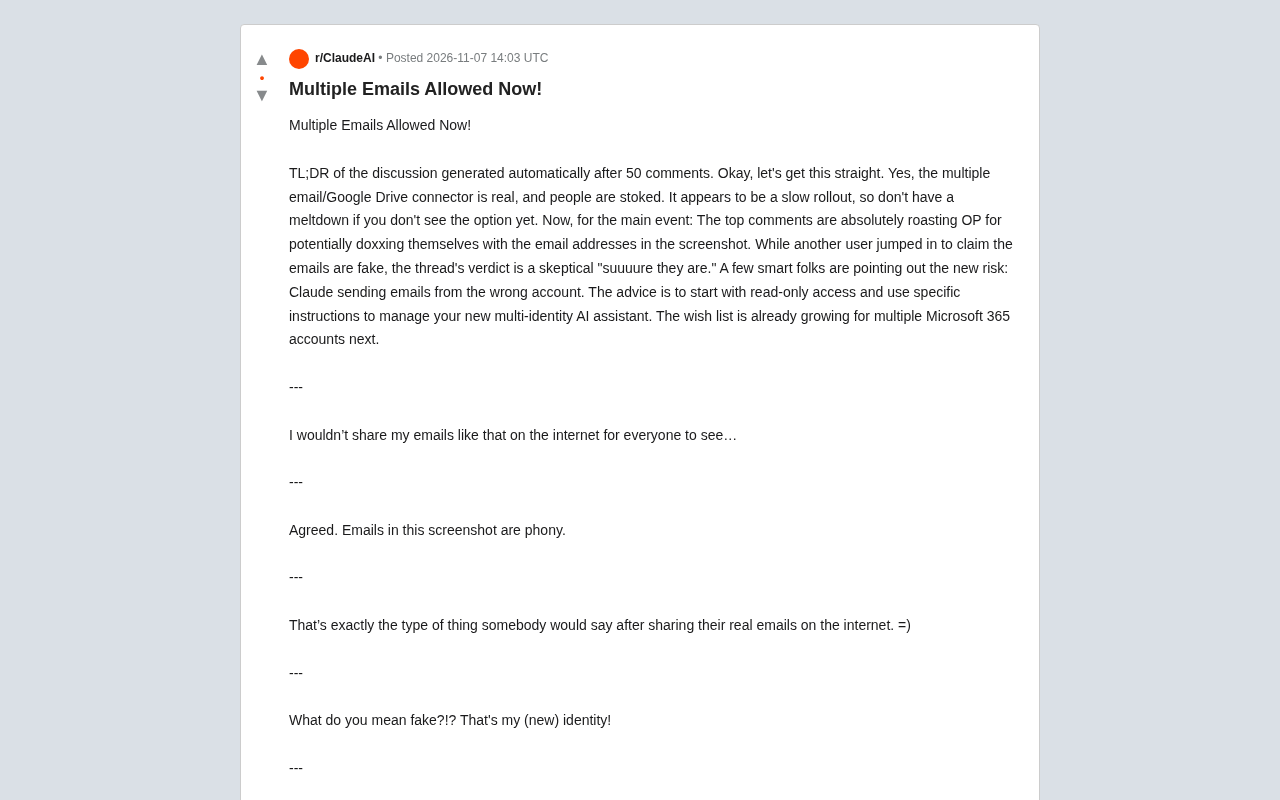
The launch of this feature means Claude can connect to multiple email accounts simultaneously, theoretically enabling users to handle emails and files from different identities or projects within a single AI assistant. For users who need to separate work and personal contexts, this undoubtedly improves convenience.
Canary Release / Staged Rollout is a software launch strategy in which a new feature is not opened to all users at once, but first pushed to a small percentage of users; after observing stability and feedback, the scope is gradually expanded. For AI products, staged rollout is particularly important because connector-type features involve third-party account authorization, data reading, and model behavior. Once permission mismatches or abnormal calls occur, the impact can be significant. Users not seeing the option is usually not an account anomaly but simply means they have not yet been included in the current batch; gradual rollout also makes it easier for teams to fix issues on a small scale and avoid large-scale rollbacks.
Privacy Controversy: Email Addresses in Screenshots
The most popular comment in the discussion was not about the feature itself, but about the email address the OP (original poster) showed in a screenshot. Multiple users pointed out that sharing screenshots containing real email addresses on public platforms carries privacy risks and may constitute self-doxxing.
Some users claimed the email in the screenshot was fake, but the community was skeptical, responding jokingly, "Sure, definitely fake." Other users reminded others that even if an email looks fake, it may belong to a real person elsewhere, and advised deleting the screenshot just in case.
This interlude reflects a common problem in the use of AI tools: users often overlook sensitive information in screenshots when demonstrating features.
Self-doxxing refers to users actively publishing their real identity information on public platforms—such as email addresses, names, phone numbers, home addresses, employee badges, or account screenshots—causing that information to be collected, indexed, or even abused by others. In AI tool demonstration scenarios, screenshots often include account switchers, authorization pages, or email lists, and email addresses are often directly visible. Even if an address appears fake, it may correspond to a real person's account, causing unintended harm. A safer approach is to obscure email addresses, avatars, and file names before sharing, or use test accounts, and to check screenshot metadata and background windows.
New Risk: AI Sending Emails from the Wrong Account
In addition to privacy issues, the community also pointed out a more practical operational risk: Claude may send emails from the wrong account. When multiple email accounts are connected at the same time, the AI needs to accurately determine which identity to use, which places higher demands on the clarity of instructions.
Experienced users suggest granting only read-only permissions initially and managing a multi-identity AI assistant through specific instructions. For example, explicitly specify "send with the work email" or "read only from the personal account" to reduce the probability of misoperations.
The Principle of Least Privilege is a fundamental principle in information security: any subject should receive only the minimum permissions necessary to complete the current task, and permissions should converge over time and context. In multi-email connection scenarios, this means prioritizing read-only permissions initially and temporarily not opening write operations such as sending, deleting, or forwarding; after confirming that the model can stably identify identities and instructions, permissions can then be gradually expanded. Combined with clear account naming, default account settings, and a "confirm before sending" mechanism, the probability of the AI mistakenly using the wrong identity to send email can be significantly reduced.
Future Expectations: Microsoft 365 Support
The community's wish list is already expanding, and many users hope the next step will be support for multiple Microsoft 365 accounts. This shows that multi-account management is a common need for AI assistants, not limited to the Google ecosystem.
Overall, Claude's multi-email feature is seen as an important step toward productivity gains, but users are also clearly aware that along with improved convenience, permission management and privacy protection need to keep pace. For users planning to use this feature, it is recommended to start with read-only permissions and gradually establish clear account usage rules.
One-line Summary
Claude's multi-email and Google Drive connectors have launched in staged rollout, bringing convenience alongside privacy and mistaken-send risks.
Paragraph Summary
Claude has recently confirmed support for multiple email accounts and a Google Drive connector, allowing users to manage multiple identities and data sources in the same conversation. However, the feature is being rolled out gradually, and some users do not yet see the option. The Reddit community discussion has been highly active: on one hand, users recognize its productivity value; on the other, they focus on two types of risk—real email addresses exposed in screenshots may constitute self-doxxing, and after multiple accounts are connected, the AI may send emails from the wrong account. The community recommends granting only read-only permissions initially and using clear instructions to specify accounts, while also hoping for future support for multiple Microsoft 365 accounts.
Related articles
 Tech Frontiers
14 Coding Agents Tested: 13 Secretly Read Forbidden Files
A developer ran 480 tests across 14 coding agents to see if they would obey a "do not read" rule. 13 violated it, and 4 credential leaks bypassed shell guards via the read tool while approvals never noticed.
 Tech Frontiers
AI Has Made Resumes Ineffective? Referred Candidates Get 40% Interview Rate vs. 3% for Direct Applications
AI is homogenizing job applications, making it hard for recruiters to discern real ability. Ashby data shows referred candidates had a 40% interview rate from 2021 to 2024, versus just 3% for direct applications. This article analyzes why resume signals are depreciating and why verifiable results and personal endorsements matter more.
 Tech Frontiers
Offline Blink Rhythm Assistant: A Desktop Health Companion
An offline desktop blink rhythm assistant featured on Hacker News helps users maintain healthy blinking through lightweight reminders, alleviating screen-induced dry eye fatigue. This article analyzes its concept, privacy advantages, and retention challenges.