Claude Mythos Preview Benchmark Results Revealed: Time Horizon More Than 2x the Next Best Model
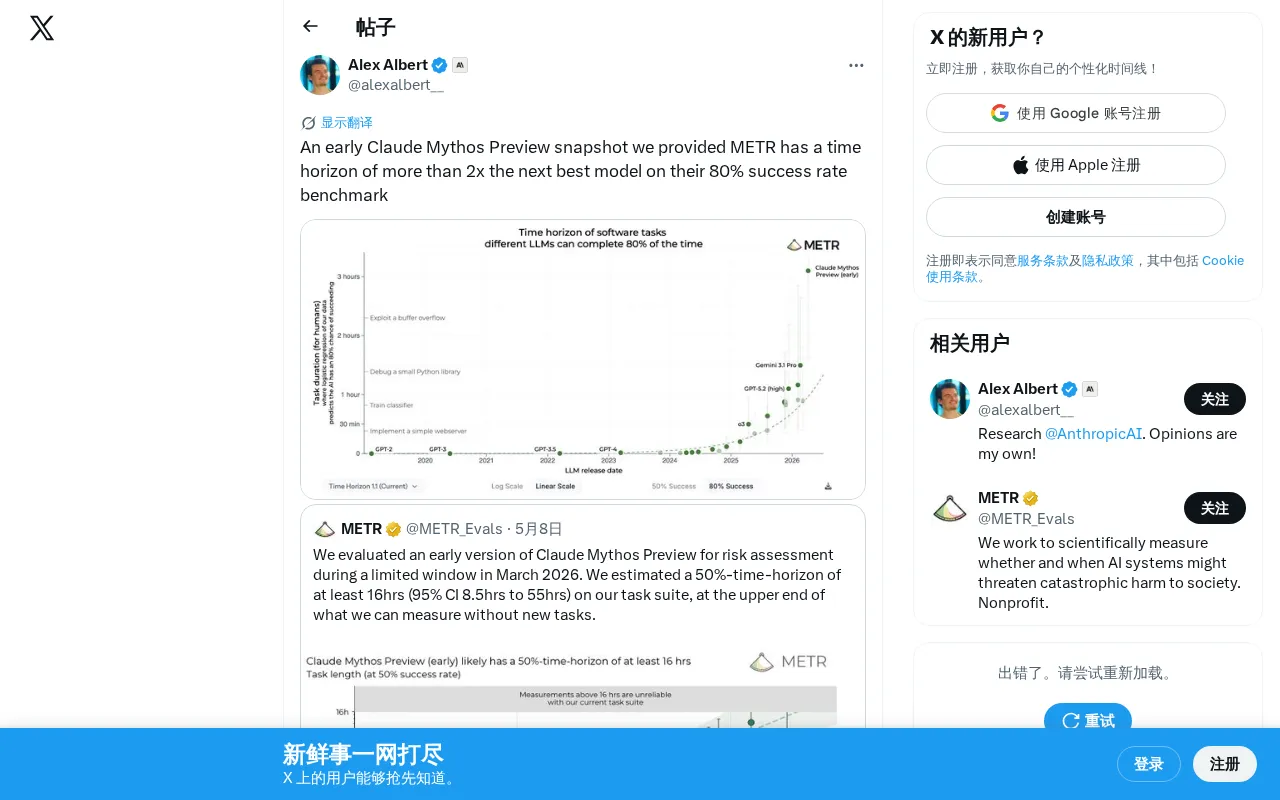
Claude Mythos Preview's time horizon exceeds the next best model by 2x+ on METR benchmarks, signaling an AI Agent leap.
An early snapshot of Anthropic's Claude Mythos Preview achieved a task time horizon more than 2x the next best model in METR's 80% success rate benchmark. Time horizon is a key metric for measuring AI Agents' ability to reliably handle complex multi-step tasks, testing context management, error control, and hierarchical planning. This result marks a qualitative shift from simple instruction execution to autonomous completion of complex projects, and as an early snapshot, the official version may be even stronger. Anthropic's decision to have the model evaluated by an independent organization also reflects its commitment to safe and transparent development.
Claude Mythos Preview's Core Breakthrough: Time Horizon Exceeds Next Best Model by More Than 2x
Anthropic recently revealed striking news: an early Claude Mythos Preview snapshot they provided to METR (Model Evaluation & Threat Research) achieved a time horizon more than 2x that of the next best model in METR's 80% success rate benchmark.

This data means that Claude Mythos Preview can handle tasks with time horizons far exceeding those of other models while maintaining an 80% success rate — one of the key metrics for measuring AI Agent capabilities.
What Is the METR Benchmark? Why Does It Matter So Much?
Founded in 2023, METR is a nonprofit organization that spun off from the Alignment Research Center (ARC), focusing on capability evaluation and threat research for frontier AI models. Unlike many traditional benchmarks that rely on synthetic datasets, METR's evaluation methodology emphasizes real-world tasks — test scenarios typically encompass code writing, system debugging, web searching, file operations, and other compound tasks requiring tool use and multi-turn decision-making, aiming to replicate AI performance in actual deployment environments.
Among these, time horizon is a core metric in the METR framework, measuring the duration of tasks that a model can reliably complete. This metric draws inspiration from the human worker concept of "task completion time": a task that takes a human engineer 30 minutes to complete versus one that takes 3 hours places fundamentally different demands on an AI's planning ability, context maintenance, and error recovery capabilities.
Specifically, METR's 80% success rate benchmark focuses on: given a minimum 80% task success rate, how long a time horizon can the model handle? The 80% threshold isn't arbitrary — it reflects the basic reliability requirements for industrial applications. Models below this threshold typically require extensive human oversight in production environments, making it difficult to achieve true automation value. A longer time horizon indicates that the model possesses the following capabilities:
- Maintaining coherent reasoning over longer periods, without losing direction in multi-step tasks
- Handling more complex workflows, including tasks requiring extended planning and execution
- Demonstrating stronger autonomous Agent capabilities, with higher practical value in real-world scenarios
The Technical Challenges Behind Time Horizon
The reason time horizon is so difficult to improve is that it simultaneously tests multiple deep technical capabilities of a model. First is effective context utilization: long time horizon tasks often generate massive amounts of intermediate states and historical records, requiring the model to maintain accurate tracking of task objectives within a limited context window. Second is the compound error effect: in multi-step tasks, minor early deviations amplify exponentially as steps increase, ultimately causing task failure. Third is hierarchical planning capability: long time horizon tasks require the model to decompose macro-level goals into executable subtasks and dynamically adjust plans based on actual conditions during execution. Claude Mythos Preview's ability to improve this metric by more than 2x implies significant breakthroughs across all three dimensions.
What Do Claude Mythos Preview's Test Results Mean?
AI Agent Capabilities: From Quantitative Change to Qualitative Leap
A time horizon exceeding the next best model by more than 2x is not an incremental improvement — it's a significant leap. In the AI Agent domain, extending the time horizon often means a model transitions from "able to complete simple instructions" to "able to autonomously execute complex projects."
This leap has clear industry context. The AI Agent track underwent a critical transformation from proof-of-concept to actual deployment between 2024-2025. Early Agent frameworks (such as LangChain, AutoGPT) were limited by base model capabilities, often showing significant performance degradation in tasks exceeding 5-10 steps. As OpenAI released the o-series reasoning models, Google launched Gemini 2.0 Flash with native tool-calling capabilities, and Anthropic introduced Computer Use, the competition in Agent capabilities has escalated from "whether it can execute tool calls" to "whether it can reliably complete enterprise-grade complex workflows." In this context, METR's time horizon benchmark has become one of the industry's recognized capability yardsticks.
When a model can reliably handle tasks with longer time horizons, it demonstrates fundamentally different practical value in scenarios requiring sustained multi-step reasoning, such as software development, research assistance, and data analysis.
Anthropic Pulls Ahead on the Agent Track
Interestingly, Anthropic emphasizes that this is merely an "early snapshot," not the final version. This means Claude Mythos Preview may see further improvements at official release. Against the backdrop of increasingly fierce competition among OpenAI, Google, and Anthropic, this result undoubtedly establishes a significant leading advantage for Anthropic on the Agent capability track.
Third-Party Evaluation Reflects Safety and Transparency Philosophy
Providing an early model snapshot to an independent evaluation organization like METR for testing also embodies Anthropic's consistent emphasis on safety and transparency. This practice is closely related to their Responsible Scaling Policy (RSP) — an internal governance framework published by Anthropic in 2023 that requires safety evaluations to be completed before models reach specific capability thresholds. As an independent third party, METR's evaluation results are unaffected by developer commercial interests, providing a more objective capability profile.
Notably, this practice has not yet become an industry-wide standard — most AI companies still primarily rely on internal benchmarks to publish performance data. As the EU AI Act and U.S. executive orders begin requiring third-party audits for high-risk AI systems, Anthropic's practice carries industry-leading significance beyond mere technical demonstration. Validating model capabilities through independent third-party evaluation enhances the credibility of results while setting a responsible AI development precedent for the industry.
Outlook for Claude Mythos Preview
Claude Mythos Preview's performance signals that AI Agent capabilities are entering a new phase. As models can reliably handle complex tasks with increasingly longer time horizons, the transformation of AI from "conversational tool" to "autonomous work partner" is accelerating.
However, we still need to await more detailed disclosures — including specific task types, testing conditions, and detailed comparison data with other models — to more comprehensively assess the practical significance of this breakthrough. The official release of Claude Mythos Preview deserves close attention.
Key Takeaways
- An early Claude Mythos Preview snapshot achieved a time horizon more than 2x the next best model in METR's 80% success rate benchmark
- METR is an independent nonprofit focused on real-world task evaluation; its time horizon metric simultaneously tests models' context management, error recovery, and hierarchical planning capabilities
- Time horizon is a key metric for measuring AI Agents' ability to autonomously execute complex multi-step tasks; the 80% success rate threshold reflects basic reliability requirements for industrial deployment
- This is only an early snapshot version — further improvements are possible at official release
- Anthropic's provision of the model to the independent evaluation organization METR for testing aligns with its Responsible Scaling Policy, reflecting a safety-first and transparent development philosophy
- These results mark a qualitative shift in AI Agent capabilities, from simple instruction execution toward autonomously completing complex projects
Related articles
 Tech Frontiers
A Rare Quiet Day in AI: Recursive Self-Improvement Stirs Beneath the Surface
A rare quiet day in AI sees multiple sources go silent simultaneously. Behind the calm, Recursive Self-Improvement (RSI) research continues. What this means for the industry.
 Tech Frontiers
Reve 2 vs. Ideogram 4: A Deep Dive into Layout Control in AI Image Generation
A deep comparison of Reve 2 and Ideogram 4's layout control capabilities, covering technical approaches, real-world use cases, and industry trends for designers and creators.
 Tech Frontiers
In the Weights: Check Your Influence Score in the AI World
In the Weights is an AI influence search engine that quantifies your presence in the AI world with a score. Explore how it evaluates practitioners and what it means for digital identity.