Claude Opus 4.7 Released: 20% Coding Performance Boost, Same Price, Widening Gap with Chinese Models

Claude Opus 4.7 launches with 20% better coding performance at the same price, widening the gap with Chinese models.
Anthropic released Claude Opus 4.7 with approximately 20% improved coding Agent performance at unchanged pricing ($5 input / $25 output per million tokens). The model leads Tier 1 in coding capability, while China's strongest model GLM 5.1 only ranks between the previous-generation Opus 4.5 and Sonnet 4.6, with the gap widening further. Despite costing roughly twice as much as competitors, Opus's single-round task completion efficiency delivers better overall value. Coding Agents are becoming the core battlefield of LLM competition.
Claude Opus 4.7 Officially Released: A Major Leap in Coding Performance
Anthropic has officially released Claude Opus 4.7, an update that quickly ignited discussion across the AI coding community. The core highlight: coding Agent performance improved by approximately 20%, while pricing remains identical to the previous Opus 4.4—$5 per million input tokens and $25 per million output tokens.

In today's increasingly fierce price war among large language models, Anthropic's "more performance, same price" move packs serious punch. For developers and enterprise users, getting noticeably stronger coding capabilities without spending an extra cent makes the upgrade case self-evident.
What is a Coding Agent? A coding Agent refers to an AI system capable of autonomously planning and executing multi-step programming tasks, distinct from simple code completion tools. It doesn't just generate code snippets—it understands project context, invokes toolchains, automatically runs tests, and iterates fixes based on error feedback, forming a complete "perceive-plan-execute" loop. Core benchmarks for measuring coding Agent capability include SWE-bench (real GitHub issue fix rate) and HumanEval, with SWE-bench considered the most practically relevant indicator due to its proximity to real engineering scenarios. A 20% performance improvement on these benchmarks is highly significant, as score differences between top models are typically only a few percentage points.
Coding Ability Rankings: Claude Opus 4.7 Creates Clear Tier Separation
Based on the latest benchmark data and hands-on testing, Claude Opus 4.7 has established clear tier differentiation in coding tasks. Synthesizing multiple evaluations, the approximate coding capability ranking of mainstream large models is as follows:
- Tier 1: Claude Opus 4.7 (latest release)
- Tier 2: Claude Sonnet 4.6
- Tier 3: GLM 5.1 (between Opus 4.5 and Sonnet 4.6)
- Tier 4: Claude Opus 4.5, GPT series, Gemini series
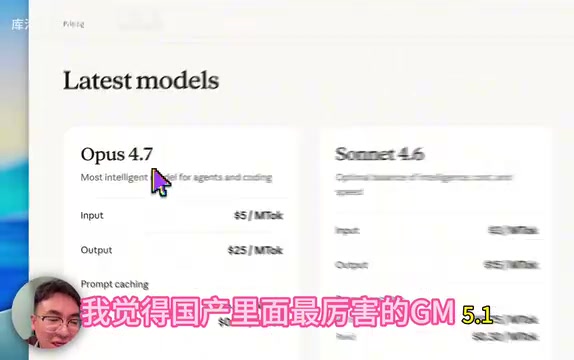
Among Chinese domestic models, GLM 5.1—currently the strongest in coding—performs at roughly the level between Claude Opus 4.5 and Sonnet 4.6 in practice. In other words, China's best contender still trails the previous-generation Sonnet 4.6, while Opus 4.7 has taken yet another major step forward, making the catch-up even more difficult.
The Technical Ecosystem of Chinese LLMs The GLM series is jointly developed by Tsinghua University's KEG Lab and Zhipu AI, representing a collaborative effort between Chinese academia and industry. Its architecture is based on the General Language Model pre-training framework, with continuous optimization for Chinese understanding and code generation. Kimi, developed by Moonshot AI, specializes in ultra-long context processing. Chinese models face multiple structural challenges in catching up on coding capabilities: first, the high cost of acquiring high-quality code training data; second, the scarcity of professional programmer annotation resources for RLHF (Reinforcement Learning from Human Feedback); and third, compute infrastructure limitations due to export controls constraining training scale. These factors collectively determine that "incremental iteration" will struggle to achieve leapfrog progress in the short term.
Cost-Effectiveness Analysis: Twice the Price on Paper, Potentially Cheaper in Practice
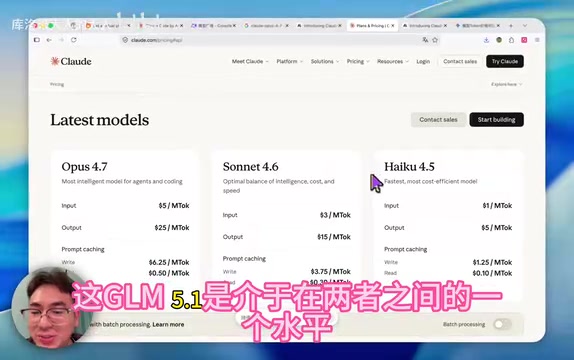
Looking at API pricing alone, Claude Opus 4.7 costs roughly twice as much as comparable GPT and Gemini models. But in real coding scenarios, price is only part of the cost equation—completion efficiency is the key variable.
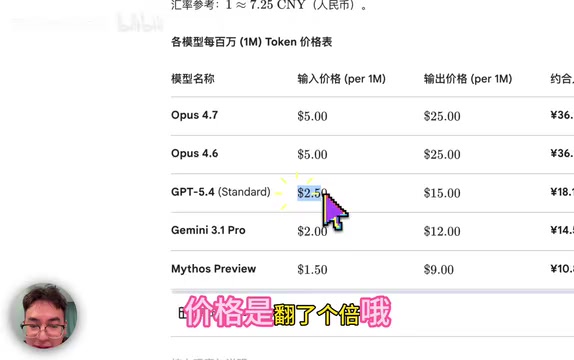
Understanding Token Pricing and Real Costs A token is the basic unit of text processing for large language models, roughly corresponding to 3/4 of an English word or 1-2 Chinese characters. "Per million tokens" pricing is the industry-standard billing unit. Notably, coding tasks typically consume far more input tokens than output tokens—full codebase context, error logs, and requirement descriptions all consume substantial input quota, while the generated code is relatively concise. Therefore, the input price ($5/million) has a greater impact on the actual bills of heavy coding users. Meanwhile, Claude's 200K context window allows loading entire large codebases in a single session, reducing the fragmented costs of multi-turn conversations—another technical reason for its superior cost-effectiveness in complex engineering projects.
Many developers report that coding tasks Opus can handle in a single conversation round often require two or more rounds with GPT or Gemini to achieve the same results. When you factor in the time costs of back-and-forth debugging and repeated iterations, Opus's overall cost-effectiveness is actually higher. For professional developers racing against project deadlines, the time saved is worth far more than the additional API fees.
Three Takeaways for Chinese LLM Developers
The release of Claude Opus 4.7 sounds several alarm bells for Chinese LLM companies.
The Window for Technical Catch-Up Is Shrinking
While Chinese models are still working hard to match previous-generation performance, Anthropic has already moved further ahead. If this cycle of "just catching up only to be left behind again" continues, the gap will only widen. For GLM, Kimi, and other Chinese models to genuinely close the distance, they need breakthrough advances in core technology—incremental iteration alone likely won't suffice.
The No-Price-Increase Strategy Squeezes Competitive Space
Anthropic's choice to deliver major performance gains without raising prices is essentially using technological advantage and economies of scale to squeeze competitors' survival space. Although Chinese models have always had a pricing advantage, when the performance gap widens beyond a certain threshold, the appeal of low-price strategies rapidly diminishes—after all, no one wants to settle for a noticeably inferior coding experience just to save money.
Coding Agents Are Becoming the Core Battlefield
From Opus 4.7's update focus, it's clear that coding Agent capability has become the most fiercely contested track in LLM competition. Whoever can achieve "one-shot completion" in code generation, bug debugging, and architecture design will win the long-term trust and willingness to pay from the developer community.
The Deeper Logic of Moats Anthropic's "moat" strategy manifests technically through Constitutional AI training methods—constraining model behavior through preset principles to maintain higher instruction-following accuracy and safety in complex Agent tasks, which is especially critical for enterprise coding scenarios. On the commercial side, developer toolchain ecosystem lock-in effects are significant: once teams deeply integrate their CI/CD pipelines, IDE plugins, and code review workflows with a specific model, migration costs accumulate rapidly over time. This also explains why the "no price increase" strategy is far more lethal than the surface numbers suggest—it accelerates the formation and solidification of developer ecosystems, and once an ecosystem takes shape, competitors will struggle to displace established user habits even if they match the performance.
Conclusion: The AI Coding Competition Is Far from Over
The release of Claude Opus 4.7 once again demonstrates that competition in LLM coding capabilities is still accelerating. Through continuous technical iteration and restrained pricing strategy, Anthropic is building an increasingly deep moat in the AI coding space.
For Chinese LLM companies, rather than pursuing a full-spectrum catch-up in general capabilities, it may be wiser to concentrate resources on finding breakthroughs in specific vertical scenarios, competing for a place through differentiated advantages. After all, in this marathon, finding your own rhythm matters more than blindly following the leader.
Key Takeaways
- Claude Opus 4.7 delivers 20% coding Agent performance improvement at unchanged pricing ($5 input / $25 output per million tokens)
- China's strongest model GLM 5.1 ranks between Claude Opus 4.5 and Sonnet 4.6 in coding ability, with the gap to Opus 4.7 widening further
- Although Opus pricing is twice that of GPT and Gemini, its single-round task completion efficiency makes it more cost-effective overall
- Chinese LLMs face dual challenges of a shrinking catch-up window and pricing strategy pressure
- Coding Agent capability is becoming the core battlefield of LLM competition
Related articles
Meta Muse Hits 900K Downloads in Six D…
Meta Muse Hits 900K Downloads in Six Days: The AI Agent Era Has Officially Arrived
Meta's AI agent Muse hit 902K downloads in 6 days, topping US App Store and Google Play charts above ChatGPT and Claude. A deep dive into Muse's capabilities and the AI Agent race.
 Industry Insights
IRS Fully Embraces Claude AI, Accelerating Federal Government's AI Adoption
The IRS is recruiting staff with 24/7 Claude AI access, marking Anthropic's breakthrough into the federal government. Explore the strategic implications and tax use cases.
 Industry Insights
The IRS Mobile App Debate: A Trust Crisis in Government Digital Transformation
The IRS's proposed mobile app has sparked heated debate. This article analyzes the core arguments, exploring data security, privacy, and the trust crisis in government digital transformation.