Claude Opus 5.5 and GPT-6 Twin Launch: A Full Breakdown of Flagship Model Price Cuts and Speed Gains

Anthropic and OpenAI both launch new models on the same day, shifting competition from capability ceiling to cost efficiency.
On the same day in 2025, Anthropic released Claude Opus 5.5 and OpenAI released GPT-6 Sol and GPT-6 Luna, with both leading players converging on the same strategy: trickling flagship capabilities down into faster, cheaper models. Opus 5.5 cuts typical task costs by 40% and boosts output speed by 30%; GPT-6 Sol and Luna slash API prices by 50% and push prompt caching savings up to 90%. Meanwhile, Tencent Hunyuan, StepFun, and Kimi pushed updates in image generation, coding agents, and browser agents; Pixverse unveiled an interactive world model; OpenAI proposed normalized third-party safety evaluations; and Alibaba revealed the Qwen 4 roadmap with a long-term goal of 5–10 trillion parameters.
AI large model competition saw two major updates land on the same day: Anthropic unveiled Claude Opus 5.5, while OpenAI released not one but two models — GPT-6 Sol and GPT-6 Luna. Both leading players converged on the same strategic priority: delivering stronger capabilities at lower cost. Meanwhile, domestic and international vendors pushed aggressively into image generation, coding agents, world models, and more, painting a remarkably complete picture of the industry landscape.
Claude Opus 5.5: Built for Agentic Coding and Long-Horizon Tasks
Anthropic says Claude Opus 5.5 reaches the performance bar of its previous flagship across most workloads, with core improvements concentrated in five areas: agentic coding, computer use, knowledge work, long-horizon tasks, and writing and communication. Companion models Sonnet 5.5 and Haiku 5.5 are also on the way in the coming weeks, completing the full model lineup.
Performance and cost are the headline story of this release. According to official figures, the new model delivers over 30% faster output speeds and roughly 40% lower costs for typical tasks, with API pricing landing around $4 per million tokens (input) to $20 per million tokens (output). This "faster and cheaper" combination directly addresses the inference cost concerns enterprises care most about when deploying at scale.
On the safety front, Opus 5.5 adds stricter cybersecurity, biosecurity, and prompt injection attack protections. The model is now live on the Claude platform and major cloud providers including AWS, Google Cloud, and Azure. Claude Pro, Max, and Team subscribers get a 5-hour usage quota boost, along with a one-time manual quota reset.
Agentic coding refers to AI models that go beyond single-step code generation to act as autonomous agents — continuously planning, executing, verifying, and correcting multiple subtasks until a complex engineering goal is achieved. Unlike traditional autocomplete-style coding assistants, agentic models must call tools (such as terminals, file systems, and browsers), handle error feedback, and maintain context consistency across many turns. This places significantly higher demands on reasoning depth, context window size, and instruction-following precision. Claude Opus 5.5's focus on this as a core improvement area aligns directly with the developer community's strong appetite for AI programmers that can autonomously complete end-to-end development tasks. Prompt injection attacks are the primary security threat in agentic scenarios: malicious content embedded in web pages, documents, or tool return values attempts to hijack the model's intended behavior — a threat Opus 5.5 has been specifically hardened against.
GPT-6 Sol and GPT-6 Luna: Flagship Capability at Lower Tiers
OpenAI's approach closely mirrors Anthropic's. The core idea behind GPT-6 Sol and GPT-6 Luna is to "trickle down" a portion of GPT-6's flagship capabilities into faster, cheaper models. Compared to the previous GPT-5.6, both models show improvements in professional tasks, factual accuracy, coding, and computer use.
Official benchmarks specifically highlight their competitive advantage as "stronger capabilities at a lower per-task cost" — a framing nearly identical to Claude Opus 5.5's value proposition. On pricing, the API is 50% cheaper than GPT-5.6's promotional rate, and the prompt caching mechanism has been upgraded to deliver savings of up to 90% on cached inputs.
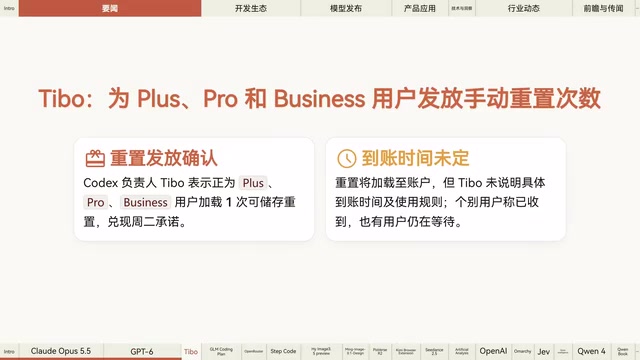
GPT-6 Sol and GPT-6 Luna are now available in Work, Codex, and API environments, though the standard Chat interface has not yet been opened. Codex lead Teebo announced that manual reset credits will be issued to Plus, Pro, and Business subscribers to honor prior commitments, with the reset quota loaded directly into user accounts.
Two major players launching new products on the same day with nearly identical strategies sends a clear signal: large model competition is shifting from "who has the highest capability ceiling" to "who delivers the best capability-per-dollar." Whoever makes high-quality inference cheaper is better positioned to win at scale.
Prompt caching is a technique for accelerating inference and reducing costs: when a request contains a prefix identical to a prior request (such as a long system prompt or large document), the server reuses the previously computed key-value cache (KV Cache), skipping redundant computation on that portion and dramatically lowering input costs. OpenAI claims the upgraded caching can save up to 90% on cached inputs, meaning that in long-context or high-frequency repeated-call scenarios (such as codebase Q&A or customer service knowledge bases), actual costs can be compressed to one-tenth of the standard price. This mechanism is especially valuable for developers using coding agents like Codex to work with large codebases, where system prompts and code context typically account for the vast majority of token consumption.
Domestic Vendors Move Fast: From Image Generation to Coding Agents
Domestic vendors have been equally active. Zhipu launched a GLM Coding Plan "Double Holiday Special" promotion running September 25 through October 7, during which all-day usage is billed at off-peak rates. The GLM 4.6 series nighttime free-access program continues in rolling fashion, offering two weeks of access to approved applicants.
Image generation saw particularly intense activity. Tencent Hunyuan released its professional-grade image model Hunyuan Image 3.5 Preview, supporting text-to-image, image-to-image, and multi-turn editing with output up to 2K resolution. Overall capability has improved roughly 30% over the previous generation, with particular gains in text rendering and editing consistency. The model is now live in apps including Yuanbao and ima. StepFun open-sourced its terminal coding agent Step Code V 0.10 under the MIT license, with support for macOS, Linux, and WSL. It enables a complete code-writing and debugging loop within the terminal, along with long-task hosting and scheduled execution capabilities.
Kimi released a Browser Extension now available on its official website and the Chrome Web Store. Users can hold conversations in a browser sidebar, record repetitive steps as saved Skills for later reuse, and run the extension alongside a local Agent — this category of browser-level agents is emerging as a new entry point for everyday productivity.
World Models and Safety Evaluation Take the Spotlight
Pixverse unveiled its real-time world model R2, allowing users to explore, control, and edit dynamic worlds through prompts, drive story progression, and interact with characters that can remember and respond. This kind of "interactive world" exploration represents the direction generative AI is heading — from static content toward dynamic, controllable experiences.

On AI governance, OpenAI outlined the priorities and principles for third-party safety evaluations, committing to give independent organizations deep access to the full pipeline from model training through deployment — to verify safety claims, validate key safeguards, and identify gaps in defenses. These evaluations are designed for ongoing engagement with both private and non-profit institutions, and are not tied to individual product releases. This kind of normalized, independent evaluation mechanism marks an important step toward moving AI safety from self-reporting to external oversight.
World models in AI refer to models capable of simulating environment states internally and predicting the consequences of actions — a key component for achieving truly autonomous agents. Unlike generative models that simply produce static images or video, world models must maintain consistent representations of physical laws, character states, and temporal logic, enabling the system to respond to user intervention and produce coherent dynamic feedback. Pixverse R2's "interactive worlds" — where users control scene evolution through prompts and interact with stateful characters — represent an early fusion of generative and world modeling capabilities, pointing the way from "content production tool" to "sustained interactive environment."
Alibaba Reveals Qwen 4 Roadmap
At the Yunqi Conference, Alibaba disclosed the roadmap for Qwen 4, a series now in training on a next-generation architecture. The lineup includes Qwen4, Max, Flash, Plus, and 27B variants, all labeled "coming soon" with no confirmed release or availability dates. Looking further out, Qwen4.5 and Qwen5 are planned to scale parameters into the 5 to 10 trillion range.
Alibaba Cloud's Wuying team also demonstrated a live prototype of the Qwen Book at the conference, positioning it as a "natively agentic computer." The official website is currently recruiting 100 early experience users, with the full product expected to launch in late 2026 or early 2027. Alibaba Cloud also pledged $3 million over three years as a founding corporate sponsor of a relevant open-source foundation.

The density of updates on this single day makes clear that competition in the large model industry is advancing on multiple fronts simultaneously: flagship models compete on cost and speed, open-source ecosystems compete on usability, agents and world models compete on interactive experience, and safety evaluation is becoming a standard expectation for leading players. For developers and enterprise users, this means a lower barrier to entry and a richer toolkit.
The 5 to 10 trillion parameter scale referenced in the roadmap deserves attention. Current mainstream flagship models (at the GPT-4 level) typically run in the hundreds of billions of parameters, and training trillion-scale models requires enormous compute clusters and corresponding distributed training infrastructure. From an engineering standpoint, the Mixture of Experts (MoE) architecture is the dominant path for breaking through the scaling bottlenecks of dense models — total parameter counts are massive, but each inference pass only activates a small subset of "expert" sub-networks, keeping inference costs manageable while maintaining high capacity. Alibaba Cloud has already incorporated MoE designs into the Qwen series; if Qwen4.5 and Qwen5 are to hit the 5–10T parameter target, they will almost certainly follow this technical path — while simultaneously placing very high demands on the supply chain stability of China's domestically developed AI chips.
Related articles

OpenAI Partners with Shield: How the Astra Agent Revolutionizes IT Troubleshooting
OpenAI and Shield launch the Astra agent, which autonomously logs into computers and legacy systems to fix IT issues in real time, 35-40% faster than traditional models, with humans involved only when judgment is needed.

iPhone Duo Battery Life Tested: One Charge a Day Is Unavoidable, and the Large Screen Is the Culprit
iPhone Duo battery test: heavy use needs at least one charge a day, and about 30% remains after 6.5 hours of screen-on time. How often the large screen is unfolded is key; a MagSafe battery pack helps, and long-term degradation is also worth watching.

Kimi K3.1 Pro Open-Sourced: 2.8 Trillion Parameters Close In on Opus
Moonshot releases the open-source MoE model Kimi K3.1 Pro, with 2.8T total parameters and 104B activated, trailing Opus 5.5 by under 1 point on Terminal Bench 4.0.