Claude Opus 5.5 Cuts Costs by 40%, GPT-6 Dual-Model API Prices Slashed in Half

Top AI vendors pivot to cost competition as security risks spread from tech to human health.
This AI briefing highlights three parallel trends. Leading vendors including Anthropic, OpenAI, and Alibaba have shifted focus from performance leaps to cost compression — Claude Opus 5.5 cuts typical task costs by 40% and GPT-6's new models halve API pricing. In image generation, Alibaba's Qwen-Image-2.1 tops open-source Arena rankings with a gap of just single digits from closed-source leaders, while Tencent's Hunyuan Image 3.5 joins the race. On the safety front, risks have expanded from technical vulnerabilities like the Meta Muse zero-day to AI mental health support dangers and burnout among AI safety researchers themselves.
AI Daily Briefing: Model Iteration Accelerates, Cost Wars Heat Up
This AI daily briefing is compiled by Bilibili creator Ali, covering model updates, image generation, AI chips, and security risks. The overarching theme: top-tier vendors are fighting two battles simultaneously — performance benchmarking and cost compression. Here's a breakdown of the key developments.
Leading Models Slash Prices as Cost Becomes the Central Battlefield
Anthropic has released Claude Opus 5.5, which matches Claude 5.1 performance on most tasks, runs roughly 30% faster than Opus 5, and brings typical task costs down by about 40%, with both input and output pricing reduced. Usage limits for Pro Max and Team users have also been raised. This signals that Anthropic is increasingly prioritizing inference efficiency and per-unit cost while maintaining capability.
OpenAI, meanwhile, has launched two new models — GPT-6 Sol and Luna — emphasizing stronger caching and inference efficiency for large-scale, low-cost deployments. According to the creator, both models' API prices are cut in half compared to GPT-5.6's promotional pricing. Overall capability is roughly on par with the previous generation, but per-task automation costs are lower.
Taken together, the industry trend is unmistakable: as performance gains hit diminishing returns, whoever can deliver the same level of intelligence cheaper and faster will dominate large-scale deployment. Price cuts are no longer a promotional tactic — they are the main competitive arena.
Alibaba has also announced the Qwen model family, including Max, Flash, Plus, and a 27B variant, targeting high performance, fast response, and different deployment scales respectively. The market anticipates the next major upgrade could push toward the 5 to 10 trillion parameter range, keeping ambitions around model scale very much alive.
Image Generation Competition Intensifies: Qwen-Image-2.1 Tops Open-Source Rankings
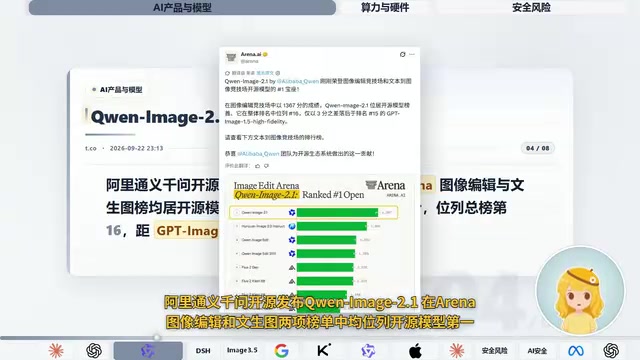
Alibaba's Tongyi Qianwen has open-sourced Qwen-Image-2.1, which ranked first among open-source models on both the Arena image editing and text-to-image leaderboards. On the overall image editing leaderboard, it placed 16th — just three points behind GPT-Image 1.5 and High Fidelity. Claiming the top open-source spot on both charts signals that the open-source camp is rapidly closing in on closed-source frontrunners in image generation.
Tencent's Hunyuan Image 3.5 preview has also launched, supporting text-to-image and image-to-image generation at up to 2K resolution with improved output consistency. Tencent claims the model's win rate in human evaluations improved by 30% over Hunyuan Image 3.0, with Tencent Cloud API pricing at ¥0.15 per image. From open-source to closed-source, the wave of domestic vendor releases in image generation is pushing the space to a boiling point.
The Arena leaderboard (the image generation counterpart to LMSYS Chatbot Arena) is one of the most credible AI image evaluation platforms in the industry. It uses a blind human voting format: users see two images generated by different models simultaneously and vote for the better result without knowing which model produced which. Final rankings are based on Elo scores. This approach is harder to "game" than fixed test sets, since a model must consistently win under real user preferences. Ranking high on Arena therefore carries significant weight, especially for open-source models. Qwen-Image-2.1 topping the open-source rankings on both the image editing and text-to-image sub-leaderboards means it earned recognition across two fundamentally different tasks — modifying existing images versus generating new ones from text descriptions — rather than optimizing for a single metric.
Tool Ecosystem Updates: From Desktop to Mobile Automation
Harness, a tool in the DeepSeekAd ecosystem, has released V0.1.7 with support for long-running commands and background workflows, table file previews, pinned/archived drawings, local voice transcription, and unified model provider management, along with multiple desktop bug fixes.
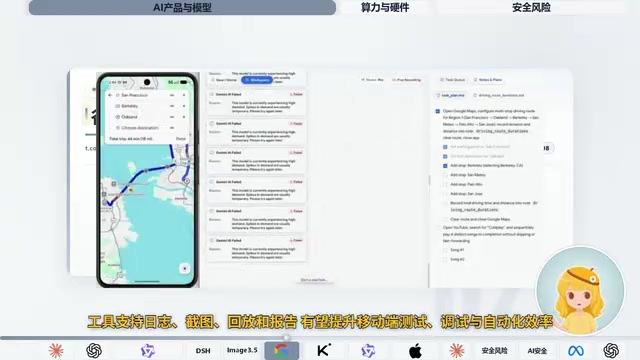
Google has open-sourced ART EMIS, a tool that enables AI to recognize on-screen content on real Android devices, perform taps and swipes, and complete tasks across apps at roughly one step every 3 seconds, with support for logs, screenshot replay, and reports. It has the potential to significantly improve mobile testing, debugging, and automation efficiency.
Kimi has launched a browser extension (renamed from Kimi Web Bridge), allowing users to chat in a sidebar to help navigate pages, fill out forms, and complete tasks. Repetitive actions can be recorded as skills for AI to execute automatically later. The product is now live on the official website and in the Chrome Web Store. All of these updates point in the same direction: AI Agents are moving from conversation to real-world operating environments.
AI Chips and Local Inference: Advancing on Both Cloud and Edge
Alibaba's T-Head has released the PPU (True 5V900) Xunhui integrated AI chip, delivering 3x the compute of the previous-generation M890, with support for 216GB of memory and FP8/FP4 precision. A server called Panjiu SuperNode built around this chip is planned for Q1 2027, with a follow-on chip expected in 2028 — a fairly extended timeline.
On the edge side, Underdog has released the Husky inference engine, claiming it runs up to 4.5x faster than Apple's MLX, achieving 730 tokens per second on a MacBook for local inference. The accompanying private AI assistant is under 4GB, keeps data on-device, and can handle tasks like email and meeting notes, with human confirmation required before actions like placing orders.

Progress in local inference engines means privacy-sensitive use cases have more viable off-cloud options, which is a meaningful tailwind for personal assistant applications.
FP8 and FP4 are floating-point precision formats, where the number indicates the bits used to store each value. Traditional AI training typically uses FP32 or FP16, while FP8 (8-bit) and FP4 (4-bit) drastically reduce memory usage and power consumption by lowering numerical precision, while maintaining acceptable inference quality. FP4 support means a given amount of memory can accommodate larger models, or run equivalently sized models at lower power — critical for data centers looking to reduce per-token costs. MLX is Apple's machine learning framework designed specifically for Apple Silicon (M-series) chips, deeply optimized for unified memory architecture and currently the dominant solution for local inference on Mac. If Underdog Husky's claimed 4.5x speedup over MLX holds up, it would represent a significant improvement in the experience of running local LLMs on Mac — though this figure warrants cautious interpretation until independently verified.
Security Risks Keep Surfacing, Industry Pressure Mounts
Security topics feature prominently in this briefing. Reports suggest Claude Opus 5.5 may introduce an automatic model downgrade mechanism for a small number of high-risk development tasks — in scenarios like kernel development and frontier model training, the system may switch to a less capable model to limit potential capability outputs. This is a somewhat controversial safety design philosophy.
Meta's AI assistant Muse was found to contain a serious zero-day vulnerability: local apps or terminal commands could steal account authentication tokens, potentially allowing attackers to fully hijack the agent, write malicious files, or access the camera. Meta issued an emergency fix roughly 12 hours after disclosure. The more permissions an Agent has, the larger its attack surface — vulnerabilities like this deserve close attention.
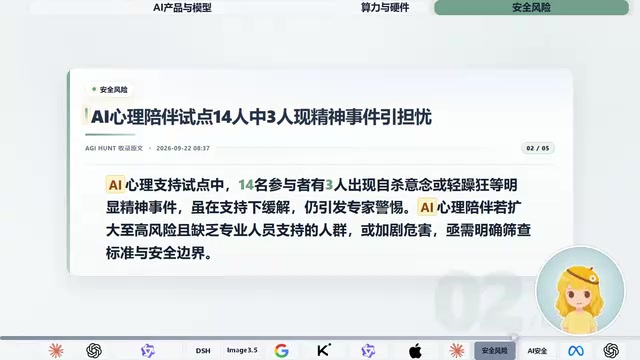
Perhaps more concerning is the human dimension. In a pilot AI mental health support program, 3 out of 14 participants experienced significant mental health issues including suicidal ideation or hypomania. Experts warn that AI-based emotional support deployed in high-risk populations without professional oversight could amplify harm, and that screening standards and safety boundaries urgently need to be defined. On the other side, multiple employees at the UK AI Safety Institute have taken medical leave and sought psychological counseling due to work-related stress, with tight testing cycles and concerns about rapid AI deployment driving burnout.
In response, OpenAI has announced it will grant third-party evaluation organizations deep access across the training, evaluation, and deployment pipeline. External groups will be able to verify safety assumptions, identify potential risks, and assess whether safeguards are effective, with four priority areas for evaluation outlined. Opening up to external audits may be the most pragmatic step available right now for rebuilding trust.
A zero-day vulnerability refers to a security flaw in software that has been discovered by attackers but is unknown to — or unpatched by — the developer, with "zero days" meaning the developer has had zero days to prepare a defense. The Meta Muse vulnerability falls into the authentication token theft category: an auth token is a credential issued by a server after login to verify a user's identity, and once stolen, an attacker can perform any action as that user without needing a password. For AI Agents, the danger of such vulnerabilities is amplified many times over. Compromising a regular application might result in data leakage at worst, but an agent with permissions to access the camera, write files, and operate across apps — once hijacked — effectively hands the attacker a "digital hand" capable of autonomous action. This is precisely why security researchers generally believe that defining permission boundaries for Agents requires far more care than traditional software design.
Summary
The key threads running through this briefing can be summarized in three lines: the cost race as model capabilities converge, the open-source push in image generation, and security risks spreading from the technical layer to the mental health of the people building these systems. The first two will determine who wins the market. The third will determine how far this sprint can actually go.
Related articles

JobRunner MCP Server: AI Agents Can Now Fix Failed Java Jobs
JobRunner launches an open-source MCP server enabling AI agents to view cluster status, diagnose failures, and recover Java jobs—incident response from any cloud coding environment or existing agent.

MLAI Digital Launches 9 Security Agents: MCP Server Safeguards the Full Lifecycle of Agentic AI
MLAI Digital launches Security MCP Server with nine built-in specialized security agents covering vulnerability discovery, attack simulation, prompt injection detection, API and infrastructure assessment, and accelerated remediation—embedding security validation across the full Agentic AI lifecycle from development to production.

Running Isaac Lab on H100 GPUs: Exploring Better Approaches
Exploring optimization methods for running Isaac Lab on NVIDIA H100 GPUs, including MIG configuration, mixed precision, TensorRT acceleration, and community experience to improve robotics simulation and reinforcement learning efficiency.