Claude Opus 5.5 vs GPT-6: How Much Can You Actually Get Done for the Same Budget?

Anthropic and OpenAI both go tiered — the real competition is now cost-per-completed-task, not raw model power.
Anthropic's Claude Opus 5.5 and OpenAI's three-tier lineup (Astra, Sol, Luna) both cut API prices, but the deeper shift is how tiered pricing is reframing the LLM value question. Third-party benchmark Automation Bench shows Opus 5.5 at 40% task success for ~$1.28/attempt versus Sol's 33.2% at ~$0.27 — which is better depends entirely on failure cost and retry tolerance. The article warns readers to distinguish vendor-reported savings from actual billing changes, and notes that Sol and Luna show regression on some knowledge-work metrics.
If you're paying the same monthly subscription fee, why do platforms still separate flagship, balanced, and lightweight models? The answer is straightforward: the most expensive model shouldn't handle every task. The real comparison isn't which single model is more powerful — it's how much quality work you can get done with the same amount of money.
Recently, Anthropic released Claude Opus 5.5, while OpenAI simultaneously launched its flagship Astra, balanced Sol, and lightweight Luna. On the surface, both companies are cutting prices. Look deeper, and you'll see they're routing tasks of different difficulty to models of different cost. This tiered strategy is reshaping how we measure the value of large language models.
Anthropic's Price Cuts and Tiered Lineup
Claude Opus 5.5 remains positioned as a high-capability model. Its standard API pricing has dropped significantly: per-million-token input and output costs fell from Opus 5's $5 and $25 to $4 and $20 respectively, while cache reads dropped from $0.50 to $0.20.
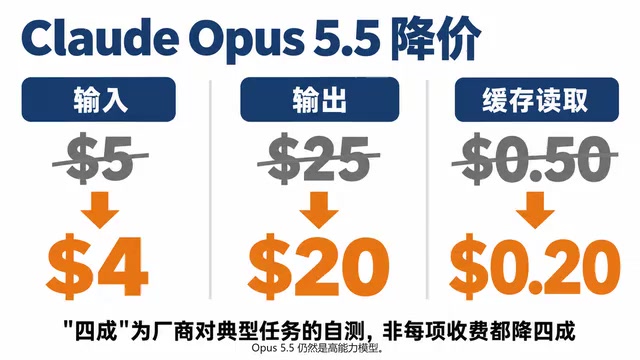
Anthropic states that under default settings, the cost of completing typical tasks has dropped by roughly 40%. One important caveat: this "40%" is the vendor's estimate for typical tasks — it doesn't mean every price line dropped by 40%. Vendor-reported cost reductions and the actual change in your bill are often two very different things.
Beyond pricing, Anthropic has also increased the 5-hour usage quotas for some subscription plans. The lighter Sonnet 5.5 and Haiku 5.5 are expected to roll out over the coming weeks, completing the full product lineup from flagship to lightweight.
What is a Token? A token is the basic unit large language models use to measure text — think of it as a "word fragment." In English, one token is roughly 0.75 words; in Chinese, one character typically maps to 1–2 tokens. API billing separates input tokens (the content you send, including prompts and context) from output tokens (the model's generated response), with output usually priced higher. Prompt Caching is an optimization: when the same long context (like a system prompt or document background) is used repeatedly, the platform can store it temporarily so subsequent requests pay a lower cache-read rate instead of recomputing the full input. Opus 5.5 drops cache reads from $0.50 to $0.20 per million tokens — for enterprise users who repeatedly reference the same background material, this saving can sometimes exceed the reduction in standard input pricing.
OpenAI's Three-Tier Product Line
OpenAI's approach follows the same logic: tiered offerings. Flagship Astra handles the hardest tasks, Sol balances capability with cost, and Luna absorbs high volumes of lightweight work.
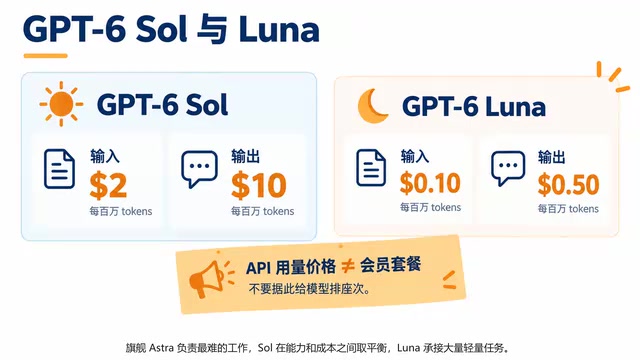
One easily overlooked point: Sol isn't just a "tidy-up model" for light work — it can handle complex tasks too, just with a different capability-to-cost trade-off. On API pricing, Sol's standard context runs $2 per million input tokens and $10 per million output tokens; Luna is $0.10 and $0.50 respectively. The price gap is large, but these are pay-as-you-go API rates and can't be directly translated into the actual experience of a monthly subscriber.
For subscription users, what really matters is quota: how many uses does your membership actually cover? Even the highest-tier plans have limits on flagship model usage. If a platform can route routine organizing, sorting, and rewriting to cheaper tiers — reserving expensive inference for complex projects — the same monthly fee can support significantly more work.
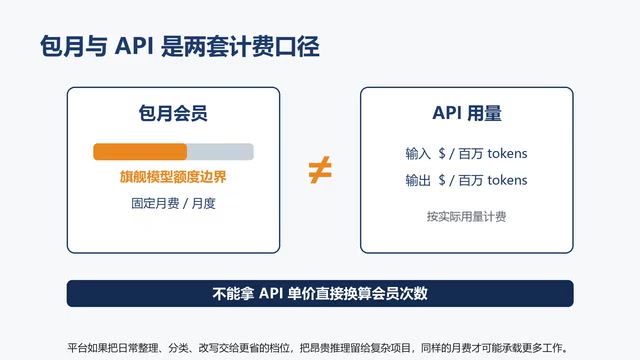
Officially, some quota increases have been announced, but how much individuals will actually feel this depends on the product, plan, and task type. The new Sol and Luna models have entered ChatGPT's work environment and Codex first — they're not yet available in standard Chat conversations.
A Cheaper API Call Doesn't Mean a Cheaper End Result
The easiest thing to misread in this comparison is "per-call pricing." A cheaper call doesn't mean the whole job is cheaper. If a model misses a requirement and you have to retry, verify, and manually fix the output — those are hidden costs.
Third-party benchmark Automation Bench offers a concrete example: Opus 5.5 at its highest-tier setting achieves a task success rate of 40%, with an average model cost of about $1.28 per attempt. GPT-6 Sol at high-reasoning settings hits 33.2% success, at roughly $0.27 per attempt.
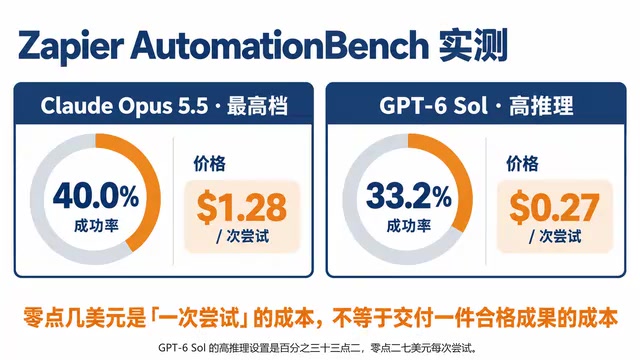
The critical detail: these figures measure the cost per attempt, not the final price of one completed, acceptable deliverable. The reasoning settings used for each model also differ, so this data can't be used to declare an overall winner. It's better understood as a thinking framework than a definitive conclusion.
The right choice depends on the nature of the task:
- If one failure means hours of rework, success rate matters more — Opus 5.5's 40% may be the better value.
- If the task is low-stakes and batch-retryable, unit cost matters more — Sol's $0.27 advantage becomes compelling.
Independent evaluations also flagged a trend worth watching: while Sol and Luna are more economical, they show regression on some knowledge-work metrics. The tension between saving money and maintaining capability never fully disappears.
What is Automation Bench? Automation Bench is a third-party benchmarking framework focused on evaluating large language model performance in automated workflow scenarios. Unlike traditional tests measuring Q&A accuracy or code pass rates, it simulates real multi-step tasks — such as extracting information from unstructured documents or executing cross-tool operation sequences — and judges success by whether the task was fully completed, not whether intermediate steps were correct. This makes it especially sensitive to "failure cost": a model that gets the first nine steps right but fails on step ten scores the same as one that failed completely. As a result, Automation Bench success rates tend to be lower than vendor-reported benchmark scores, and more reflective of real-world automated task performance. Understanding this helps correctly interpret 40% vs. 33.2% — those numbers represent the probability of completing an entire task, not single-step accuracy.
The Right Standard for Evaluating This Competition
Choosing a model can't come down to price alone. You need to weigh task difficulty, the cost of failure, and final quality of output.
A more practical evaluation framework uses two lenses:
The first measures how hard a problem the flagship model can solve — the capability ceiling. The second measures the entire product line: how many quality deliverables does a given monthly or API budget actually produce — the overall value proposition.
If a platform can handle everything from "quick organizational tasks" all the way to "complex projects," it may generate stronger user retention and capture more market share. This is a business-level inference, not a result either company has publicly reported — readers should keep that distinction in mind.
Ultimately, whether it's Opus 5.5 or GPT-6's Sol and Luna, the bottom line is always the same question: with the same budget, how much actually gets done? Price cuts and tiered lineups are just the mechanism. What determines real-world value is whether the right tasks end up with the right-cost models.
Related articles

Workbuddy for Absolute Beginners: How a Desktop AI Agent Fits Into Real Workflows
A beginner's guide to the Workbuddy desktop AI agent: installation, claiming credits, file management, and building automated workflows—compared with CodeX for fit and cost, helping professionals shift from AI question-askers to AI managers.

OpenAI's New Agent Stack: Computer Use, Decisions API, and Ultra-Fast Workflows
OpenAI Dev Day unveiled a new agent stack: Computer Use outperforms humans, Decisions API delivers ultra-low-latency classification via Luna, Agents API opens the same Computer Use capabilities, and GPT-6.1 Sol costs only one-seventh of Astra. Core updates, benchmark data, and developer insights.

Liang Wenfeng Open-Sources DeepInfo Inference Framework, Takes On U.S. Ban
DeepSeek open-sources its DeepInfo inference framework after its models, featuring GPU/CPU cross-pipelining, small-model prediction with large-model verification, and full Huawei Ascend and NVIDIA chip support—facing the U.S. federal ban head-on. This article analyzes its significance for AI deployment and open-source strategy.