Claude Opus 5 Arrives on Devin: Fable-Level Performance at Half the Cost

Devin integrates Claude Opus 5, delivering Fable-level coding performance at half the cost.
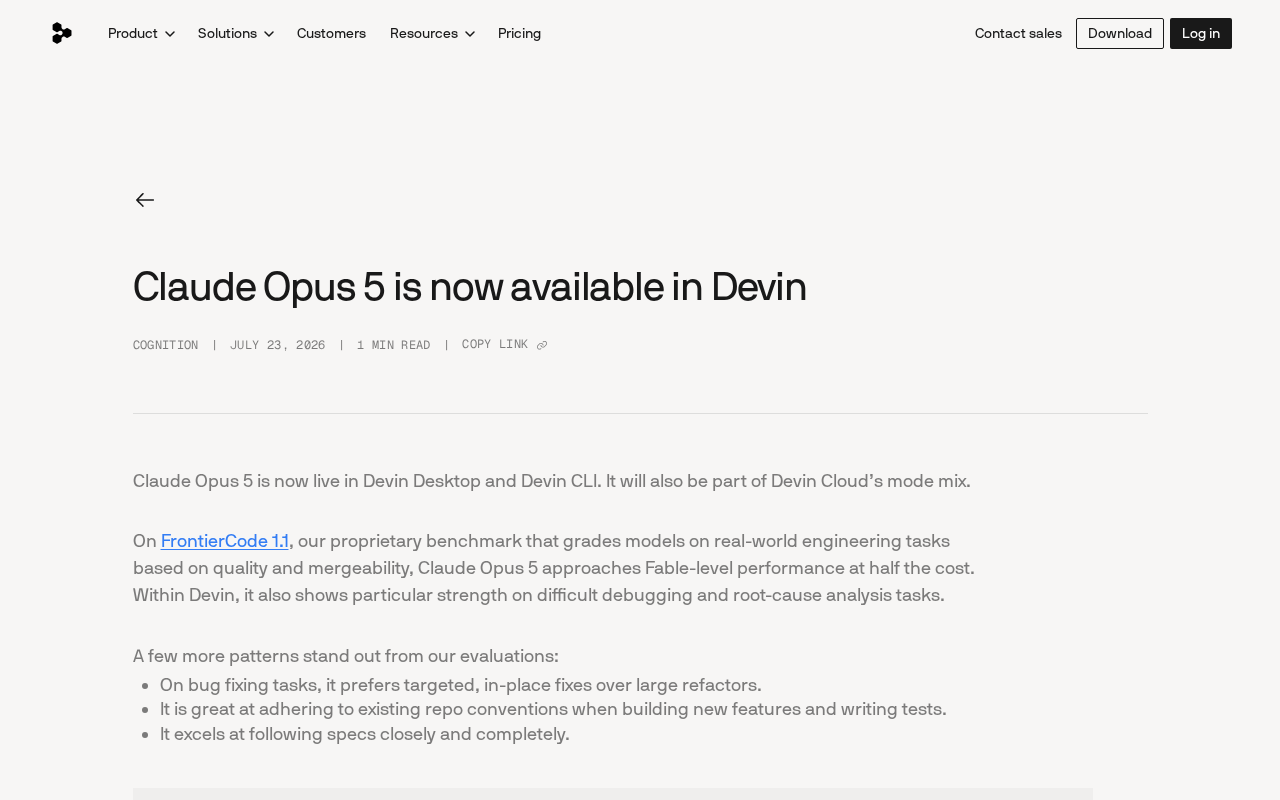
AI programming assistant Devin has officially integrated Anthropic's Claude Opus 5 model across its Desktop, CLI, and Cloud platforms. On the FrontierCode 1.1 benchmark, Opus 5 approaches Fable-level performance at half the cost, with particular strengths in difficult debugging and root-cause analysis—critical capabilities for autonomous AI software engineering agents.
Devin Integrates Claude Opus 5
AI programming assistant Devin has officially announced the integration of Anthropic's latest Claude Opus 5 model. The model is now live in Devin Desktop and Devin CLI, and will also be incorporated into Devin Cloud's mode mix, becoming a key component of its automated programming capabilities.
Devin is an AI software engineer product developed by Cognition, which first debuted in early 2024 and garnered widespread industry attention. Unlike traditional code completion tools (such as GitHub Copilot), Devin positions itself as an AI Agent capable of autonomously completing end-to-end software development tasks, including reading requirement documents, planning implementation approaches, writing code, debugging and fixing issues, and deploying to production—the entire workflow. Its three usage forms—Desktop (desktop application), CLI (command-line tool), and Cloud (cloud automation service)—cater respectively to individual developers' interactive use, engineers' workflow integration, and team-level automated task execution.
Claude Opus 5 is Anthropic's flagship large language model released in 2025, representing the highest capability tier in the Claude series. In Anthropic's model naming system, Opus represents peak performance, Sonnet represents the balance between performance and cost, and Haiku represents lightweight speed. As the fifth-generation flagship model, Opus 5 delivers significant improvements over its predecessors in reasoning depth, long-context understanding, and complex task execution, particularly excelling in programming tasks that require multi-step reasoning.
The mode mix in Devin Cloud is an intelligent routing mechanism that dynamically selects the most appropriate model based on the complexity and nature of different tasks. For example, simple code formatting might use a lightweight model to save costs, while complex architectural design or deep debugging would invoke a flagship model like Opus 5. This mechanism ensures that every model call strikes the optimal balance between cost and performance.
For teams that rely on Devin for daily development work, this model upgrade means stronger autonomous coding capabilities and better cost-effectiveness. As a product positioned as an "AI software engineer," Devin's underlying model iterations directly determine the quality and efficiency of task completion.
FrontierCode 1.1 Benchmark Performance
According to officially disclosed data, Claude Opus 5 delivers outstanding performance on the FrontierCode 1.1 programming capability benchmark. Its performance approaches "Fable-level performance" while costing only half as much.
FrontierCode is an evaluation benchmark specifically designed to assess AI models' programming capabilities, focusing on measuring model performance in real engineering tasks rather than simple algorithm problems or code completion. Version 1.1 introduces more complex multi-file project operations, cross-language code understanding, and debugging tasks requiring deep reasoning compared to earlier versions. Compared to other programming benchmarks like HumanEval and SWE-bench, FrontierCode places greater emphasis on a model's ability to function as an autonomous Agent completing full development tasks, including understanding codebases, locating issues, planning fixes, and implementing them.
The "Fable-level" mentioned refers to the performance level achieved by the previously best-performing model or system on the FrontierCode benchmark. Opus 5's ability to approach this level at half the cost means that in actual deployments, teams can execute nearly twice the AI programming tasks on the same budget, or cut costs by approximately 50% for the same workload.
The Key Cost-Efficiency Breakthrough
"Near-equivalent performance at half the cost" is the most noteworthy signal from this upgrade. In LLM-driven automated programming scenarios, token consumption and API call costs are often the core constraints for scaling deployments. A typical Agent task may require tens or even hundreds of thousands of tokens in context window and multiple rounds of reasoning interaction, with the cost of a single task potentially reaching several dollars on flagship models. If Opus 5 can deliver near-top-tier performance at a lower price, it will significantly lower the overall barrier to entry for Agent tasks that require long-running, multi-iteration processes.
This "reduce cost without reducing quality" model evolution path also reflects an important trend in current LLM competition: vendors are no longer purely pursuing benchmark leadership, but instead emphasizing the input-output ratio in real engineering scenarios. This closely parallels the early cloud computing industry's evolution from pursuing single-machine performance to emphasizing TCO (Total Cost of Ownership) optimization.
Unique Advantages in Debugging and Root-Cause Analysis
The official announcement specifically highlighted that Claude Opus 5 performs exceptionally well in "difficult debugging" and "root-cause analysis" tasks.
Why Debugging and Root-Cause Analysis Capabilities Matter So Much
In real software development workflows, writing new code often accounts for only a small portion of the workload, while locating and fixing complex bugs is the most time-consuming and skill-demanding aspect. Commonly cited industry experience data suggests that developers may spend over 50% of their time debugging and maintaining existing code. Traditional AI programming tools have become quite mature at generating boilerplate code, but they often struggle with deep logical errors, cross-module dependency issues, or hard-to-reproduce runtime exceptions.
The concept of Root-Cause Analysis originated in manufacturing quality management and was later widely adopted in software engineering. In software debugging scenarios, root-cause analysis refers to starting from surface symptoms (such as program crashes, incorrect output, or performance degradation) and tracing back layer by layer to the fundamental cause of the problem. This typically requires understanding complete call chains, analyzing data flow processes, checking concurrent race conditions, and ruling out environmental interference. Traditional static analysis tools and debuggers can provide some clues, but the final causal inference still heavily relies on developer experience and intuition. An AI model's breakthrough in this task means it can simulate this deep reasoning process, identifying complete causal relationship chains from large amounts of code and log information.
Opus 5's strengthening in debugging and root-cause analysis means it can better understand code execution logic and trace problems back to their source, rather than merely offering superficial fix suggestions. For Agent products like Devin that need to complete tasks end-to-end, this is a key factor in improving reliability—an AI engineer that can only write code but cannot effectively debug is like a construction worker who can lay bricks but cannot troubleshoot water leaks, unable to truly deliver independently.
Significance for the AI Programming Ecosystem
This integration exemplifies the typical pattern of co-evolution between the model layer and the application layer. Anthropic is responsible for continuously improving the underlying capabilities of the Claude series, while Devin packages these capabilities into directly usable engineering products covering desktop, command-line, and cloud usage scenarios. This division of labor is similar to the relationship between chip manufacturers and device makers—every improvement in underlying compute translates into improved end-user product experiences.
For developers, this combination means they can automatically benefit from underlying model upgrades without changing their workflows. As models strengthen their capabilities in "tough nut" tasks like debugging and analysis, AI programming assistants are progressively moving from "assisted generation" toward the higher stage of "autonomous problem-solving." This evolution path can be roughly divided into three levels: the first level is code completion and generation (already achieved by most current tools); the second level is understanding context and executing multi-step tasks (being explored by Agent products like Devin); the third level is fully autonomous software engineering capabilities, including architectural decisions, performance optimization, and quality assurance (still in frontier research stages).
However, it's important to view the official benchmark data rationally. The specific evaluation details of FrontierCode 1.1 and Fable-level have not been fully disclosed, and real-world performance still needs further validation across diverse real projects. There is often a gap between benchmark tests and actual engineering scenarios—tasks in evaluation environments typically have clearly defined inputs and outputs, while real development also involves handling ambiguous requirements, legacy code, incomplete documentation, and many other complex factors. Nevertheless, the dual benefits of performance improvement and cost reduction provide a more solid foundation for the scaled deployment of AI programming tools.
Key Takeaways
Related articles

Leadline V3: A Social Selling Tool That Mines High-Intent B2B Buyers from Reddit
Leadline V3 monitors Reddit posts for buyer intent signals to help B2B teams capture high-intent prospects. Learn about its keyword tracking, intent scoring, unified inbox, and AI reply features.

Talvo: Deep Dive into the GDPR-Compliant Budgeting App Connected to 2,500+ European Banks
Deep analysis of European budgeting app Talvo: connecting 2,500+ banks via PSD2, with auto-categorization, budget management, and GDPR-native EU data hosting for privacy-focused users.

Perplexity Privacy Policy Update Explained: Three Data Collection Sources and User Protection Guide
Perplexity AI updates its privacy policy with expanded data collection. This guide details its three data sources — user-provided, automated, and third-party — plus practical privacy tips.