Talvo: Deep Dive into the GDPR-Compliant Budgeting App Connected to 2,500+ European Banks

Talvo leverages PSD2 and GDPR-native hosting to deliver privacy-first budgeting for European users across 2,500+ banks.
Talvo is a European budgeting app connecting 2,500+ banks via PSD2 open banking APIs, offering automatic transaction categorization, budget tracking, and net worth monitoring. Its key differentiator is EU-hosted, GDPR-native data sovereignty, addressing European users' privacy concerns amid transatlantic data transfer conflicts. The app faces challenges including fragmented bank API standards, 90-day SCA re-authentication friction, and monetization constraints under strict privacy regulations.
A Native Budgeting Tool Built for the European Market
The personal financial management (PFM) space has never lacked products in Western markets. However, as the EU's General Data Protection Regulation (GDPR) and Payment Services Directive 2 (PSD2) continue to take deeper root, a budgeting app purpose-built for European users—one that emphasizes data sovereignty and compliance—is becoming increasingly important. Talvo, which recently launched on Product Hunt, is exactly that kind of product.
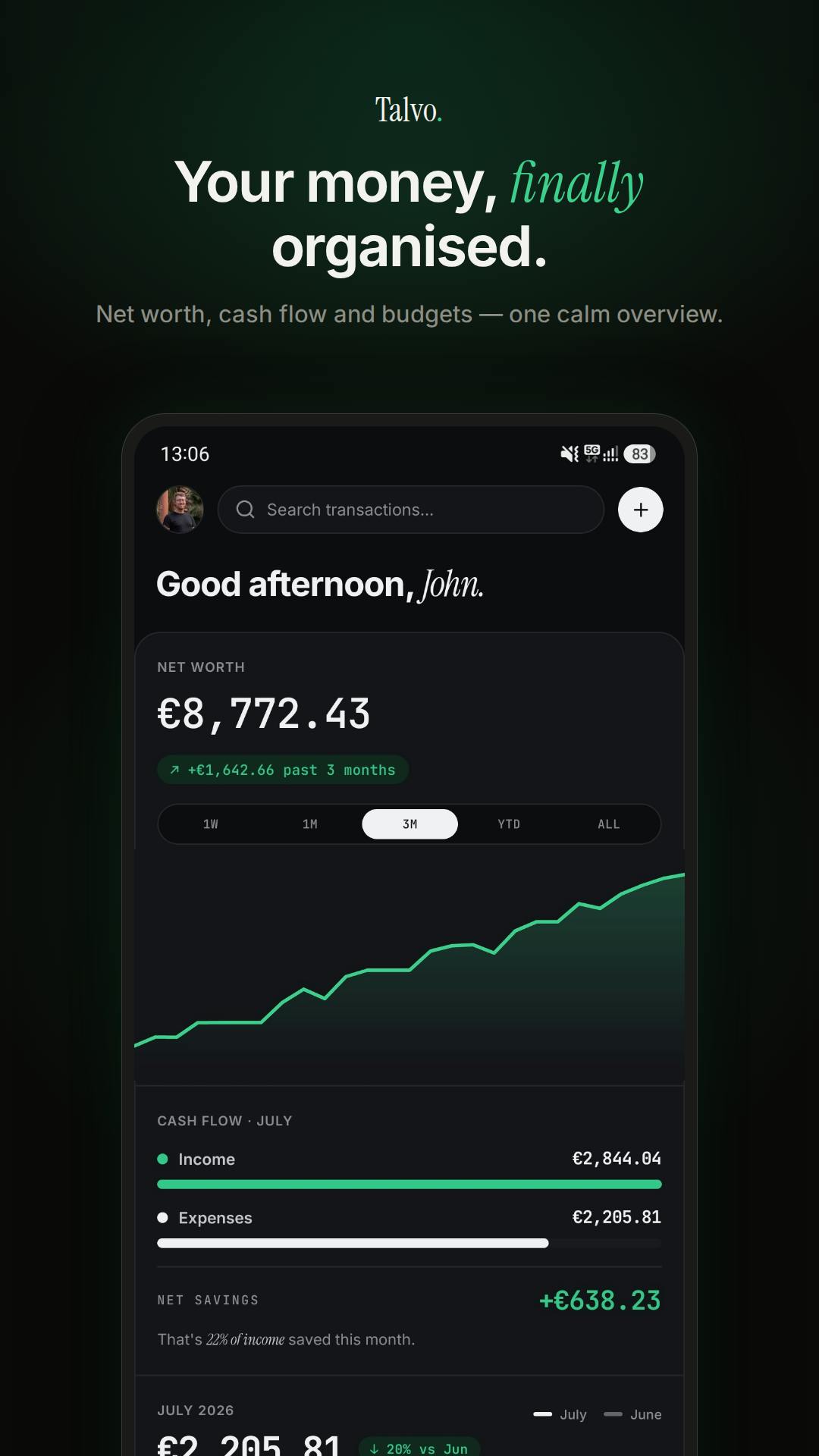
Built by Philippe Maes, Talvo positions itself as "Europe's money tracking and budget management app." It focuses on three core capabilities: connecting to over 2,500 European banks via the PSD2 protocol, automatically categorizing every transaction, and tracking budgets and net worth. With this positioning, it garnered 77 upvotes on launch day, ranking 11th on the daily leaderboard and gaining visibility in the Fintech category.
PSD2: The Technical Foundation of European Open Banking
Talvo's most noteworthy technical pillar is its deep integration with PSD2 (Payment Services Directive 2). PSD2 is an EU payment regulation that took full effect in 2018, with one of its core mandates being the requirement for banks to open account information interfaces (AIS) to authorized third parties. This laid the legal groundwork for the Open Banking ecosystem.
For budgeting apps, PSD2 means they no longer need to rely on fragile, non-compliant "screen scraping" methods to obtain user account data. Instead, they can read transaction records directly through official, encrypted, and regulated APIs. Before PSD2, the predominant method for third-party apps to access bank data was screen scraping—simulating user login to bank websites and parsing page data. This approach was not only technically fragile (breaking whenever a bank redesigned its website) but also posed serious security and compliance risks. PSD2 introduced two key license types: AISP (Account Information Service Provider) and PISP (Payment Initiation Service Provider). Talvo relies on the AISP framework, meaning that after obtaining regulatory authorization, it reads users' account balances and transaction records through standardized APIs provided by banks.
Notably, PSD2's technical standards are not fully unified—multiple API specifications coexist, including the Berlin Group's NextGenPSD2, the UK's Open Banking Standard, and France's STET. This makes cross-border, cross-bank integration far more complex than one might imagine. Talvo's claim of connecting to 2,500+ European banks represents a significant engineering barrier in itself, given Europe's reality of multiple countries, currencies, and banking systems.
Why Bank Coverage Breadth Matters
Unlike the relatively concentrated US banking system, Europe's banking market is highly fragmented—Germany's savings banks, France's Crédit Agricole, the Netherlands' ING, and Nordic local banks all operate independently. This fragmentation is rooted in history and institutional structure: Germany alone has over 1,400 banks, many of which are regional savings banks (Sparkassen) and cooperative banks (Volksbanken) that serve local communities with varying levels of technical capability and API maturity. France's banking system is dominated by several large banking groups (such as BNP Paribas and Crédit Agricole), but also includes numerous local mutual credit institutions. Nordic countries, while highly digitized, have local banks like Nordea and Handelsbanken with different API implementation details.
Whether a budgeting app is truly usable often comes down to whether it supports the user's "everyday bank." This fragmentation means that to achieve "pan-European coverage," an app must either build its own integration layer connecting to each bank individually (extremely costly) or rely on aggregation intermediaries such as Tink (acquired by Visa), Plaid (expanding in Europe), or Nordic API Gateway. Talvo's 2,500+ bank coverage most likely leverages such aggregation service providers' infrastructure, but even so, maintaining the stability of these connections remains an ongoing operational challenge.
Automatic Transaction Categorization and Net Worth Tracking
Beyond data connectivity, Talvo's second layer of value lies in automated processing. The product emphasizes automatic categorization of every inflow and outflow—dining, transportation, subscriptions, rent, and more. For average users, the biggest barrier to budgeting has never been "not being able to see the data" but rather "not bothering to organize it." Automatic categorization reduces the threshold of manual bookkeeping to a minimum and is the key feature determining user retention.
From a technical implementation perspective, automatic transaction categorization involves natural language processing (NLP) and machine learning engineering challenges. Bank transaction descriptions are typically unstructured short texts filled with abbreviations, merchant codes, and reference numbers. For example, "POS 2847 ALBERT HEIJN 1032 AMSTERDAM" needs to be correctly identified as belonging to the "Supermarket/Groceries" category. Classification systems typically combine MCC (Merchant Category Code), fuzzy matching of merchant names, and supervised learning models based on user behavioral history. In Europe's multilingual environment, this challenge is even more complex—the same type of transaction is described completely differently in German, French, and Dutch. Classification accuracy directly impacts user trust: if the system frequently misclassifies transactions, users lose willingness to rely on automation and revert to manual bookkeeping or abandon the app entirely.
Additionally, Talvo provides two core modules: budget tracking and net worth tracking. The former helps users keep monthly spending within budget, while the latter aggregates assets and liabilities to provide an overall financial health view. This three-layer structure of "transactions—budgets—net worth" follows the same logic as mature products like Mint, YNAB, and Monarch, representing the standard paradigm of personal financial management.
Data Sovereignty: The Trust Advantage of EU-Hosted and GDPR Native
Among Talvo's differentiating labels, the most distinctive is "EU-hosted, GDPR native"—data hosted within the EU, natively compliant with GDPR.
This might seem like mere compliance marketing, but it actually addresses a core anxiety of European users. Financial data is among the most sensitive personal information, and many international budgeting apps store data on US servers, which could theoretically be subject to extraterritorial jurisdiction under the US CLOUD Act.
GDPR took full effect in May 2018 and is one of the world's strictest data protection regulations. It grants data subjects (i.e., users) extensive rights, including the right to access, the right to erasure (right to be forgotten), and the right to data portability. It also sets strict conditions on cross-border data transfers—data can only be transferred to third countries or regions that provide an "adequate level of protection." Meanwhile, the US CLOUD Act (2018) grants US law enforcement the power to access data stored overseas by US companies, even if the data is physically stored within the EU. The conflict between these two laws (the so-called "transatlantic data transfer dilemma") became even more acute after the Schrems II ruling (2020), when the EU Court of Justice invalidated the Privacy Shield agreement between the EU and the US.
In this context, Talvo's emphasis on "EU-hosted" means: users' financial data is controlled by an EU-registered entity and stored in EU-based data centers, legally circumventing CLOUD Act jurisdiction risks. For privacy-conscious European users, "data stays in the EU" is a trust selling point with real persuasive power.
In other words, Talvo isn't disrupting the industry on features—it's building a moat on the dimension of trust and compliance. It wields "localization" and "privacy-first" as core weapons against American competitors, a typical regionalized Fintech strategy.
Competitive Landscape and Challenges Ahead
Despite its clear positioning, Talvo faces equally clear challenges.
First, the European open banking space is far from empty. Emma, Snoop, Yolt, Bud, and other apps have been cultivating this market for years, some backed by banks or large financial institutions. As an independent product, Talvo needs to continuously invest in customer acquisition costs and data connection maintenance.
Second, PSD2 API stability is a long-term operational challenge. Bank interface authorizations typically expire after only 90 days (based on Strong Customer Authentication, or SCA, requirements), requiring users to repeatedly re-verify. This creates experience friction. In practice, users might open their budgeting app one day to find weeks of missing data, needing to redirect to their bank app to complete verification. Worse still, re-authentication flows vary drastically between banks—some only require fingerprint confirmation, while others demand complex PIN codes and SMS verification codes. This friction causes some users to churn after failed reconnection attempts. The European Banking Authority (EBA) has discussed relaxing the 90-day limit multiple times, but no substantive changes have been made to date. Optimizing the reconnection flow within the compliance framework remains a shared challenge for all open banking applications.
Finally, budgeting apps' monetization paths still need validation. Free budgeting is hard to monetize, while paid subscriptions, financial product referrals, or data insight value-added services all need to be carefully designed without violating "privacy-first" promises. Looking at industry precedents, America's Mint attracted millions of users with a free model and earned commissions by recommending credit cards and financial products, but was ultimately shut down in 2023 due to insufficient profitability. YNAB adopts a pure subscription model ($99/year) and maintains a loyal paying user base through strong methodology and community stickiness, but its scale has always been limited. In Europe, monetization is even trickier: European users generally have lower willingness to pay for subscriptions than Americans, and financial product referrals face more restrictions under GDPR—apps cannot use users' spending behavior data to recommend financial products without explicit consent. This forces European budgeting apps to walk a narrower path between "privacy promises" and "monetization needs."
Conclusion: A Regional Fintech Sample Driven by Data Sovereignty
Talvo represents a typical sample of European Fintech: rather than pursuing technical showmanship, it builds value along three main threads—compliance, privacy, and localization. For users within the EU who struggle with cross-bank financial management and privacy concerns, it offers an option worth trying. Whether it can gain a firm foothold amid fierce open banking competition still depends on connection stability, user experience refinement, and a sustainable business model. Regardless of the outcome, it validates a trend—data sovereignty is becoming the most powerful differentiating weapon for regionalized tech products.
Related articles

AI Writes Code, Will Programmers Lose Their Jobs? The Truth About Devin's Autonomous Programming
Devin and other autonomous AI coding agents are changing software development: from Copilot-assisted coding to fully automated engineering agents, the programmer's role shifts from writing code to system design and oversight. This article analyzes the impact of AI programming on employment, code security, and junior developer training, as well as the real direction of programmer demand under the efficiency paradox.

Citigroup's 14,000 Engineers Use Devin, Slashing Tech Outsourcing Bill by 30%
Citigroup's 14,000 engineers used AI coding agent Devin to cut its tech vendor bill by 30% and speed releases 30-40%, while JPMorgan says AI gains aren't in earnings yet.

AGENTS.md in Practice: Making Coding Agents Actually Work
AGENTS.md and CLAUDE.md can boost coding agent performance, but research shows misuse raises costs 20%. Here's what to write, what to delete, the 200-line and 32KB limits, monorepo nesting rules, and a security warning.