Claude Opus 5 Generates Frame-by-Frame Animation in JavaScript — A New Milestone for AI Coding
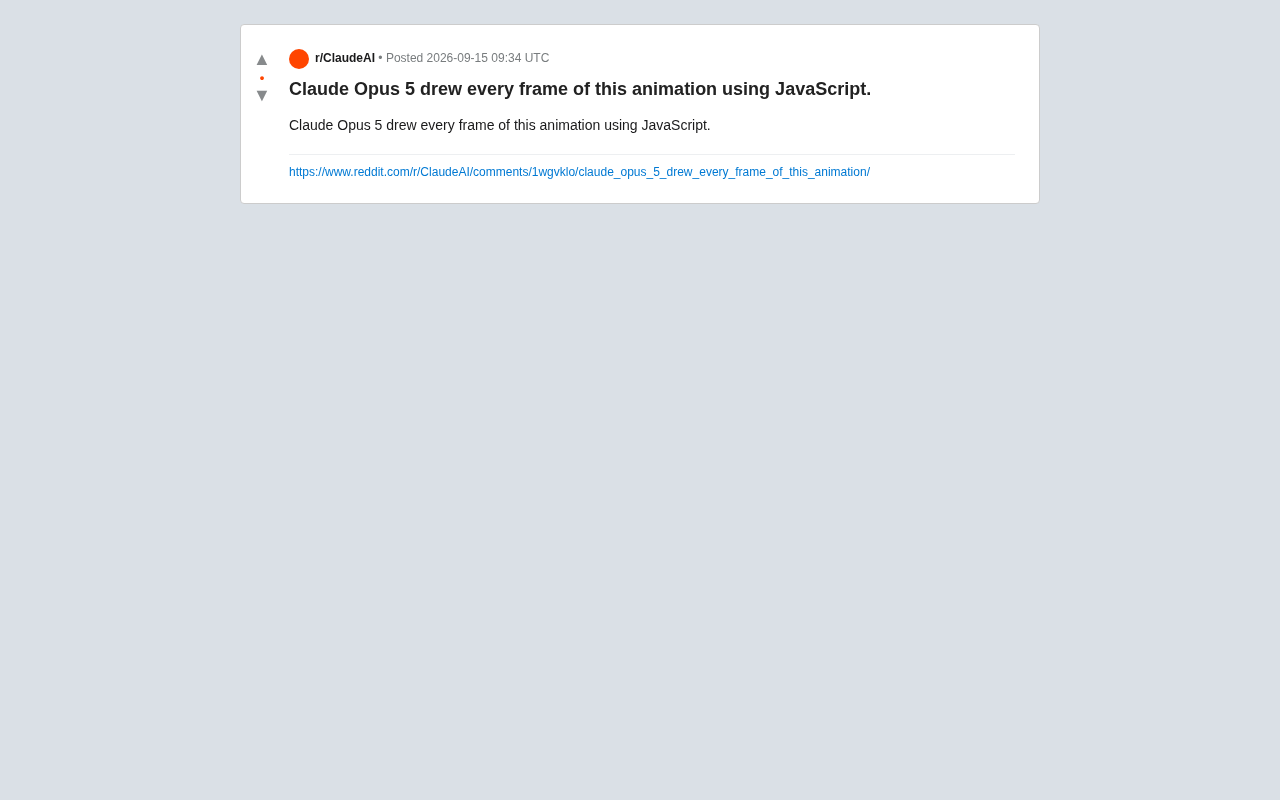
Claude Opus 5 generates frame-by-frame JavaScript animation, showcasing AI's potential to turn creative ideas into executable code.
A Reddit demo shows Claude Opus 5 generating a complete animation frame by frame using only JavaScript, without relying on existing animation libraries. This represents a key direction in LLM evolution: using code as a creative medium that translates visual motion into precise, executable logic. Unlike direct image generation, code-based animation is inherently parameterizable and reusable. However, single social media demos typically show best-case results and lack quantifiable metrics, so they're best treated as capability indicators rather than definitive benchmarks.
When AI Starts Drawing Animation Frame by Frame
A demo circulating on Reddit has sparked considerable discussion: according to the poster, Claude Opus 5 generated a complete animation entirely through JavaScript code, frame by frame. The case may seem straightforward, but it touches on a highly representative direction in the evolution of large language models — using code as a "paintbrush" to move AI from generating static content toward programmable, dynamic creation.
"Frame-by-frame drawing" means the model isn't relying on existing animation libraries or assets. Instead, it writes JavaScript logic to compute the state of each frame within a Canvas or similar rendering environment. This requires the model not only to understand the continuity of visual motion, but to translate that understanding into precise, executable code. For a code-generation model, this is a dual test of logical reasoning and "spatial-temporal imagination."
Why "Coding an Animation" Deserves Attention
Generating a static image and generating runnable animation code are two entirely different tasks. Image generation models (like diffusion models) output pixels directly, whereas having a language model "draw" an animation through code is fundamentally an act of indirect creation: the model must construct a mathematical model of the animation in its "mind" — such as functions describing how an object's position changes over time, easing curves, frame rate control — and then translate all of that abstract logic into error-free code.
The value of this capability lies in controllability and reusability. Animations produced through code are inherently parameterized — to adjust speed, color, or trajectory, you only need to change a few variables rather than regenerating the entire piece. For developers, educational content creators, and interaction designers, this means AI can become a collaborator that understands intent and rapidly produces editable prototypes.
An easing curve is the core mechanism in animation for controlling the sense of rhythm in movement. It describes the rate at which a property value changes over time — linear easing means constant velocity, while the common ease-in and ease-out correspond to gradual acceleration and deceleration respectively, more closely resembling natural physical motion. At the code level, easing is typically implemented via cubic-bezier functions or predefined mathematical formulas. For a language model, generating animation that "looks smooth and natural" requires not just syntactically correct code, but numerically appropriate choices that align with visual intuition — which is precisely one reason why generating animated code is harder than writing ordinary functions.
Reading the Model's Capability Boundaries from a Demo
Judging from this Reddit post alone, the information is limited. It lacks hard metrics like animation complexity, line count, and generation time, making it difficult to draw definitive conclusions about Claude Opus 5's true capabilities. That said, it does reflect the community's sustained interest in large models using "code as a creative medium."
Many developers have already tested models in similar ways — asking AI to write particle systems, physics simulations, SVG animations, and even small games. Frame-by-frame animation falls on the harder end of this spectrum, because it demands high coherence along the time dimension — any logical error in a single frame will manifest as a stutter or jump during playback. If Claude Opus 5 can reliably handle tasks like this, it suggests its performance on long-range logical consistency and numerical computation is worth further investigation.
A particle system is a classic test scenario for procedural animation: by defining the initial position, velocity, lifespan, and force rules for a large number of particles, it simulates natural phenomena like smoke, fire, and explosions. SVG animation, on the other hand, depends on precise manipulation of vector paths, requiring the model to understand SVG coordinate systems and transformation matrices. Both have been widely used by the community to evaluate a model's spatial reasoning ability. By comparison, frame-by-frame animation is closer to a "manually controlling every time step" programming paradigm, requiring the model to maintain consistency simultaneously across loops, state management, and numerical computation — with the probability of error rising exponentially with frame count and complexity.
A Grounded View of Community Demos
It's worth noting that single demos on social platforms are often curated to showcase the best results, not average performance. To truly evaluate a model's code creation capabilities, you need to examine its success rate across tasks of varying complexity, its ability to interpret ambiguous requirements, and whether it can self-correct after making mistakes.
For general users, cases like this are better treated as a "capability indicator": they signal that code generation is expanding beyond writing functions and fixing bugs into more creative domains like visualization and interaction. Real judgment should still be grounded in reproducible, systematic testing — not a demo clip whose origin and details cannot be independently verified.
Conclusion
Claude Opus 5's case of generating frame-by-frame animation in JavaScript is an interesting snapshot of how large model coding capabilities are evolving. It showcases AI's potential to transform abstract creative ideas into executable, editable code — while also reminding us to remain measured about community demos. As models continue to advance in logical consistency and creative tasks, "creating through code" is likely to become an important dimension for evaluating the next generation of AI models.
Related articles
Building Open-Source Video Editor Concat with Claude: A Free Alternative to CapCut
A developer used Claude to build Concat, an open-source CapCut alternative, in just three weeks. With nearly 10K downloads, it's a striking example of AI-assisted solo development.

The Overlooked Gems of Self-Hosting: Fun and Useful Services Nobody Talks About
From a Reddit thread, we explore overlooked self-hosted services — including video scraper RECLIP and data viz project WORLD MONITOR — and why fun services are so rare.
CrofAI Fraud Exposed: 'World's Cheapest AI Inference' Turns Out to Be an OpenRouter Wrapper Scam
CrofAI claimed to offer the world's cheapest AI inference, but was exposed as an OpenRouter wrapper silently rerouting requests to cheap models at up to 20x markups.