Claude Opus 5 Launch Imminent, Alibaba Qwen Officially Integrated into Apple Intelligence

Claude Opus 5 imminent, Qwen joins Apple Intelligence, and on-device AI hits new milestones.
Anthropic's Claude Opus 5 is set to launch next week with near-flagship capability at lower inference costs. Alibaba's Qwen model has been officially integrated into Apple Intelligence for Chinese users, driving a 5% pre-market stock surge. A new 27B on-device model compresses to 3.8GB for smartphone use, while open-source models have narrowed the performance gap with closed-source rivals to just 3.3%.
Flagship Model Iteration Accelerates: Claude Opus 5 Enters Final Countdown
According to industry insiders, Anthropic's flagship model Claude Opus 5 has entered the final stage of launch preparation, with a target release date set for next week. The new model's capabilities are said to approach those of the previous-generation flagship Opus, while significantly reducing inference costs — which is precisely the central challenge in today's LLM competition: continuously cutting costs while maintaining peak capability.
LLM inference costs are determined by a combination of model parameter count, inference architecture, quantization precision, batch processing efficiency, and the use of specialized inference chips. Early GPT-3-class models cost several cents per API call, while current mainstream models have dropped to fractions of a thousandth of a cent. The main technical approaches to cost reduction include: knowledge distillation (transferring large model capabilities to smaller ones), model quantization (reducing weight precision from FP32 to INT4/INT8), inference engine optimization (e.g., FlashAttention, continuous batching), and architectural innovation (MoE models that activate only a subset of parameters). Claude Opus 5's ability to approach previous-generation flagship performance while dramatically reducing inference costs is a direct embodiment of this technical trajectory.
Anthropic also announced it will remove the current flagship model from its subscription tier after July 19 to make way for the next generation. More notably, Claude Opus 5's successor is rumored to launch in August, directly targeting OpenAI's next-generation GPT series — the version iteration arms race among top-tier players is intensifying.
On OpenAI's side, CEO Sam Altman revealed that inference demand surged to 5.6x its previous level following the launch of GPT-5.6, and while the inference team has completed a capacity expansion, he warned of potential service disruptions in the short term. Inference compute is rapidly becoming a critical bottleneck constraining large-scale LLM deployment.
Alibaba on Two Fronts: Real-Time Voice Model Tops Rankings, Qwen Integrated into Apple Intelligence
Alibaba has been making aggressive moves in the AI space recently, advancing on two simultaneous fronts.
Real-Time Voice Model Ranks #1 Overall
Alibaba first released its real-time voice interaction model Qwen-Audio-3.0-Realtime, featuring comprehensive upgrades across four dimensions: IQ, tool calling, empathetic dialogue, and duplex interaction — available in Plus and Flash variants. In the authoritative Artificial Analysis voice evaluation, the model ranked first overall, surpassing OpenAI GPT Realtime 2, and supports voice cloning, primarily targeting customer service and education scenarios.
Qwen Officially Integrated into Apple Intelligence for Chinese Users
Apple Intelligence is Apple's system-level AI capability framework announced at WWDC 2024, built on a two-tier architecture: an on-device local small model (approximately 3 billion parameters, running on A17 Pro and M-series chips) and a cloud-based large model extension (accessed via Private Cloud Compute nodes). For the Chinese market, Apple chose to partner with Alibaba's Qwen — primarily for compliance reasons. Chinese regulations require AI services to use models that have completed registration within the country, and data cannot leave Chinese borders. On the technical integration side, the Qwen large model is embedded into the system-level call chain through Apple's standard API interface; when Siri detects a need for stronger language understanding or generation capabilities, it routes the request to Qwen's backend — the entire process is transparent to the user.
Alibaba confirmed that Qwen will be integrated into Apple Intelligence as the AI capability layer, providing text and image understanding, content generation, and other features for Chinese users on iOS, iPadOS, macOS, and visionOS — all without needing to switch apps. This news immediately drove Alibaba's pre-market US stock price up more than 5%, underscoring capital markets' strong endorsement of the prospects for Sino-American tech collaboration. This partnership model effectively provides a replicable template for cross-border AI capability localization and compliance.
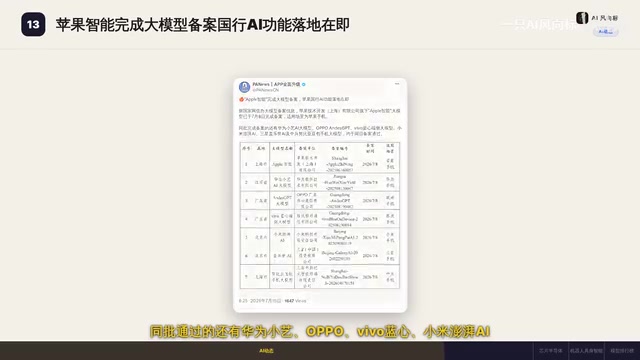
Registration information from the Cyberspace Administration of China (CAC) further confirms the concentrated on-device AI rollout — Apple Intelligence's large model completed registration on July 8, with the trial use case listed as Apple smartphones.
China officially implemented the Interim Measures for the Management of Generative AI Services in 2023, requiring companies providing generative AI services to domestic users to complete security assessments and registration with the CAC. Registration requirements cover multiple dimensions including service descriptions, training data compliance, security safeguards, and content filtering mechanisms. Apple's completed registration technically means that the Qwen model it calls on the backend has undergone a compliance review, ensuring it meets content safety standards for use by users in mainland China. Other models that passed registration in the same batch include Huawei, OPPO, vivo, Xiaomi澎湃AI, Samsung, Nubia, Doubao, and others — marking the transition of smartphone on-device AI from a "gray-area trial" phase into a "compliant normalization" phase. This regulatory framework effectively creates a market access barrier that objectively encourages the prioritized integration of domestic large models into China's hardware ecosystem.
On-Device AI Explosion: 27B Large Model Squeezed onto a Smartphone
Technical breakthroughs in on-device AI are equally noteworthy. One company has released Bonsai 27B — the first 27B-class large model capable of running on a smartphone. Using innovative quantization techniques, it compresses a 54GB model down to 3.8GB, a roughly 93% size reduction, while retaining approximately 90% of its intelligence, and can run locally on high-end devices such as the iPhone 17 Pro.
Model quantization is the core enabling technology for on-device AI deployment. Its essence is reducing the numerical precision of neural network weights to shrink model size and computational requirements. Standard training uses FP32 (32-bit floating point) or BF16 (16-bit brain float), while on-device deployment typically uses INT8 (8-bit integer) or even INT4 (4-bit integer) or lower precision. Bonsai 27B achieving approximately 93% compression suggests its quantization precision may reach INT2, or it may employ a hybrid approach combining non-uniform quantization (such as mainstream frameworks like GPTQ, AWQ, GGUF) with structured pruning. Retaining 90% intelligence is typically measured by comparing against the original model on standard benchmarks (such as MMLU, HumanEval), though it's worth noting that quantization losses tend to be more pronounced on tasks requiring precise computation, such as reasoning, mathematics, and code. The A19 Pro chip in the iPhone 17 Pro features a dedicated neural engine that accelerates low-precision matrix operations, which is the critical hardware foundation supporting local inference for a 27B model.
This achievement demonstrates that large parameter models and mobile deployment are not inherently incompatible. Through aggressive quantization compression, models that once relied on cloud compute are progressively moving into users' pockets — not only dramatically reducing inference costs, but also delivering qualitative improvements in data privacy protection and response latency.

Additionally, the real-time interactive digital human model Colored 4 has achieved a breakthrough average response latency of just 180 milliseconds, capable of handling mid-speech interruptions and responding promptly, with natural micro-expressions and eye movements — targeting commercial scenarios including customer service, sales, language tutoring, and healthcare.
Open-Source Ecosystem Continues Closing the Gap on Closed-Source
Mozilla's State of Open Source AI Report, based on Chatbot Arena data, shows that the average capability gap between open-weight models and closed-source models has narrowed to 3.3%, down significantly from 8.04% in January 2024 — the open-source camp is closing in on closed-source leaders at a remarkable pace.
Chatbot Arena (now rebranded as LMSYS Arena) is an anonymous comparative evaluation platform operated by a team at UC Berkeley, using the Elo rating system — originally developed for chess rankings — to statistically measure relative model capabilities through large volumes of human preference votes. Its core advantage is that results come from real users asking real questions, making it harder to game than fixed benchmark test sets (like MMLU), and covering diverse scenarios including creative writing, code, reasoning, and multilingual tasks. It should be noted that Chatbot Arena primarily reflects general conversational ability; in specialized sub-dimensions such as advanced reasoning, long-context processing, and multimodal capabilities, the gap between open-source and closed-source models may still be significant.
DeepSeekAd is the defining example of this trend. Its V4 Flash topped the open-source model usage rankings with 18.4 trillion tokens of global monthly usage, indirectly confirming its cost-efficiency competitiveness — when developers deploy at scale in production environments, inference cost is often the overwhelming decision factor. More significantly, even while selling the V4 model at low prices, DeepSeek maintains a gross margin exceeding 50%, far above typical industry levels, forcing US AI companies to fundamentally rethink their pricing and profitability models.
On the tooling ecosystem front, NVIDIA's NeMo Labs open-sourced a PyTorch-native reinforcement learning framework. The complete RL path consists of only approximately 8,600 lines of code, can scale to MoE models like DeepSeek V3 through FSDP's tensor, expert, and context parallelism, and requires only three runtime dependencies: Ray, vLLM, and Automodel — dramatically lowering the engineering barrier for RL training.
Chips & Hardware: Intel 18A Achieves High-NA EUV Mass Production
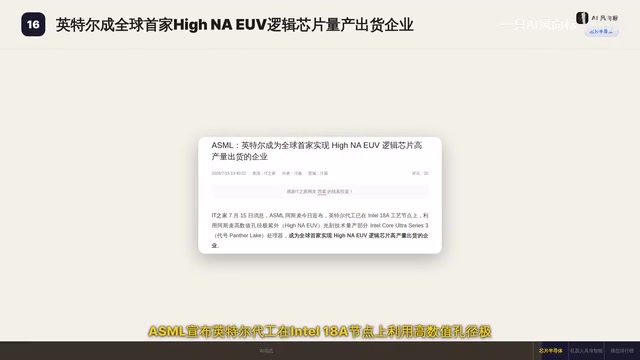
ASML announced that Intel Foundry has achieved mass production of select Panther Lake processors using High-NA EUV (High Numerical Aperture Extreme Ultraviolet Lithography) technology at the Intel 18A node, making it the world's first company to achieve high-volume shipment of logic chips using High-NA EUV.
Extreme ultraviolet lithography (EUV) uses a 13.5nm wavelength light source, delivering a significant resolution improvement over the previous ArF light source (193nm), and is the core technology for process nodes below 5nm. High-NA EUV raises the numerical aperture from 0.33 to 0.55, improving theoretical resolution by approximately 40%, enabling single-exposure patterning of features below 8nm and reducing reliance on expensive multi-patterning processes. Currently, only ASML manufactures High-NA EUV equipment, with each unit priced at approximately $350 million — more than three times the cost of conventional EUV equipment. Intel 18A node (equivalent to approximately 1.8nm process) achieving mass production with High-NA EUV is significant because it validates the industrial viability of this technology roadmap, exerts competitive pressure on TSMC's N2P and sub-N2P nodes, and signals that the global competitive landscape for advanced semiconductor manufacturing may be undergoing a substantive shift.
Several process layers at Intel 18A have completed dual certification, with yields reaching existing EUV levels, marking the semiconductor manufacturing industry's entry into an entirely new technology node.
On the hardware front, Bloomberg reporter Mark Gurman revealed that OpenAI's first consumer hardware device is a mobile, screenless home smart speaker positioned as an "AI companion" with which users can form emotional connections. Boston Dynamics is also testing the potential use of its quadruped robot Spot for delivery, equipping it with a conveyor belt accessory that enables it to retrieve packages from vehicles and autonomously unload them at customers' doorsteps.
Summary: The AI Competitive Landscape Is Being Fundamentally Reshaped
Taken together, the current AI industry is exhibiting several distinct trends: flagship model iteration is accelerating, with cost compression emerging as the core competitive differentiator; domestic Chinese models are rising broadly, with Alibaba Qwen's integration into Apple Intelligence and DeepSeek's low-price, high-margin strategy rewriting the global market landscape; and on-device AI is seeing concentrated deployment as large models rapidly migrate from the cloud to local devices.
The statement by Kingsoft Office CEO Zhang Qingyuan is particularly telling — the company's internal AI models used for development have shifted from heavily relying on foreign models last year to being entirely replaced by domestic models as of June this year, confirming the reality that the capability gap of domestic large models is closing rapidly. Behind this transformation lies both a substantive improvement in domestic model technical capabilities, and the institutional driving force created by the CAC's registration and compliance framework working in tandem.
Key Takeaways
Related articles

Felix Rieseberg Personal Homepage
Felix Rieseberg's personal homepage sparks attention on Hacker News. This article covers the Slack engineer's technical background, the rise and fall of nativefier, and the value of a developer homepage as a tech calling card.

@ai-sdk/vue 3.0.306 Patch Release Syncs with [email protected] Update
@ai-sdk/vue 3.0.306 released, synced with [email protected]. A routine patch release for the Vercel AI SDK ecosystem with no public API changes; the Vue adapter layer stays version-aligned with the core package.

Gemini 4 Argon API Launches: The Era of Million-Token Output Begins
Google launches Gemini 4 Argon with sparse MoE architecture, up to 1M output tokens, and a 68.90% Vals Index score, available across API, AI Studio, and the Gemini app.