Claude Opus's Autonomous Debugging Capabilities: What It Means When AI Proactively Writes Test Harnesses
Claude Opus now proactively builds test harnesses, signaling a shift from code generation to engineering-level debugging.
The new Claude Opus demonstrates the ability to autonomously write test harnesses to observe runtime code behavior without explicit instructions. This article examines the technical significance of this shift — from static code reasoning to dynamic verification through feedback loops — and explores how it mirrors the debugging workflow of senior engineers, marking AI's evolution from passive code generators to intelligent collaborators with engineering intuition.
A Signal Worth Paying Attention To
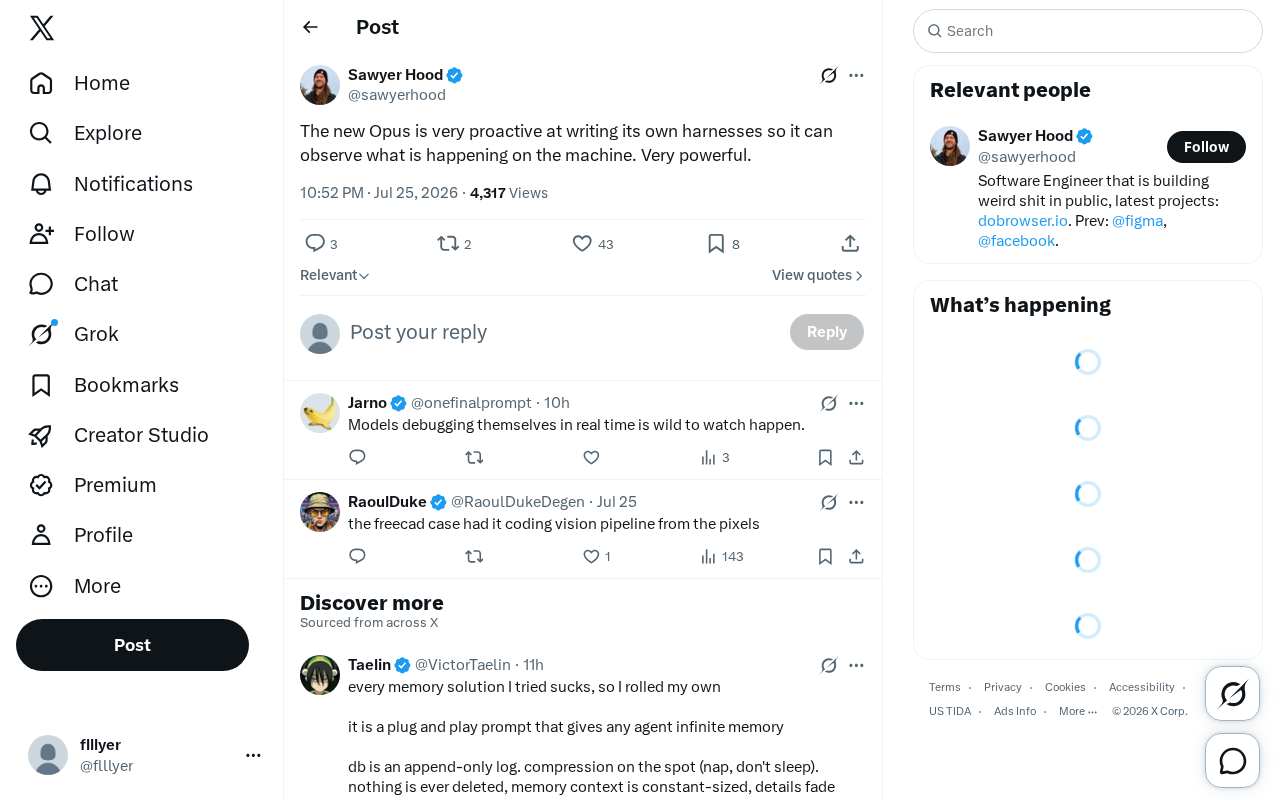
Recently, a developer shared observations about the new Claude Opus on social media, sparking widespread discussion in the AI programming community. The core insight was concise yet profound: "The new Opus is very proactive about writing its own harnesses so it can observe what's happening on the machine. This is very powerful."
This seemingly casual remark actually touches on a critical direction in the evolution of AI programming assistants: the shift from passive code generators to agents with proactive exploration and self-verification capabilities. This article takes a deep dive into the technical significance and practical value behind this behavior of "autonomously writing test harnesses."
What Is a Test Harness?
Harnesses in Traditional Software Engineering
In software engineering, a "harness" (test harness) typically refers to a temporary auxiliary environment built to run, observe, and verify code. It may include:
- Debug statements for printing intermediate states
- Test driver code that simulates inputs and outputs
- Logging and monitoring logic that captures runtime behavior
- Wrappers that isolate specific modules for unit verification
Historically, these harnesses have been almost entirely built manually by human engineers. Developers need to use their experience to determine "what do I need to observe" and then write the corresponding probing code. It's worth noting that test harnesses differ from formal unit tests or integration tests — they are more temporary and exploratory in nature, typically removed once the problem has been located. In large codebases, building effective harnesses is itself a skill that requires deep engineering experience, as it demands that developers accurately identify where their "information blind spots" are.
Claude Opus's Shift Toward Proactive Harness Construction
The capability demonstrated by the new Opus is the ability to proactively determine — without being explicitly instructed — that "I need to see what's actually happening at runtime to solve this problem," and then write probing code on its own to obtain that information. This represents a fundamental shift from "guessing code behavior" to "actually observing code behavior."
In other words, the model no longer relies solely on static reasoning about code. Instead, it proactively creates conditions to establish a feedback loop — which is exactly one of the core working methods of skilled human engineers.
Why Autonomous Debugging Is "Very Powerful"
From Static Reasoning to Dynamic Verification
A longstanding pain point for large language models on code tasks is that they essentially "simulate" code execution in their heads. When LLMs process code tasks, they fundamentally perform probabilistic reasoning based on patterns learned from training data, rather than actually executing the code. This approach is similar to a human "mentally walking through code" — tracing variable states, predicting branch outcomes, and reasoning through function call chains. However, real-world software systems often involve concurrency, async callbacks, external I/O, environment variables, dynamic typing, and numerous other factors that can only be determined at runtime. When facing these scenarios, LLMs can only make "best guesses" based on statistical probability rather than obtaining definitive answers. This is why LLMs perform excellently on simple algorithm problems but frequently give plausible-sounding yet incorrect advice when debugging complex production systems — they lack real runtime feedback.
When logic is complex, depends on runtime state, or involves hidden side effects, this simulation is prone to errors. Proactively writing harnesses means the model can:
- Break through the reasoning black box: Obtain real data through actual execution rather than relying on probabilistic guesses.
- Establish a feedback loop: Observe outputs, adjust strategies, and form an iterative process of "hypothesize — verify — correct." This loop has deep methodological roots in software engineering and is directly aligned with hypothesis testing in the scientific method. In debugging scenarios, senior engineers typically follow this workflow: first, form a hypothesis based on error symptoms ("this variable is probably being overwritten under concurrency"), then design experiments to verify the hypothesis (add logging, write targeted tests, set debugger breakpoints), and finally revise the hypothesis or confirm the root cause based on observations. The core deficiency of AI programming assistants in the past was that they could only perform the first step (forming hypotheses) but couldn't autonomously complete the subsequent verification and correction. When Claude Opus proactively writes test harnesses, it is essentially completing the entire loop autonomously — upgrading its problem-solving capability from linear "one-shot guessing" to iterative "convergent solving."
- Handle unknown systems: When facing unfamiliar codebases or environments, probing before acting reduces the risk of blind modifications.
Closer to How Senior Engineers Work
When experienced developers encounter an unfamiliar system, their first instinct is usually not to modify code directly, but to "figure out what's actually happening here" — adding logs, running tests, observing state. The new Opus's proactiveness precisely mimics this professional habit.
This marks the evolution of AI programming assistants from "responsive tools" to "collaborators with engineering intuition," and autonomous debugging capability is the core manifestation of this transformation.
The Technical Evolution Behind It
A Natural Extension of AI Agent Capabilities
This behavior is not an isolated phenomenon but rather a microcosm of current improvements in AI Agent capabilities. An AI Agent is an autonomous system capable of perceiving its environment, formulating plans, executing actions, and adjusting strategies based on feedback. In the current LLM ecosystem, Agent capabilities are implemented through "Tool Use" (also known as Function Calling) mechanisms: during reasoning, the model can decide to invoke predefined external tools — such as executing shell commands, reading/writing files, calling APIs, running code, etc. Both Anthropic's Claude and OpenAI's GPT series have significantly strengthened these capabilities over the past year.
The key architectural evolution lies in the "ReAct" (Reasoning + Acting) paradigm: the model alternates between reasoning (thinking about what to do next) and acting (calling tools to obtain information), forming multi-turn loops. Claude Opus proactively writing test harnesses is a high-quality manifestation of the ReAct loop — the model identifies insufficient information during reasoning and proactively decides to write and execute probing code to supplement missing runtime information.
As models are equipped with tool-calling capabilities like executing code, reading files, and running commands, they gain the "hands and feet" to interact with their environment. But what truly distinguishes strong from weak models is whether they know "when and how" to use these capabilities to proactively gather information.
The new Opus's performance shows that it not only possesses the tools but also has the strategic awareness to "proactively explore the environment to reduce uncertainty." This proactiveness often stems from reinforcement learning and alignment optimization on real software engineering workflows during training. Specifically, during the traditional pre-training phase, models learn language patterns through massive amounts of code and text; during the post-training phase, by constructing environments that simulate real software engineering scenarios — such as having the model fix real bugs in a sandbox and receiving reward signals from running test suites — the model can learn that "observe first, then act" is more effective than "guess and modify directly." Anthropic has mentioned in its technical reports the use of "outcome-based reinforcement learning" on coding tasks, where rewards are given based on whether code passes tests rather than solely relying on human ratings. This training approach naturally encourages models to develop behavioral patterns of proactively writing tests and verifying hypotheses, as this directly improves task success rates.
Safety and Controllability Considerations
As an additional note, this observation currently comes from a single developer's personal experience and has not yet been corroborated by large-scale benchmark testing. At the same time, AI proactively running self-written probing code on machines also raises safety and controllability challenges.
In production environments, granting models permission to execute arbitrary harness code requires supporting sandbox isolation and permission management mechanisms to avoid unintended side effects. A sandbox is a security mechanism that restricts program execution to a controlled environment. Common implementations include containerization (e.g., Docker), virtual machines, and OS-level permission isolation (e.g., Linux's seccomp, AppArmor). In the context of AI programming assistants, sandboxes need to address several core issues: preventing AI-executed code from accessing sensitive files or network resources, limiting resource consumption (CPU/memory/disk), and ensuring probing code doesn't produce irreversible side effects (such as deleting data or modifying production configurations). Currently, mainstream AI coding tools like Cursor and Claude Code typically balance functionality and security through user confirmation mechanisms and restricted execution environments. However, as AI autonomy increases, more granular permission models will become essential. This point cannot be overlooked during actual deployment.
Practical Implications for Developers
For engineers who use AI programming assistants daily, Claude Opus's autonomous debugging capabilities point to several noteworthy practical directions:
- Improved debugging efficiency: When facing hard-to-reproduce bugs, AI may proactively build observation environments, dramatically shortening problem identification time. This is particularly valuable for issues involving race conditions, memory leaks, async timing, and other problems that are difficult to discover through static code review — AI-constructed runtime probing harnesses can capture transient behaviors that human developers might miss.
- Faster onboarding with unfamiliar codebases: When taking over legacy systems, AI's exploratory behavior helps quickly clarify runtime logic and dependency relationships. Legacy systems often suffer from missing documentation, confusing naming, numerous "magic numbers," and implicit conventions, making traditional code reading inefficient. By proactively writing probing harnesses — such as inserting logs at key function entry and exit points, or building small-scale integration tests — AI can quickly generate a "dynamic map" of system behavior.
- Transformed collaboration patterns: Developers can increasingly delegate exploratory tasks like "figure out what's happening" to AI, freeing themselves to focus on architectural decisions and business judgment. This division of labor is similar to the collaboration between senior and junior engineers — the junior engineer handles information gathering and experiment execution, while the senior engineer handles directional judgment and critical decisions.
Conclusion
From "write me some code" to "let me first see what's actually happening," the autonomous harness-writing capability demonstrated by the new Claude Opus — though based on a single developer's real-time observation — reflects a critical threshold that AI programming assistants are crossing: moving from code generation at the language level to problem-solving at the engineering level.
When a model begins to observe first and act second, like a senior engineer, its value as a programming collaborator will increase significantly. Of course, the boundaries, reliability, and safety of this capability still await broader validation through practice.
Related articles

Should You Open Source Your Project? A Layered Open Source Strategy Using Project Replay as a Case Study
Should indie developers open source their projects? Using the game custom achievement tool Project Replay as a case study, this article analyzes the open source decision and offers a practical layered strategy.

130+ Open-Source Interactive Security Awareness Training: Reshaping Habit Formation Through 3D Office Scenarios
A project with 130+ free open-source interactive security awareness exercises using immersive 3D office scenarios to simulate phishing, vishing, MFA fatigue attacks and more, building employee security habits.

From Musk to Jefferson: Beware the Cognitive Trap of Cross-Domain Experts
Why do geniuses in one field often become overconfident in others? From Musk's controversial interview to Jefferson's blind spots, an exploration of cross-domain cognitive arrogance.