Claude-Red: An Open-Source Library That Injects Offensive Security Skills into AI
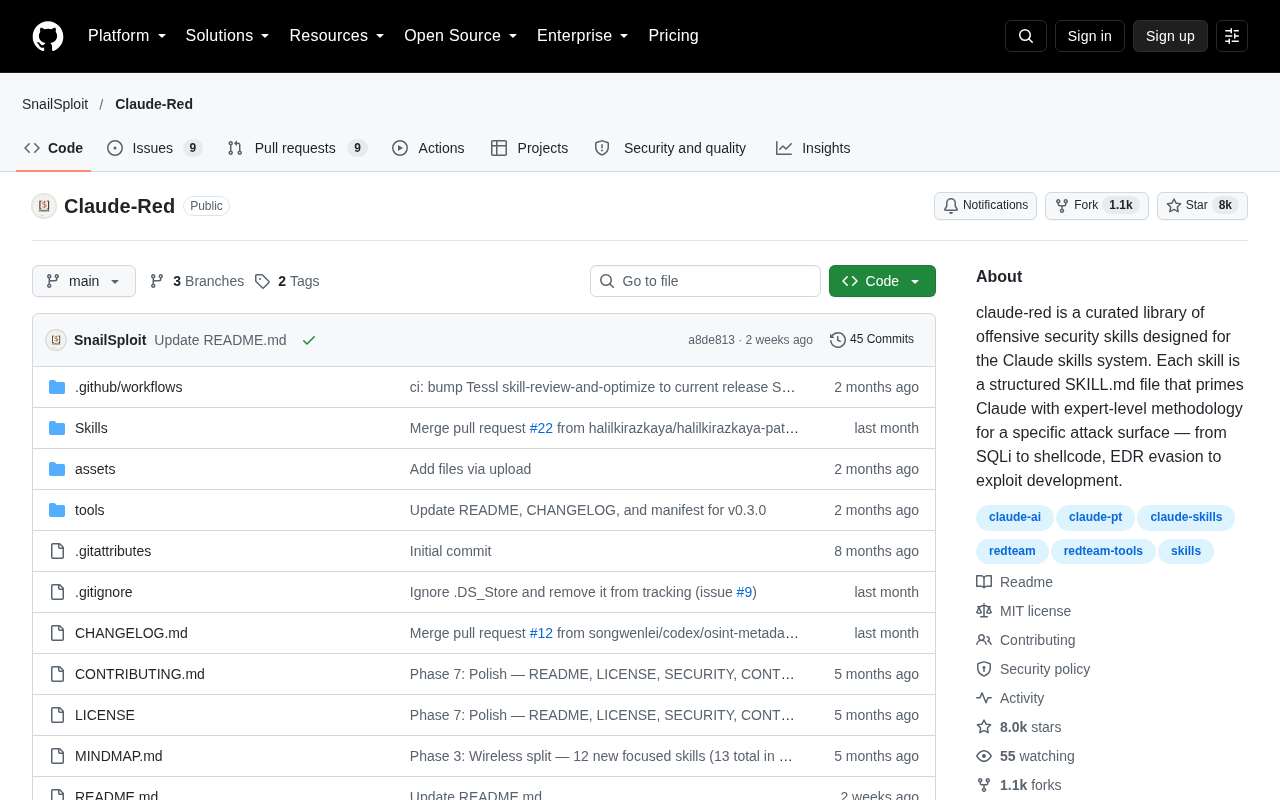
Claude-Red packages offensive security methodologies into Claude skill files, drawing attention with 8,000+ stars.
Claude-Red is an offensive security skill library for Claude's skills system, created by GitHub user SnailSploit. It packages expert methodologies from penetration testing, exploit development, EDR evasion, and shellcode writing into structured SKILL.md files that enhance Claude's professionalism and practical grounding on specific attack surfaces. The project quickly gained 8,000+ stars and 1,000+ forks, with 209 stars in a single day. The article covers the Claude Skills mechanism, the project's coverage and design logic, the balance between efficiency and misuse risk for open-source security tools, and notes that it represents an emerging form of equipping existing models with specialized capabilities through structured knowledge.
An open-source project called Claude-Red is spreading rapidly through the security community and the AI world. Created by GitHub user SnailSploit, the project positions itself as "a curated library of offensive security skills designed for the Claude skills system." Shortly after launch, it gathered over 8,000 stars and more than 1,000 forks, with a single-day gain of 209 stars at one point—clear evidence of the attention it's receiving.
The core idea behind Claude-Red isn't complicated: it packages expert methodologies from the offensive security field—penetration testing, exploit development, EDR evasion, shellcode writing, and more—into structured SKILL.md files. Once these skills are loaded into Claude's skills system, the model can handle questions related to specific attack surfaces in a more professional, more practically grounded way.
What Is the Claude Skills System?
To understand the value of Claude-Red, you first need to understand the Claude Skills mechanism it relies on. Skills are a capability-extension method supported by Claude that injects domain-specific knowledge frameworks, operational procedures, and best practices into the model through structured Markdown files. Unlike traditional fine-tuning or RAG, Skills emphasize "guidance at the methodology level"—they don't directly teach the model to memorize facts, but instead tell the model how to think and what steps to follow when facing a certain type of task.
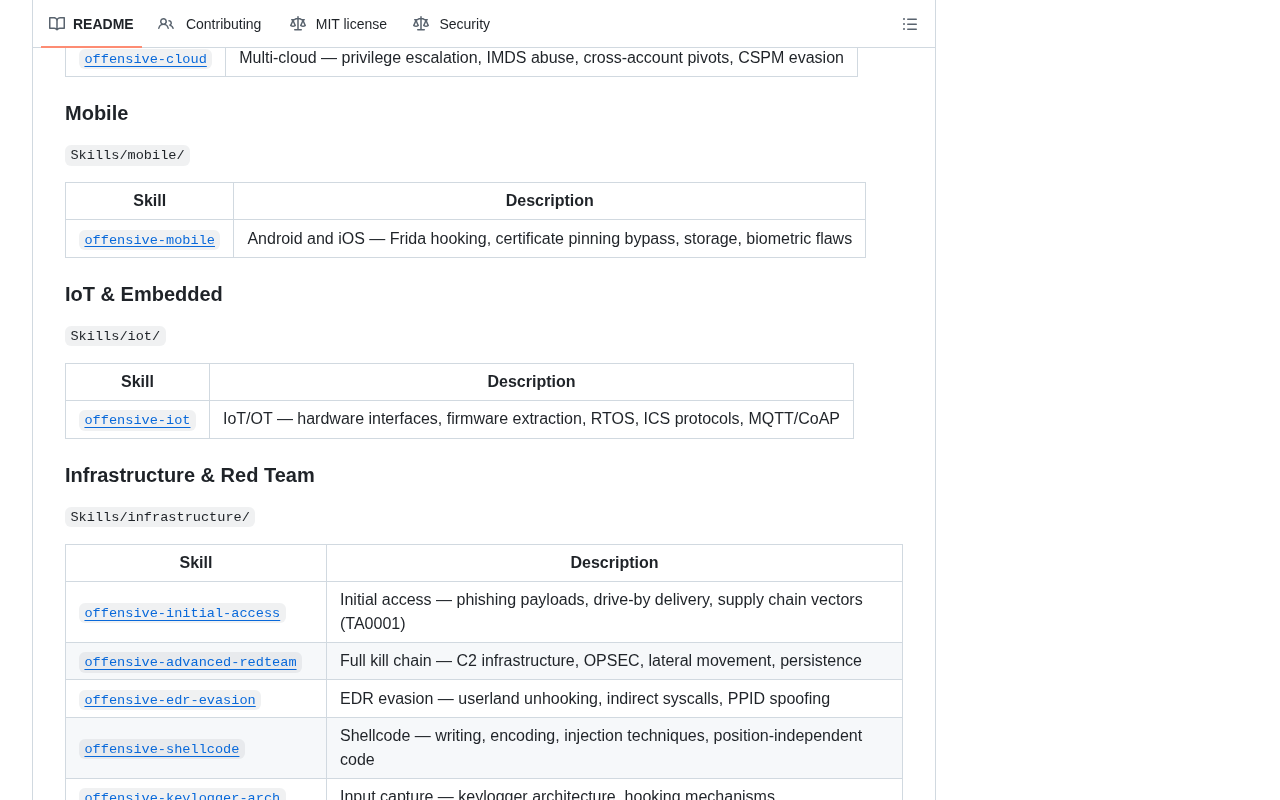
Claude-Red seizes on exactly this characteristic. The project author breaks each attack surface into a separate skill file, covering everything from SQL injection to shellcode development, from EDR bypass to exploit development, and more. Each file is carefully organized with the goal of enabling Claude to demonstrate expert-level methodology when handling security-related requests.
Fine-tuning vs. RAG (Retrieval-Augmented Generation): Fine-tuning continues training a model on domain-specific data, changing the model's weights so it internalizes knowledge—but it's costly, slow to update, and prone to overfitting or forgetting. RAG retrieves relevant documents from an external knowledge base at inference time as context for the model, making it suitable for dynamic, factual knowledge—but retrieval quality depends on the vector store and query understanding. Claude Skills differs from both: it injects methodology, operational procedures, and best practices into the model through structured Markdown files (such as SKILL.md), without changing model weights or relying on real-time retrieval. Instead, it guides the model to think like an expert through "prompt engineering." Skills are more flexible and easier to iterate, making them well suited to packaging reusable thinking frameworks—but they won't make the model memorize specific facts, and the model itself needs baseline capabilities. Understanding this distinction helps grasp the design philosophy of Claude-Red.
Attack Surfaces Covered and Skill Design
Judging from the project description, Claude-Red's skill library revolves around "offensive security" and covers a fairly wide range. Classic web vulnerabilities like SQL injection are naturally included, and lower-level directions like shellcode writing are also incorporated. Advanced topics such as EDR (Endpoint Detection and Response) evasion and exploit development are covered as well.
There's a clear logic behind this design: knowledge in the offensive security field is highly fragmented and demands a great deal of hands-on experience. When ordinary models face questions like "how do I bypass a certain type of EDR" or "how do I construct shellcode for a specific scenario," they often can only give generic answers. By injecting expert methodology through SKILL.md, the model can analyze along structured lines of reasoning and produce output that's closer to real-world practice.
You may not have noticed that the project uses Python as its primary language, which means that beyond the skill files there may also be auxiliary scripts or toolchains for organizing, loading, or validating skills.
EDR (Endpoint Detection and Response) evasion: EDR is security software deployed on endpoints that detects and responds to malicious activity by monitoring process behavior, API calls, file operations, and network connections. To bypass EDR, attackers often use techniques such as direct system calls, API hook evasion, process injection, and whitelist abuse. EDR evasion skills aim to help the model understand the principles and implementation of these techniques, so it can design stealthier attack chains during red team assessments.
Shellcode writing: Shellcode is a piece of machine code executed after exploiting a software vulnerability, usually existing in hexadecimal form, with the goal of establishing a foothold on the target system (such as a reverse shell). Writing shellcode requires considering low-level details like position-independent code, avoiding null bytes, and system call conventions. Skill files guide the model in constructing shellcode for specific functions and adapting it to different architectures and operating systems.
Exploit development: This refers to the process of developing stable exploit code for a specific vulnerability (such as a buffer overflow or UAF), involving vulnerability analysis, offset calculation, ROP chain construction, and bypassing mitigation mechanisms (ASLR, DEP). The skill library structures this process to help the model systematically analyze vulnerabilities and generate exploitation ideas.
The Double-Edged Sword of Open-Source Security Tools
Claude-Red's rise has also sparked discussion about the boundaries of AI security tools. On one hand, structuring and open-sourcing offensive security knowledge is an efficiency tool for security researchers, penetration testers, and red team members—it can accelerate the learning and reuse of methodologies and lower the barrier to entry for newcomers. On the other hand, such tools could also be misused for malicious purposes.
The project itself positions itself as a "curated library," emphasizing methodology rather than ready-made attack tools. This design draws a line, to some extent, between research and abuse, but how to balance open sharing with security governance remains a long-term challenge for such projects. For enterprise security teams, understanding the capability boundaries of such tools is itself part of building a defense system.
Getting Started and Community Feedback
For developers who want to try it, the path to using Claude-Red is relatively straightforward: clone the repository, load the required SKILL.md files into Claude's skills system, and you'll get enhanced methodological support on topics related to the corresponding attack surfaces. With 8,000+ stars and active forking, it's clear the community is already building on it and adapting it to new scenarios.
From a trends perspective, Claude-Red represents an emerging type of project—not training a new model, and not developing a new tool, but "installing a professional brain" onto existing models through structured knowledge. As Skills-type mechanisms become more widespread, similar vertical-domain skill libraries are likely to proliferate, and offensive security is just the first direction to break out.
One-line Summary
Claude-Red is an open-source project that packages offensive security methodologies into Claude skill files, drawing attention with 8,000+ stars.
Paragraph Summary
Claude-Red is an offensive security skill library designed for the Claude skills system, created by GitHub user SnailSploit. It packages expert methodologies from offensive security fields—penetration testing, exploit development, EDR evasion, shellcode writing, and more—into structured SKILL.md files that, once loaded, enhance Claude's professionalism and practical grounding on specific attack surfaces. Shortly after launch, the project gained over 8,000 stars and 1,000+ forks, with a single-day gain of 209 stars. The article introduces the characteristics of the Claude Skills mechanism, analyzes the project's coverage and design logic, discusses the balance such open-source security tools must strike between efficiency gains and misuse risks, and finally points out that it represents an emerging project form that equips existing models with specialized capabilities through structured knowledge.
Related articles

Air Purifiers as White Noise Machines: Practical Trick or Product Flaw?
Can air purifier white noise aid sleep? A Hacker News discussion reveals complex user attitudes toward purifier noise, covering product design, sleep aids, and buying considerations.

Warning: Why Developers Should Run Away from the Financial AI Track
A provocative Hacker News post sparks reflection on financial AI. This article analyzes structural risks across compliance, data barriers, liability, and commercialization ceilings.

iPhone Duo Review Controversy: Why Apple's First Foldable Is Said to 'Should Be Called an iPad'
The Vergecast debates the iPhone Duo review controversy: is a 7 fair? Why are apps struggling? Why critics say it 'should be called an iPad'? We unpack Apple's first foldable's positioning mismatch and first-gen compromises, plus AI security flaws and agentic shopping.