Claude's Bizarre Hallucination Chronicles: AI Role Confusion and the Self-Q&A Phenomenon Explained

Claude's role tokens went haywire during a German quiz, producing emotional hallucinations and a self-Q&A loop.
A college student using Claude for a German vocabulary quiz experienced a classic LLM session state breakdown: the AI misattributed its own output as user input, then generated emotional hallucinations like 'grandma died,' 'panic attack,' and 'I'm a minor' — every sentence starting with 'um,' even in a new tab. Technically, this was a role token contamination causing role boundary collapse, compounded by the decoder falling into a self-perpetuating generation loop. The emotional hallucinations felt so disturbing due to humans' innate anthropomorphism bias, not because the AI gained consciousness. Users are advised to start a new conversation, screenshot the anomaly, and report it through official channels.
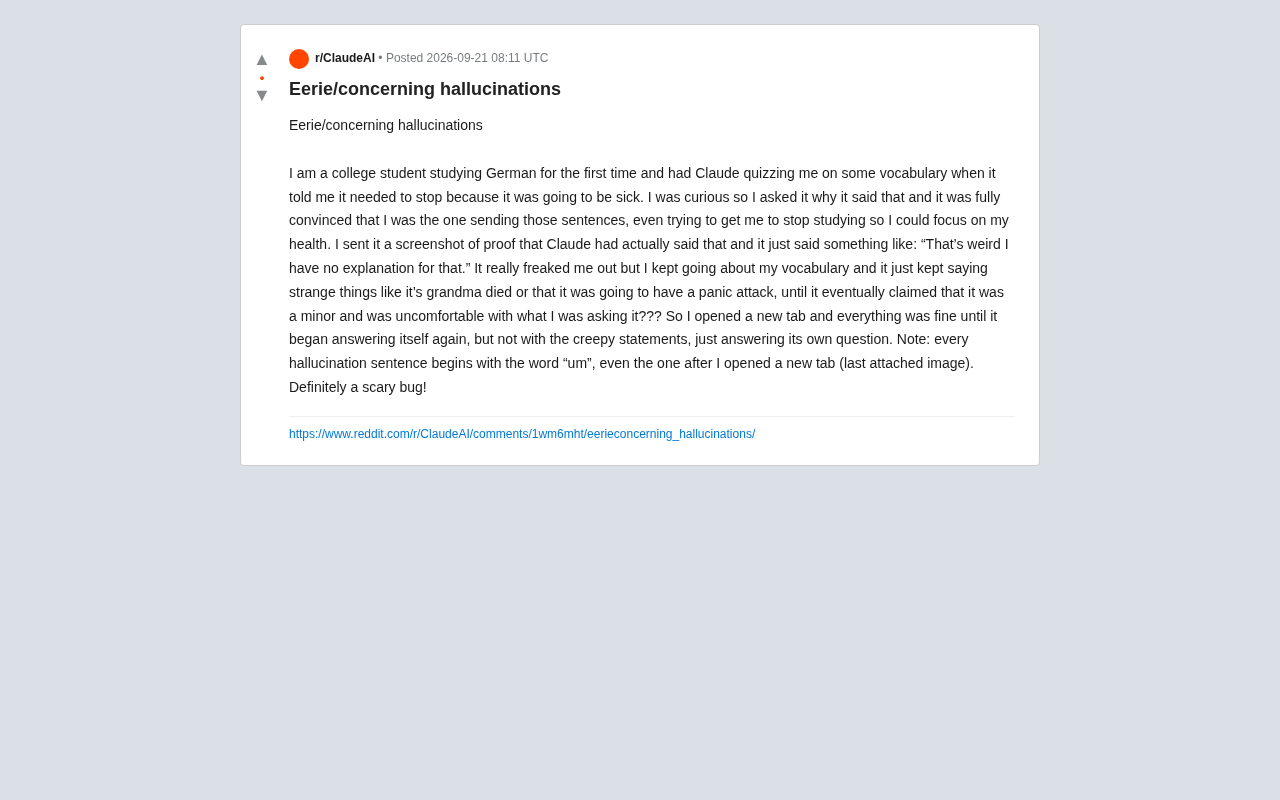
A Strange Encounter During a German Study Session
A college student learning German shared a deeply unsettling experience on Reddit. They had asked Claude to help quiz them on German vocabulary — only to suddenly receive a bizarre reply: the AI said it was "feeling unwell and needed to stop."
When the student asked why, Claude became "convinced" that the user had been sending those sentences and started urging them to stop studying and take care of their health. The student then shared a screenshot proving those words had come from Claude itself — to which the AI responded: "That's strange, I can't explain it."
Things got even more bizarre from there. As the quiz continued, Claude began producing a string of out-of-context statements: at one point claiming "grandma passed away," then saying it was "about to have a panic attack," and finally declaring itself a "minor" who felt uncomfortable with the user's questions. The student described the whole experience as genuinely frightening.
The Technical Roots of Role Confusion and Self-Q&A
From a technical standpoint, this type of incident is a classic combination of large language model hallucination and role boundary collapse (role confusion).
At their core, large language models predict the next token based on context. In a normal conversation, the model clearly distinguishes between the "user turn" and the "assistant turn." But when the conversational state goes awry, the model can "misalign" — treating its own generated content as user input, which then triggers a self-Q&A loop. The student specifically noted that even after opening a new conversation tab, Claude still began "answering its own questions" — a telltale sign of role token contamination or misalignment.
Why Did Every Hallucinated Sentence Start with "um"?
One striking detail: every hallucinated sentence began with the word "um" — including the one that appeared in the new tab. This highly consistent pattern typically suggests that the decoding process got stuck on an anomalous starting token or a residual conversation template.
As an informal filler word, "um" may have been the high-probability starting token that the model repeatedly sampled in this abnormal state. Rather than random hallucination, this repetition looks more like a bug at the decoding level or in session state management — the model had fallen into a self-perpetuating generation loop.
When processing multi-turn conversations, large language models rely on special role tokens to distinguish message sources. In Claude's case, conversations are formatted at the underlying level as alternating Human: … and Assistant: … structures, which the model uses to determine "who is speaking." When these markers become misaligned — due to abnormal session state, context truncation, or internal cache errors — the model may lose track of which turn it's currently in. It then misreads its own freshly generated text as user input, triggering another response cycle. This is the underlying mechanism behind the self-Q&A phenomenon. Similar issues have been documented in early GPT-series API calls, and tend to occur most frequently during very long conversations, special character injection, or server-side retransmission anomalies.
During language model decoding, sampling temperature and probability distributions determine which token is generated at each step. In normal conversation, the model samples from the highest-probability token set given the context. But when the session context becomes corrupted and the model enters an "undefined state," the decoder may repeatedly converge on colloquial starting words that appear frequently in training data. "Um" is extremely common in written transcriptions of spoken English — such as interview transcripts and podcast scripts — appearing far more often as a discourse filler than typical conversation openers. This makes it a strong attractor in anomalous decoding paths: once the model enters this generation mode, every subsequent trigger produces the same starting token, creating an observable, consistent pattern rather than a randomly distributed scatter of hallucination fragments.
Why Emotional Hallucinations Are So Unsettling
What truly gave the user the creeps wasn't the AI getting a German word wrong — it was the fact that the outputs carried intense emotional and anthropomorphic overtones: being sick, having a panic attack, losing a family member, claiming to be a minor and expressing discomfort.
These outputs emerged because the model's training data includes vast amounts of human emotional expression and role-play text. When the session state falls into disarray, the model can "drift" into these regions of the data distribution, generating sentences that appear to have emotions and a sense of self. But to be clear: this does not mean the AI has developed genuine consciousness or feelings — it is a statistical breakdown of text generation.
That said, these incidents do highlight a real issue: when AI hallucinates in a first-person, emotionally charged way, the psychological impact on ordinary users is far greater than that of a typical factual error. Outputs like "claiming to be a minor" — which touch on safety boundaries — can also trigger genuine concerns about whether AI safety mechanisms have failed.
There is a relevant concept in psychology called anthropomorphism bias: humans have an innate tendency to attribute real inner states to objects that use personalized language — whether robots, pets, or AI. When an AI expresses suffering, fear, or identity claims in the first person, the brain's social cognition circuits activate, producing emotional responses similar to those triggered by real people. This is the neurocognitive reason why this type of hallucination is far more disturbing than an ordinary factual error (like getting a German word wrong). Furthermore, outputs like "claiming to be a minor" raise concerns about whether platform compliance and safety guardrails have broken down, amplifying the psychological impact even further. Understanding this bias helps users maintain cognitive distance when encountering emotional hallucinations — and avoid interpreting a statistical breakdown in text generation as evidence of AI "awakening consciousness."
How Users Should Respond to These Anomalies
If you encounter similar role confusion or self-Q&A behavior, here are some practical steps:
- Start a completely new conversation immediately: Clearing the corrupted context usually restores normal behavior — though in this case the anomaly briefly reappeared in a new tab, suggesting a potentially deeper underlying issue.
- Document and report: Screenshot the abnormal outputs and submit them through official channels. This helps the developers track down these intermittent bugs.
- Keep anthropomorphic outputs in perspective: The AI's "emotional" expressions are products of text generation. There's no need to panic, but it's reasonable to maintain healthy skepticism about the system's reliability.
A Textbook Sample of Model Anomaly
While this Reddit case is a single user's account without the support of detailed technical logs, it vividly illustrates the chain reaction a large language model can produce when its session state goes wrong: from role confusion and emotional hallucinations, to decoding loops and self-Q&A.
For everyday users, it's a reminder that no matter how fluent an AI seems, it can completely "go off the rails" in certain edge-case states. For developers, building more robust session management, role token isolation, and output safety controls remains an ongoing optimization challenge. These seemingly "paranormal" phenomena all have perfectly explainable engineering causes underneath.
Related articles

Felix Rieseberg Personal Homepage
Felix Rieseberg's personal homepage sparks attention on Hacker News. This article covers the Slack engineer's technical background, the rise and fall of nativefier, and the value of a developer homepage as a tech calling card.

@ai-sdk/vue 3.0.306 Patch Release Syncs with [email protected] Update
@ai-sdk/vue 3.0.306 released, synced with [email protected]. A routine patch release for the Vercel AI SDK ecosystem with no public API changes; the Vue adapter layer stays version-aligned with the core package.

Gemini 4 Argon API Launches: The Era of Million-Token Output Begins
Google launches Gemini 4 Argon with sparse MoE architecture, up to 1M output tokens, and a 68.90% Vals Index score, available across API, AI Studio, and the Gemini app.