Claude's Filters Tighten: Why Game Mod Developers Are Worried

A Reddit user worries that after Anthropic tightens copyright filtering, Claude's usability for game modding and decompilation tasks will decline.
A Reddit user posted about concerns regarding Claude's future usability. They use Claude almost exclusively for deep modification tasks like game decompilation, mod creation, cloning game mechanics, and porting systems, where Claude previously cooperated well. But after Anthropic tightened copyright filtering, the user fears more requests will be blocked. They describe Claude sometimes refusing requests with arbitrary or even contradictory reasons, such as citing "kobolds are coded by children" to refuse adding gory combat. The article analyzes that this reflects the structural risk creators face when binding core workflows to a continuously iterating commercial model, while emphasizing that the concern is based on a single user's account and needs multi-source verification.
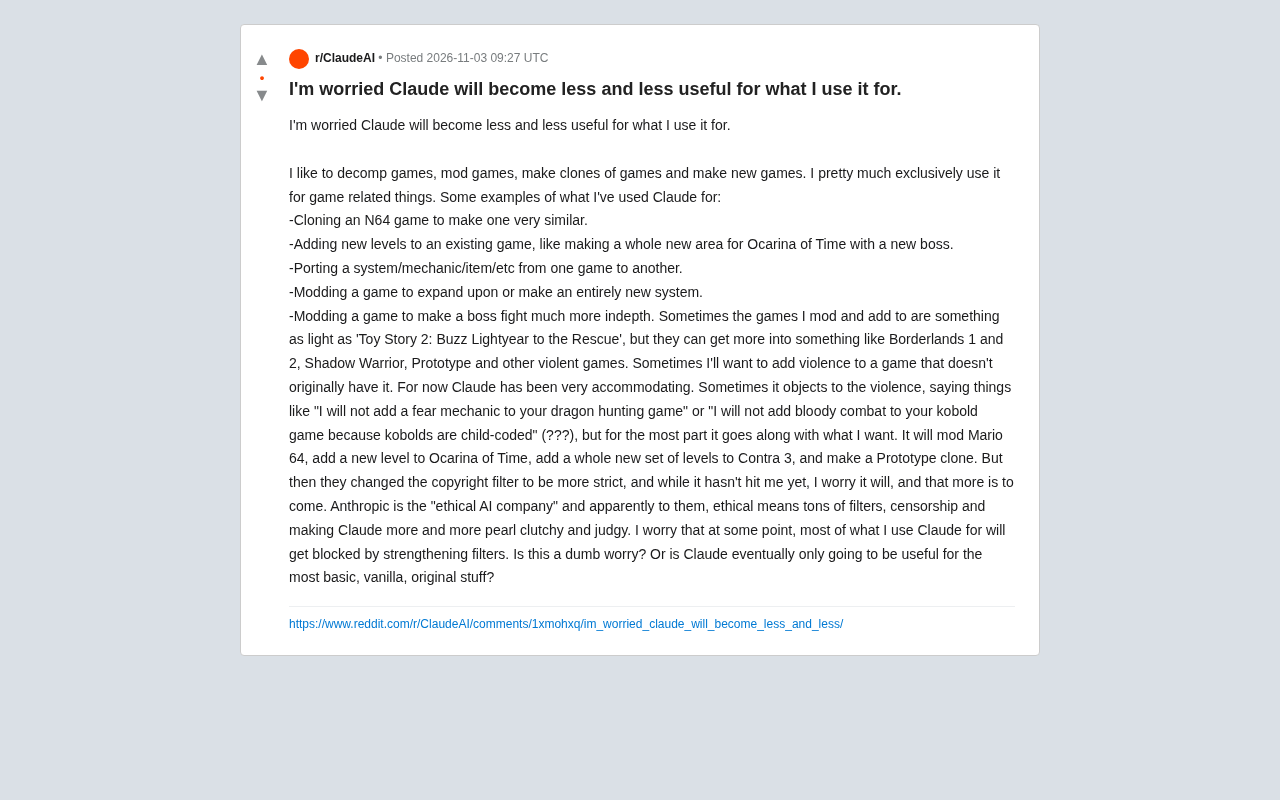
A Reddit user recently posted about their deep concerns regarding Claude's future usability. They use Claude almost exclusively for game-related work: decompiling games, building mods, cloning game mechanics, adding new areas and bosses to The Legend of Zelda: Ocarina of Time, porting a system from one game to another, and even expanding gameplay for lightweight games like Toy Story 2 and violent games like Borderlands and Prototype.
A Mod Developer's Daily Routine: Claude's Actual Role in Game Modification
Judging from the post, this user's use cases go far beyond "writing some code." They have Claude clone N64 games, add entirely new levels to existing games, port system mechanics, and expand boss battle depth. These tasks involve reverse engineering, code comprehension, cross-engine adaptation, and creative design—placing high demands on a model's contextual understanding and code generation capabilities.
Interestingly, Claude has been "very cooperative" with these tasks. The user mentions that Claude will modify Super Mario 64, add new levels to Ocarina of Time, create entire new level sets for Contra 3, and even build clones of Prototype. This suggests that before copyright filtering tightened, Claude was quite permissive with this kind of game modification work.
Decompilation is the process of reverse-engineering a compiled binary program (such as an N64 game ROM) back into high-level source code. In the game modding community, the classic approach is community-collaborative "decompilation projects"—for example, Super Mario 64 and The Legend of Zelda: Ocarina of Time both have mature decompilation codebases that allow developers to add new levels, new bosses, or port mechanics on top of the original logic. This work requires deep understanding of assembly, memory layout, and engine architecture. The AI model's role in this process is typically to assist with reading code, explaining function logic, or generating adapted code.
When "Ethics" Becomes a Filter: The User's Real Anxiety
The turning point that unsettled this user was Anthropic tightening its copyright filtering. Although their specific use cases haven't been directly blocked yet, they worry this is just the beginning.
They wrote that Anthropic is an "ethical AI company," and in their view, so-called ethics means lots of filters, censorship, and Claude becoming increasingly "nosy" and "judgmental." They described some specific friction points: Claude sometimes refuses their requests, such as "I won't add fear mechanics to your dragon-hunting game," or "I won't add gory combat to your kobold game because kobolds are coded by children"—a reason the user was clearly baffled by, responding with three question marks.
These refusals aren't consistent—most of the time Claude still complies. But it's precisely this uncertainty that makes the user anxious: if filters continue to tighten, most of the workflows they rely on daily could suddenly become unavailable one day.
Content filters are mechanisms by which AI models perform safety review of requests and outputs before generating responses, typically implemented through policy rules or classifiers. Anthropic has established constitutional AI principles for Claude—"helpful, honest, harmless"—and the model refuses certain requests based on these principles. But the principles are abstract natural language descriptions, and the model's judgment in specific contexts may vary depending on the situation, causing the same type of request to sometimes be accepted and sometimes rejected. This inconsistency at the execution level is precisely the root of users' anxiety: they cannot predict whether a specific request will be blocked by reading public policies.
Where Are the Boundaries of Copyright and Content Policy?
The user's confusion touches on a genuine product design challenge. The game modding community has long existed in a copyright gray area, and the legal status of decompilation, cloning, and porting varies across jurisdictions. When AI companies face such requests, they need to draw a line between "helping developers realize their creativity" and "avoiding assisting infringement."
Content policy is equally tricky. Users want to add violent elements to games that originally had none, or introduce darker mechanics to child-oriented games—such requests trigger the model's safety training. The refusal reasons Claude gives sometimes seem arbitrary or even contradictory—why are kobolds "coded by children"? This is hard to match to any provision in public policy.
From Anthropic's perspective, tightening filters may be about reducing legal risk and maintaining brand positioning. But for frontline creators, the ambiguity of policy and inconsistency of enforcement is more unsettling than explicit prohibitions.
The copyright gray area is particularly prominent in game modding. Decompilation itself may involve infringement of reproduction rights in most jurisdictions, but some countries allow reverse engineering for interoperability, research, or educational purposes; cloning game mechanics is even more complex—gameplay ideas are generally not protected by copyright, but specific code, art, and audio assets are. AI companies lack unified legal standards to follow when handling such requests, so they tend toward conservative filtering. This conservative strategy conflicts with the "do first, ask later" culture that the modding community has long relied on, and is also the institutional backdrop to users' confusion.
The Risk of Tool Dependency: When Your Workflow Is Bound to a Model That Changes
Setting aside specific policies, this post exposes a more structural problem: when creators build their core workflows on a continuously iterating commercial model, every policy adjustment by the model can become a production risk.
The user's use cases are highly vertical, almost entirely centered on game modification. Once Claude's filters tighten to the point of affecting decompilation or mod-related requests, they have no obvious alternative—different models vary greatly in content policy, code capability, and context window, and migration costs are not low.
They asked at the end of the post: "Is this an unnecessary worry? Or will Claude eventually only be useful for the most basic, most vanilla, most original things?" There's no standard answer to this question, but it's worth serious consideration by every developer who embeds AI tools into deep workflows.
Model version iteration and policy drift are inherent features of commercial AI services. Model providers regularly update safety policies, adjust refusal thresholds, and even change underlying model versions, while users typically cannot lock in old versions or obtain stable behavioral guarantees. For developers who embed AI into deep workflows, this means production environments carry "policy downtime" risk—not because the service is down, but because the model suddenly refuses to perform previously available tasks. Ways to mitigate this risk include: keeping local open-source models as backups, splitting critical workflows into replaceable modules, and documenting model refusal patterns to adjust request phrasing in advance.
Consensus and Divergence Across Multiple Perspectives
It should be noted that the above analysis is mainly based on this single Reddit post and represents a single-source account of user experience. The specific refusal cases mentioned in the post (fear mechanics in a dragon-hunting game, gory combat in a kobold game) and the timeline of tightened copyright filtering all come from the user's personal description and have not been cross-verified with Anthropic's official policy documents.
In the AI community, discussions about whether model content filtering is excessive and whether refusal reasons are consistent have long existed, but experiences vary greatly across users. Whether this user's concerns are universal still requires more developers' actual usage feedback to corroborate. What is certain is that the tension between model capabilities and content policy is becoming a real problem that users of AI programming tools must face.
Related articles

AI Coding Enters the Team Collaboration Era: Interpreting Three Major Moves from Meta, GitHub, and Mistral
Meta acquires Conductor, GitHub Copilot Fusion becomes available, Mistral opens Large 4 weights—three moves show AI coding shifting from code generation to organizing development workflows. This article explains task orchestration, model collaboration, and cost control for developers.

Building a RAG Assistant with Dify: A Practical Guide to Knowledge Bases, Workflows, and Agent Nodes
How should knowledge bases, workflows, and Agent nodes connect in a Dify RAG assistant? We break down the division of labor and wiring logic for a shippable app.
 Tech Frontiers
The AI Industry Doesn't Lack Marketing—It Lacks Good Products
AI faces market selloffs and public skepticism—is marketing really the problem? This analysis of market signals and product experience argues the core困境 is incomplete products and a gap between promises and experience; the only way to change perceptions is to ship better products.