Claude Service Disruption: Official Investigation into Authentication Errors
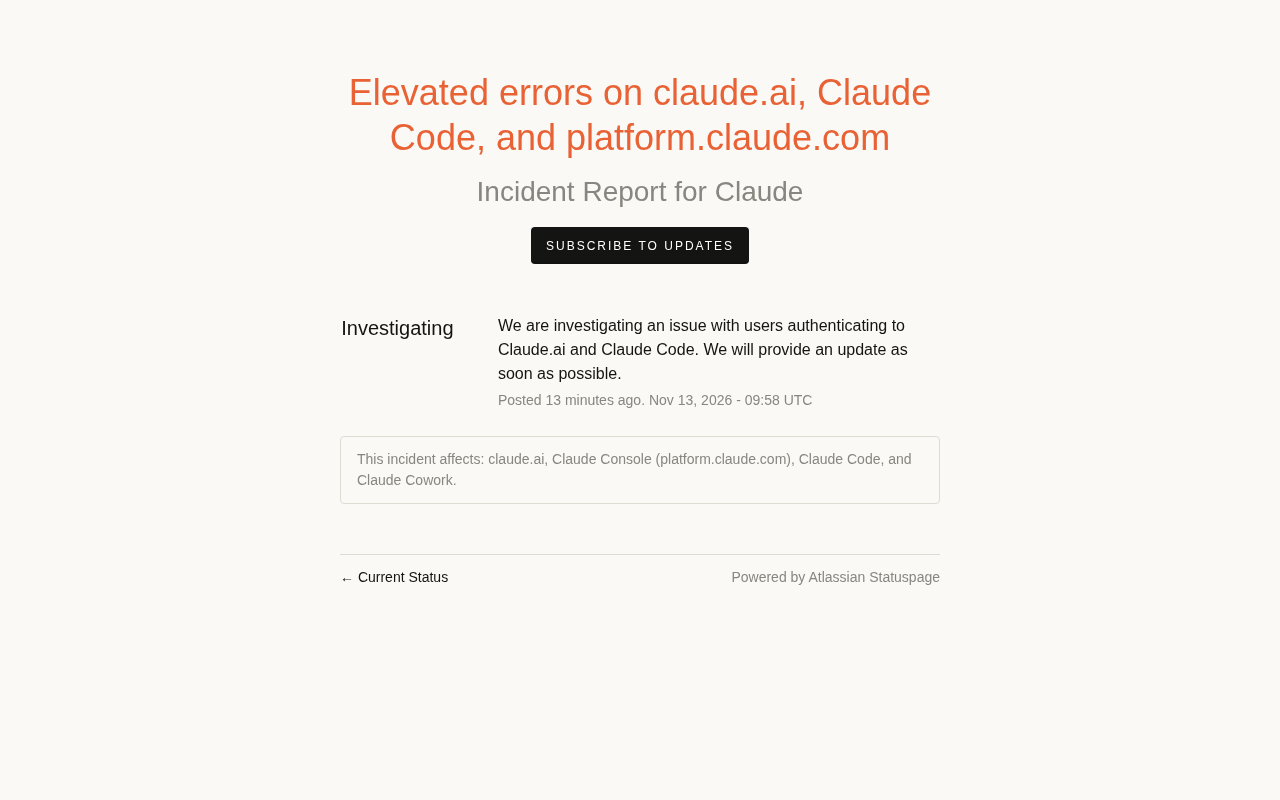
Claude's three main entry points are experiencing service errors due to user authentication failures, and the official team has launched an investigation.
The official Claude status page shows service errors at claude.ai, Claude Code, and platform.claude.com, with the issue concentrated in user authentication. At 09:58 UTC, the status was marked as Investigating, confirming the issue and promising updates soon, but no root cause or estimated fix time has been announced. The article notes that authentication failures may affect login, session establishment, and identity verification rather than model inference itself, but for developers relying on the API, authentication failures directly cause request interruptions, impacting automated workflows and production integrations. It advises developers to check logs for concentrated 401/403 error codes to distinguish platform failures from their own configuration issues, add retry and fallback mechanisms for critical tasks, and monitor status page updates; it also reminds teams relying on Claude for production to establish multi-model backups and health check mechanisms.
Incident Overview
According to the official Claude status page, claude.ai, Claude Code, and platform.claude.com are experiencing service errors, specifically in the user authentication step. At 09:58 UTC, the official status was marked as "Investigating," and the team stated they are looking into the issue and will provide updates as soon as possible.
Affected Scope
The errors impact three main entry points:
- claude.ai: The conversational product for general users.
- Claude Code: The command-line coding tool for developers.
- platform.claude.com: The API and platform console for developers.
The official description explicitly points to the "user authentication" step, meaning the impact may be concentrated in login, session establishment, or identity verification rather than model inference itself. For developers relying on the API, authentication failures often directly cause request failures, and the impact should not be underestimated.
Official Response and Timeline
The official status update is very brief: confirming the issue exists, investigating, and promising updates soon. As of the time of this information, there is no root cause explanation or estimated fix time.
This "confirm first, supplement later" response is common in cloud service outages, but for users, there is still room for improvement in transparency—especially when the failure involves authentication, a foundational capability. Users find it difficult to determine on their own whether it's an account issue or a platform issue.
Semantic Layering of Status Pages: Major cloud services typically use a fixed set of severity labels on their status pages, commonly in the order: Investigating (issue identified, being located), Identified (root cause found), Monitoring (fix deployed, under observation), Resolved (recovered). When users see "Investigating," it means the official team has not yet confirmed the root cause, and any time estimates given at this stage lack basis, so most vendors deliberately avoid committing to a fix time. A practical way to gauge the severity of an incident is to observe how long the status stays between Investigating and Identified—the longer it stays, the more complex the issue or the broader the impact.
Impact on Developers and Recommendations
Authentication failures in Claude Code and the platform will directly affect automated workflows and API integrations. Until further official clarification, developers are advised to:
- Check their own error logs to confirm whether failures are concentrated in authentication-related status codes such as 401/403, to distinguish platform issues from their own configuration problems.
- Add retry and fallback mechanisms for critical tasks to avoid single-point dependencies.
- Monitor subsequent updates on the official status page and wait for root cause and fix progress.
Information is currently limited, and the incident is still developing. For teams relying on Claude as a production dependency, this authentication-layer failure is another reminder: multi-model backups and health check mechanisms are essential to reduce the risk of service interruptions.
Difference Between 401 and 403: 401 Unauthorized means the request lacks valid credentials or the credentials have expired (e.g., token expired, incorrect key), while 403 Forbidden means the identity has been recognized but does not have permission to access the resource. Authentication-layer failures typically manifest as a large number of 401 errors across accounts and regions, persisting even with retries; whereas configuration issues usually affect only a single key or a single project. Developers can use this to quickly distinguish platform-side failures from local configuration errors, avoiding repeated key rotation during outages that could expand the impact.
Retry and Backoff: Directly retrying authentication errors without intervals is usually ineffective and increases service pressure. The industry recommends using exponential backoff with jitter, and distinguishing error categories before retrying—5xx and timeouts are suitable for retries, while 401/403 should fail fast and trigger alerts when credentials have not changed, rather than retrying indefinitely.
One-line Summary
Claude's three main entry points are experiencing service errors due to user authentication failures, and the official team has launched an investigation.
Paragraph Summary
The official Claude status page shows service errors at claude.ai, Claude Code, and platform.claude.com, with the issue concentrated in user authentication. At 09:58 UTC, the status was marked as Investigating, confirming the issue and promising updates soon, but no root cause or estimated fix time has been announced. The article notes that authentication failures mean the impact may be concentrated in login, session establishment, and identity verification rather than model inference itself, but for developers relying on the API, authentication failures directly cause request interruptions, affecting automated workflows and production integrations. Developers are advised to check logs for concentrated 401/403 error codes to distinguish platform failures from their own configuration issues, add retry and fallback mechanisms for critical tasks, and continue monitoring status page updates; it also reminds teams relying on Claude for production to establish multi-model backups and health check mechanisms.
Related articles

AI Code Generation Is Getting Cheaper—Validation Is the Real Challenge
Code generation is getting cheaper, and the bottleneck is shifting to validation. Drawing on Satya Nadella's interview, this piece analyzes coding agents' specifications, multi-model review, separation of permissions, organizational changes, and how engineers can turn a single fix into reusable team capability.

Saparo: The Shopping AI Agent That Stacks Discounts Automatically, Topping Product Hunt
Saparo is an AI shopping agent that automatically stacks discounts, topping Product Hunt. It finds the same item, matches sizes, combines promo codes and cashback, ranks by total cost including shipping and taxes, and leaves final payment to the user.

Tripmojo: The AI Travel Agent That Checks You In
Tripmojo is the #2 AI travel agent on Product Hunt: it syncs booking emails into a shared itinerary and lets Mojo attempt check-in, save boarding passes, and flag delays.