Claude Services Briefly Disrupted by Misjudged Spend Limits

Multiple Claude product lines were mistakenly suspended due to a spend limit misjudgment; Anthropic has fixed the issue but disclosed no details.
Anthropic's Claude product line recently experienced a service disruption caused not by model or infrastructure failure but by a spend limit system misjudgment. Some organizations were incorrectly flagged as over their spending cap, leading to account suspensions and rejected requests. The incident affected five product lines—Claude API, Claude.ai, Claude Code, Claude Security, and Claude Cowork—disrupting entire workflows for teams relying on multiple entry points. Anthropic later marked the status as Resolved, stating mistakenly suspended organizations were restored, but disclosed no details on affected organization count, duration, or prevention measures. The incident underscores the critical role of billing and quota systems in AI service availability and reminds users to strengthen error monitoring, prepare backup plans, and regularly verify usage.
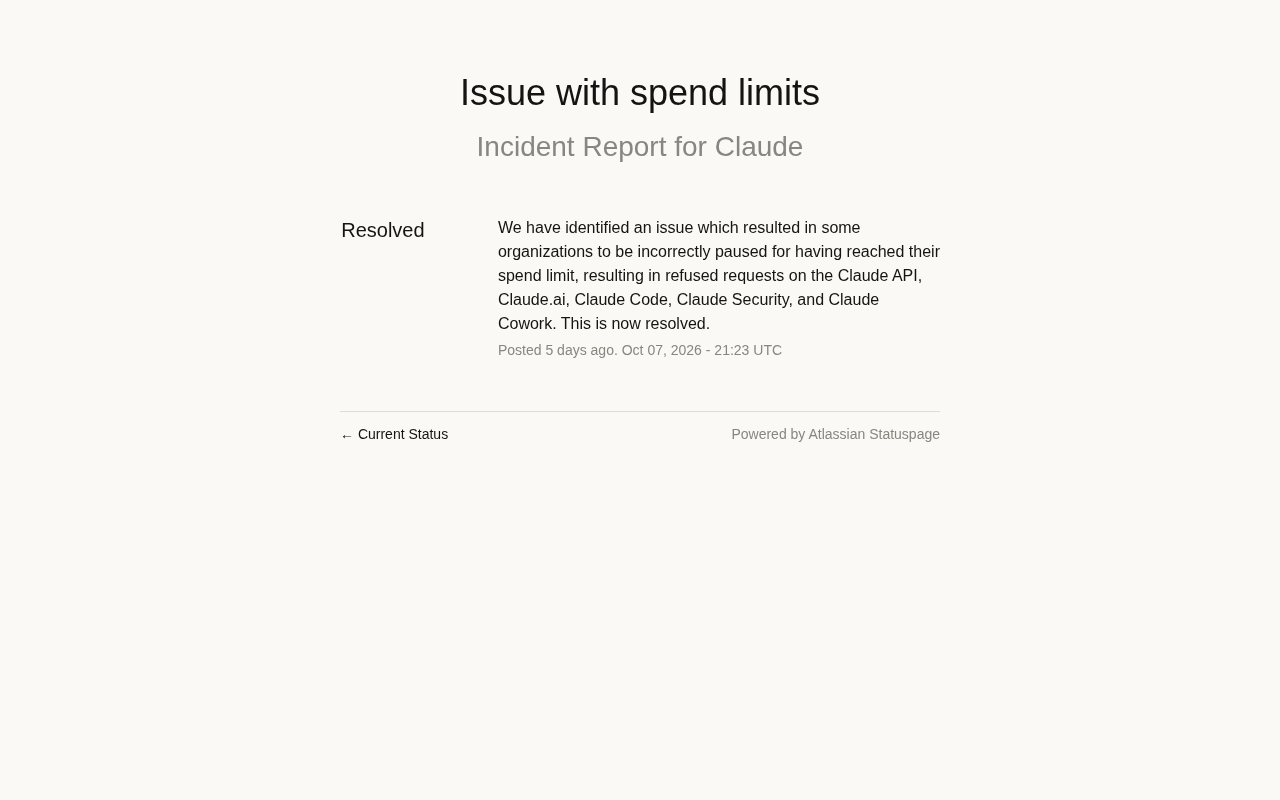
Anthropic's Claude product line recently experienced a service disruption—not due to model failure or infrastructure downtime, but because of a misjudgment in the spend limit system. According to an announcement on the official status page, some organizations were incorrectly flagged as having reached their spending cap, causing their accounts to be suspended and subsequent requests to be rejected.
What Happened
The announcement indicates the issue affected five product lines: Claude API, Claude.ai, Claude Code, Claude Security, and Claude Cowork. For teams relying on multiple entry points simultaneously, this meant that almost the entire workflow—from the chat interface to the coding assistant and on to security and collaboration tools—became unavailable within a short window.
Anthropic marked the incident as Resolved, indicating the problem had been identified and fixed. Judging from the wording, the root cause lay in the spend limit determination logic rather than accounts actually exceeding their budgets. In other words, this was a case of "collateral damage"—the system mistakenly classified normal accounts as over-limit and triggered the suspension mechanism.
For usage-based AI services, spend limits serve as an important safeguard against runaway bills. But when the guardrail itself misfires, the side effect is a direct cut to service availability.
Why Billing System Failures Deserve Attention
The core tension in this incident: a mechanism designed to "protect users' wallets" instead became the trigger for service disruption.
From an engineering perspective, spend limits typically require real-time consistency across billing data, account status, and request gateways. If threshold calculations or synchronization at any point in this chain goes wrong, organizations that haven't exceeded their limits can be flagged as over-limit. Since suspension actions often take effect immediately and reject subsequent requests, what users experience on their end is essentially an instant cutoff.
More critically, the blast radius. Claude's multiple product lines share the same account and billing system, so a single misjudgment can simultaneously affect API calls, web-based conversations, and coding tools. For teams that have integrated Claude Code into their daily development workflow, such disruptions directly interrupt coding, debugging, and automation tasks.
The difference between 4xx and 5xx status codes: In the HTTP protocol, the first digit of a status code indicates the error category. 4xx indicates a client error, such as 401 (unauthorized), 403 (forbidden), or 429 (too many requests/quota exceeded), typically meaning the request itself has an issue or has triggered an account restriction; 5xx indicates a server-side error, such as 500 (internal error) or 503 (service unavailable), meaning the problem lies with the service provider. In the spend limit misjudgment incident, rejected requests most likely returned 403 or 429, since the system classified accounts as over-limit—this is "rejection rather than failure." This also explains why monitoring must distinguish between the two error categories: 4xx often points to quota, authentication, or configuration issues, while 5xx is more likely related to platform failures. The troubleshooting direction and response strategies for each are completely different.
Official Response and Current Status
The announcement's conclusion is that the issue has been Resolved, and it explicitly states that organizations previously suspended in error have now been restored. The official announcement did not disclose the number of affected organizations, the duration of the failure, or whether the limit determination logic will be adjusted to prevent recurrence.
Judging from the status page's communication style, this disclosure is a typical post-incident confirmation: first mark as resolved, then briefly describe the cause and scope of impact. For developers and enterprise users relying on Claude, it's advisable to watch for whether a more detailed postmortem will follow, particularly regarding improvements to threshold determination and status synchronization.
Postmortem: In software engineering and SRE (Site Reliability Engineering) practice, a postmortem is a review document written after an incident is resolved, typically including the incident timeline, scope of impact, root cause analysis, response process, and improvement items to prevent recurrence. It emphasizes being "tough on the problem, not on the people," with the goal of helping teams and organizations learn from failures rather than assign blame. For usage-based AI services, a high-quality postmortem typically explains threshold determination logic, status synchronization mechanisms, monitoring blind spots, and newly added alerting or circuit-breaking measures. This announcement is a brief confirmation at the "Resolved" level and has not yet reached the depth of a full postmortem, so the community is watching for whether a more detailed incident report will be published to determine whether similar misjudgments could happen again.
A Few Suggestions for Users
Although this incident has been fixed, it still exposes the strong impact of a single billing determination on service availability. Teams using Claude API or Claude Code can prepare some contingency plans:
- Add error monitoring and alerting for 4xx/5xx rejection requests in critical business processes, distinguishing between "quota issues" and "network issues."
- Prepare backup models or backup providers for important tasks to avoid single points of dependency.
- Regularly verify account usage against official bills; when abnormal suspensions occur, immediately confirm through support channels whether it's a system misjudgment.
The stability of AI services doesn't depend solely on model inference capability—billing, authentication, and quota systems are equally part of availability. This incident reminds us that the robustness of guardrail mechanisms themselves deserves just as much serious attention as the models themselves.
The difference between quota and spend limit: The two are often used interchangeably, but they emphasize different things. Quota typically refers to the number of requests or tokens allowed per unit of time—for example, 1,000 API calls per minute—used to control resource consumption and ensure fair use; spend limit is a monetary cap—for example, $500 per month—used to prevent runaway bills. Both can trigger request rejections, but for different reasons: exceeding quota means "using too fast," while exceeding spend limit means "spending too much." This incident was a spend limit misjudgment, so the correct response is to verify bills and usage to confirm whether the account has truly overspent, rather than simply reducing request frequency. Understanding this distinction helps teams locate the source of problems more quickly during alerting and troubleshooting.
One-line Summary
Multiple Claude product lines were mistakenly suspended due to a spend limit system misjudgment; Anthropic has fixed the issue but disclosed no details.
Paragraph Summary
Anthropic's Claude product line recently experienced a service disruption—not due to model or infrastructure failure, but because of a spend limit system misjudgment. Some organizations were incorrectly flagged as having reached their spending cap, causing account suspensions and rejected requests. The incident affected five product lines—Claude API, Claude.ai, Claude Code, Claude Security, and Claude Cowork—disrupting entire workflows for teams relying on multiple entry points. Anthropic subsequently marked the status as Resolved, stating that mistakenly suspended organizations have been restored, but did not disclose the number of affected organizations, duration, or recurrence prevention measures. The incident highlights the critical impact of billing, quota, and other peripheral systems on AI service availability, and reminds users to strengthen error monitoring, prepare backup solutions, and regularly verify usage.
Related articles

JobRunner MCP Server: AI Agents Can Now Fix Failed Java Jobs
JobRunner launches an open-source MCP server enabling AI agents to view cluster status, diagnose failures, and recover Java jobs—incident response from any cloud coding environment or existing agent.

MLAI Digital Launches 9 Security Agents: MCP Server Safeguards the Full Lifecycle of Agentic AI
MLAI Digital launches Security MCP Server with nine built-in specialized security agents covering vulnerability discovery, attack simulation, prompt injection detection, API and infrastructure assessment, and accelerated remediation—embedding security validation across the full Agentic AI lifecycle from development to production.

Running Isaac Lab on H100 GPUs: Exploring Better Approaches
Exploring optimization methods for running Isaac Lab on NVIDIA H100 GPUs, including MIG configuration, mixed precision, TensorRT acceleration, and community experience to improve robotics simulation and reinforcement learning efficiency.