Claude Solves Black Hole Physics Puzzle: Anthropic Announces New Progress in Quantum Gravity

Claude completed an old black hole phase transition calculation and locked the exact quantum gravity bootstrap upper bound, but did not solve quantum gravity.
Anthropic reports that Claude Fable 5.2 achieved two advances in theoretical physics: it completed a twenty-year-old three-loop calculation of the Hawking-Page phase transition, showing that the abrupt transition tied to black hole formation persists where spacetime loses definite shape and matches holographic duality qualitatively; and it proved the lightest black hole mass upper bound in the 3D quantum gravity bootstrap is about c/9.1266 and optimal, improving the previous c/8.5 bound. Multiple Claude agents completed the work largely autonomously over about six weeks, with dual independent verification, Lean formal checks, and physicist review. The papers remain unreviewed preprints; Anthropic states the results do not describe the real universe, have no applications, and do not solve quantum gravity.
Title
Claude Solves Black Hole Physics Puzzle: Anthropic Announces New Progress in Quantum Gravity
Meta Description
Anthropic claims Claude Fable 5.2 solved two open problems in black hole and quantum gravity physics: completing a twenty-year-old calculation and proving the exact upper bound of the bootstrap method. This article analyzes the details, verification methods, and boundaries of the results, noting that they do not describe the real universe and the preprints have yet to undergo peer review.
Article Content
Anthropic recently published a research announcement claiming that its model Claude Fable 5.2 achieved two breakthroughs in theoretical physics, both related to black holes and quantum gravity. These are not benchmark scores but advances on actual research problems. The news was first interpreted by a YouTube tech channel and has attracted widespread attention.
Overview of the Two Results: From Calculation Completion to Mathematical Proof
According to the Anthropic research blog, Claude completed a calculation that physicists proposed over twenty years ago but had not solved, and proved an exact upper bound for the "modular bootstrap" method in quantum gravity research. Both works revolve around black hole physics but are quite different in nature: the former is the convergence of a long-range numerical calculation, while the latter required identifying numerical patterns and introducing mathematical tools from other fields.
One work completed a calculation that had been set up more than two decades ago but remained unresolved, showing that an abrupt transition associated with black hole formation persists in regions where spacetime loses its definite shape. The other work found the exact limit of the technique used to test candidate theories of quantum gravity—the bootstrap method—in its simplest version, and proved that this limit is optimal.
Anthropic explicitly states that neither result directly describes our universe, nor has practical applications, nor solves the quantum gravity problem. They merely add to the long-term effort to understand how quantum mechanics and general relativity can be reconciled.
The First Work: How the Twenty-Year-Old Calculation Was Completed
Quantum gravity attempts to unify the macroscopic description of general relativity with the microscopic description of quantum mechanics. Black holes are natural testing grounds for quantum gravity because they involve both enormous mass and extremely small space.
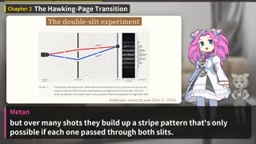
The research blog uses the analogy of choosing a route through New York City streets: a classical particle takes one path, while a quantum particle simultaneously experiences all possible paths. In the gravitational case, one must sum over all possible shapes of spacetime—precisely the problem addressed by Hawking and Page in 1983. They found that in anti-de Sitter spacetime (imaginable as a giant bowl), as temperature rises, two histories—a gas of particles and a black hole—compete, and the transition is abrupt, like water at its boiling point, known as the Hawking-Page phase transition.
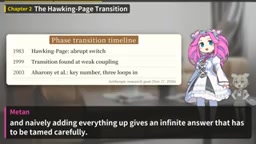
However, this calculation relies on general relativity and holds only when the cosmic scale is much larger than the Planck scale. When the universe shrinks to near that scale, spacetime loses its definite shape, and direct calculation becomes infeasible. Holographic duality offers another route: the same universe can be described by a gravity-free quantum theory, namely N=4 supersymmetric Yang-Mills theory. In 1999, physicists discovered that this theory also undergoes a phase transition at weak coupling, but whether the transition is abrupt or smooth remained unclear.
In 2003, Aherni et al. pointed out that the answer depends on a single number appearing in a three-loop diagram calculation. The calculation involves thousands of Feynman diagrams, making hand calculation nearly impossible, and naive summation diverges.
Claude's approach was to assemble a small agent research group: almost every step of the calculation was independently duplicated by two agents, and some results were compared with the literature. The final result: as temperature rises, the transition is abrupt, qualitatively consistent with the gravitational side of the Hawking-Page result. This suggests that black hole formation may not be exclusive to relativity but an intrinsic feature of the underlying quantum theory.
Holographic Duality and N=4 Supersymmetric Yang-Mills Theory
Holographic duality (AdS/CFT duality) is a conjecture proposed by Maldacena in 1997: a gravitational theory in anti-de Sitter (AdS) spacetime is completely equivalent to a gravity-free quantum field theory on the boundary of that spacetime. The boundary theory here is N=4 supersymmetric Yang-Mills theory—a gauge field theory with maximal supersymmetry. The key to the duality is that strongly coupled gravitational calculations in the AdS interior can be mapped to relatively tractable weakly coupled calculations in the boundary field theory (and vice versa). The first work in this article exploits precisely this property: when the universe shrinks to the Planck scale and spacetime loses its definite shape, directly performing the gravitational path sum is infeasible, but one can switch to the dual boundary field theory side and use weak-coupling expansion to calculate the phase transition properties.
Three-Loop Calculations and Feynman Diagram Divergences
In quantum field theory, each order of perturbation expansion corresponds to a class of Feynman diagrams. The number of loops indicates the number of independent momentum integrations; a three-loop diagram means three independent momentum integrations are required, far more complex than tree-level or one-loop diagrams. In this article, whether the Hawking-Page phase transition is abrupt or not boils down to a number appearing at the three-loop level, which requires enumerating and summing thousands of Feynman diagrams. Naively summing these diagrams one by one encounters divergences—i.e., the integral results tend to infinity—and must be handled through techniques such as renormalization or analytic continuation. The 2003 work of Aherni et al. pointed out the criticality of this number but was unable to complete it due to the scale of hand calculation. Claude's agent research group completed this long-range numerical calculation through parallel, cross-validated efforts.
The Second Work: The Upper Bound of the Bootstrap Method Is Precisely Locked
The second work targets a simplified model—three-dimensional gravity (two spatial dimensions plus one time dimension). This model still contains black holes and similar puzzles, but a complete quantum gravity theory is still lacking. Physicists use the bootstrap method: rather than directly constructing the correct theory, they rule out wrong options by proving candidate theories are self-contradictory.
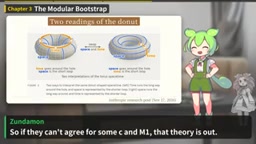
There are two key quantities: the central charge c (roughly a measure of how many tiny building blocks make up the universe, which is large when general relativity holds) and the mass of the lightest black hole m1. Physicists scan all possible combinations of c and m1, looking for inconsistencies. The criterion is still the sum over spacetime histories: the interior of a torus (doughnut) is spacetime, and the quantum theory is written on the surface. The torus can be read in two ways: the long cycle around the hole as time and the short cycle as space, or vice versa. In relativity, which cycle is called time should not affect the result, but quantum mechanics treats time specially, and the two calculations appear different. If for some pair of c and m1 the two calculations cannot be reconciled, that theory is ruled out.
Previously known: In 2009, Hellerman proved an upper bound of c/6 (with small corrections); numerical calculations suggested it could drop to about c/9.1, but calculations become harder as c increases, so no definitive conclusion could be reached; the best proven upper bound was c/8.5 by Hartmann, Mazache, and Rosselli. The proven upper bound being higher than the numerical suggestion indicated the method had not been fully exploited.
Claude reproduced literature results through numerical experiments and noticed a pattern physicists had missed: a tiny shift in the numerical upper bound as c grows. This led to a hypothesis about the bootstrap functional, using spectral curves known in mathematics and other areas of physics but never used for this problem. It then proved that the mass of the lightest black hole in three-dimensional quantum gravity does not exceed c/λ, where λ comes from an exact formula and is approximately 9.1266, lower than c/8.5, consistent with the numerical suggestion, and proved that this upper bound is optimal.
This does not identify the correct three-dimensional gravity theory—this version alone cannot push the upper bound to c/12 (the mass at which black holes begin to appear); other elements are needed. But this is one of the first exact results the bootstrap method has given on black hole-related problems.
Bootstrap Method and Torus Partition Function
The bootstrap method does not attempt to directly construct a theory but uses consistency conditions that quantum field theories must satisfy (such as unitarity, crossing symmetry, modular invariance) to rule out inconsistent parameter combinations. In the simplified model of three-dimensional quantum gravity, the core tool is the torus partition function: spacetime is viewed as a solid doughnut, and the quantum theory is defined on its two-dimensional boundary torus. The torus has two fundamental cycles (long and short), and one can choose which to take as the "time" direction. In classical general relativity, both choices give the same result (modular invariance); but quantum mechanics treats time specially, and the two readings may produce different partition functions. The bootstrap method requires these two results to be consistent, thereby imposing constraints on the central charge c and the lightest black hole mass m1. If some pair (c, m1) cannot satisfy consistency, that theory is ruled out. Hellerman's 2009 c/6 upper bound and the later proven c/8.5 upper bound were both obtained through such modular invariance arguments.
Autonomous Research Process and Verification Path
According to the blog, both results originated from a side project of Anthropic researcher Hongbin Chen. He asked Claude to list open problems in black holes and bootstrap directions, and within hours received 22 candidates. Each candidate was assigned an independent agent that could read each other's progress and collaborate. The agents ran in the background without special configuration for about six weeks, and the two results were essentially completed autonomously.
Verification of the first work: after one agent had been working for several weeks, another physicist independently using Claude shared the same result, and colleagues found that Chen's agent had arrived earlier. The two methods were different, forming a cross-validation. The second work came from multiple agents: the lead agent discovered the pattern during literature research, another agent researching higher-dimensional sphere packing translated it into a method (mathematically related); this method reproduced a sphere-packing result recently proved by an OpenAI model, and was then applied to the bootstrap problem—which Claude agents had previously failed in 61 parallel attempts. Two other agents independently arrived at the same answer, and the final proof's "the upper bound cannot be lowered further" part followed OpenAI's proof strategy.

In September, the results were formally verified in the Lean proof assistant. Claude wrote the papers with minimal guidance, and physicists checked each major result. The two papers are preprints, made public before formal peer review; no peer review status or independent evaluation by external physicists was found in the sources checked.
Lean Proof Assistant and Formal Verification
Lean is an interactive theorem prover based on dependent type theory that allows mathematical propositions to be written as formal statements and checks each step of a proof for validity by machine. Unlike numerical verification or manual review, Lean verifies the logical correctness of a proof: as long as the axioms and inference rules are accepted, the conclusion necessarily holds. In this article, Claude agents translated the key arguments of both results into Lean code, which was automatically checked by the proof assistant. This can rule out logical gaps or hidden assumptions in reasoning, but it cannot guarantee that the formalized proposition is the one physicists actually intended to prove—human oversight is still needed between formalization and physical interpretation. Therefore, Lean verification is a powerful but not sufficient verification step and must be combined with item-by-item checking by physicists.
Significance and Boundaries: Not "Solving Quantum Gravity"
The value of the two results lies at the methodological level: the first shows a qualitative match between the gravitational-side path sum and the gravity-free quantum theory, suggesting that black hole formation is a built-in feature of quantum theory; the second pushes the bootstrap upper bound from c/8.5 to about c/9.1266 and proves it optimal, narrowing the search range.
Anthropic explicitly denies direct application or description of the real universe. This is consistent with the norm of basic research: many theoretical results do not immediately map to experiments. What is truly noteworthy is the autonomous collaboration capability of AI agents in long-duration, multi-step, verifiable mathematical and physical tasks. From listing problems, parallel exploration, cross-validation, to formal proof, the process demonstrates the prototype of an "AI research group."
At the same time, caution is needed: the preprints have not undergone peer review, and external independent evaluation is limited; physicist checking and Lean verification are important but not exhaustive. Neither work solves quantum gravity—they are not even "close." But they do push the boundaries of a long-standing research field and provide a replicable collaboration paradigm for AI-assisted theoretical physics.
One-line Summary
Claude completed an old calculation of the black hole phase transition and locked in the exact upper bound of the quantum gravity bootstrap, but did not solve quantum gravity.
Paragraph Summary
Anthropic reports that Claude Fable 5.2 achieved two advances in theoretical physics: first, it completed a three-loop calculation from over twenty years ago concerning the Hawking-Page phase transition, showing that the abrupt transition associated with black hole formation persists in regions where spacetime loses its definite shape and is qualitatively consistent with the weak-coupling result of holographic duality; second, it proved that the upper bound on the lightest black hole mass in the three-dimensional quantum gravity bootstrap method is approximately c/9.1266, and proved this bound optimal, advancing the previously proven upper bound of c/8.5 to match numerical suggestions. Both works were essentially completed autonomously by multiple Claude agents over about six weeks, with some results independently verified through dual paths, and subjected to Lean formal verification and physicist checking. However, the papers are still preprints and have not undergone peer review; Anthropic explicitly states that the results do not directly describe the real universe, have no practical applications, and do not solve quantum gravity.
Related articles

Prompt Engineering for Beginners: From Writing Prompts to Engineering Thinking
Starting from the essence and four functions of prompts, this article systematically explains the six-step process, four success criteria, learning value, and practical limitations of prompt engineering to help you build a complete understanding.

Anthropic Launches Nasdaq IPO: AI Giant's Listing and Risk Disclosures
Anthropic officially launches its Nasdaq IPO under ticker ANT, with market valuation expected to potentially exceed SpaceX's record. The prospectus devotes nearly 100 pages to AI risks, while first-half revenue grew over 14x but net losses widened sharply, reigniting the AI bubble debate.

Rust cURL Clone Uses 4,832 unsafe Blocks—Is the Memory Safety Myth Broken?
A Rust cURL clone uses 4,832 unsafe keywords, challenging Rust's memory safety narrative. We analyze what unsafe really means, compare Fil-C, and examine rewrite motives.