Claude Sonnet 5.5 In-Depth Review: The Best Coding Model at Half the Price of Opus

Claude Sonnet 5.5 delivers near-Opus performance at half the price, generating complex 3D apps from a single prompt.
Anthropic's Claude Sonnet 5.5 marks a major leap in both capability and value. Real-world tests show it can generate a real-time 3D ocean, a playable Fall Guys clone, and a LEGO model creator from a single prompt — and even self-record demo videos. Rebuilding San Francisco in Unreal Engine 5 took days and millions of tokens but yielded impressive results. On benchmarks, Sonnet 5.5 beats Opus 5.5 on Terminal Bench 4.0 and nearly ties it elsewhere, with testers unable to distinguish the two after days of use. At $2/$10 per million tokens — half the cost of Opus 5.5 — its value proposition is exceptional. Key weaknesses include poor audio generation and minor rendering artifacts in complex 3D scenes.
Anthropic's latest Claude Sonnet 5.5 may be one of the best all-around AI models available today. A YouTuber with early access put the model through rigorous testing — from 3D ocean simulations to full game development to benchmark comparisons — offering a comprehensive look at this model's capabilities, limitations, and disruptive pricing strategy. This article breaks down those real-world results and explains why Sonnet 5.5 can deliver near-Opus performance at half the cost.
A 3D Ocean Built From a Single Prompt
The first demo was nothing short of stunning: the tester gave the model a single prompt asking it to "build a real-time 3D ocean in the browser and keep refining it until a still frame could pass for a real ocean photo." The prompt also described sea states ranging from glassy calm to stormy, whitecaps where waves break, realistic sky and cloud shadows on the water, time-of-day transitions from daylight to moonlit night, a sailboat with a wake in rain and lightning, and an underwater view with light beams and fish.
The final output included a wealth of adjustable parameters — sea state (from glassy calm to stormy), sun azimuth, cloud cover percentage, swell direction, choppiness, and more. As cloud cover increases, lighting naturally shifts as the sun is obscured. Clicking on the water surface triggers a splash easter egg, and switching to the underwater view reveals light shafts piercing through the ocean. Even more impressive: the tester had the model open each demo, record it, and edit the footage into a complete demo video — all without human intervention.
From Fall Guys to LEGO: Rapid-Fire Games and Apps
The tester built a playable Fall Guys clone using just one or two prompts — built on Three.js, featuring a player competing against 59 bots across five rounds culminating in a coronation ceremony. There's a key prompting tip here: you must explicitly tell the model to "repeatedly check its own work" during the build process, whether through screenshots, video, or by actually running the game itself.

Interestingly, the tester found that with improved prompting techniques, the game generated by Sonnet 5.5 was actually more fun than the Opus 5.5 version. Another highlight was a LEGO Creator app: type in text or upload an image, and the app generates a 3D model using real LEGO parts and colors, complete with step-by-step assembly instructions and a parts list you can upload to BrickLink.
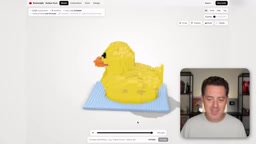
The prompt specifically instructed the model not to place bricks itself, but instead to describe the shape and let the program convert it into real parts — then verify that the model forms a single, fully connected, actually buildable structure. The final output supports exporting as a PDF instruction booklet, a BrickLink list, a Rebrickable CSV, an LDraw model, and other formats, with up to four bricks per step and new pieces highlighted.
Three.js is an open-source JavaScript 3D graphics library built on WebGL that lets developers render 3D scenes in the browser without plugins. It abstracts away the complexity of raw WebGL, providing high-level abstractions for cameras, lights, materials, and geometry — making it the go-to framework for AI-generated interactive 3D web apps. AI models favor Three.js because its API is intuitive, its documentation is extensive, and training data contains abundant Three.js examples, enabling models to generate functionally correct code with reasonable reliability. BrickLink and Rebrickable are two major LEGO community platforms for trading and cataloging parts; LDraw is an open LEGO digital model format readable by various LEGO design tools. The fact that the LEGO Creator outputs all three formats demonstrates the model's ability to map abstract shape planning to real industrial parts systems in structured output.
San Francisco in Unreal Engine and More 3D Showpieces
The tester used Sonnet 5.5 to reconstruct a photorealistic downtown San Francisco in Unreal Engine 5 — at true scale, based on real city data, populated with roughly 120,000 residents and 2,400 moving vehicles. The prompt asked for a system to govern each pedestrian's behavior and included an input box where typing an event like "Transamerica Pyramid is on fire" would trigger a city-wide response: fire trucks arriving, traffic yielding, crowds fleeing or gathering to watch.

The realism was impressive — pedestrians at street corners, traffic patterns, parked cars along the curb, and recognizable landmarks like Salesforce Tower and Union Square. But there were noticeable flaws: some buildings exhibited flickering reflections, shadows looked slightly off, and the scene would occasionally overload the computer and freeze. The tester acknowledged the project took several days and millions of tokens — it was anything but quick — but noted that "Sonnet genuinely solved the 3D problem."
Team members also created an Age of Empires-style game called Crown Fall, a Batman: Arkham Knight-style cityscape, a photorealistic Mario world, and a Forza-style racing game. The overall results were strong, with one universal weakness: the model performed poorly at generating sound effects and music. "It just doesn't sound good at all."
Benchmarks: Why Sonnet Can Challenge Opus
Pricing and benchmarks are where Sonnet 5.5 becomes truly remarkable. On Terminal Bench 4.0 — considered one of the most important benchmarks for coding — Sonnet 5.5, which is supposed to be the smaller, cheaper, faster model, actually beat Opus 5.5.
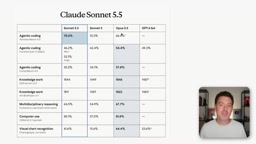
The margins on other benchmarks were equally tight: Frontier Code 1.1 (Extra High) was 52.1 vs. 54.4; Cursor Bench was 55.5 vs. 57.8; GDP Val was nearly identical (1844 vs. 1846); Humanity's Last Exam was 64.5 vs. 67.7; OS World computer operation was 80.1% vs. 81%; and chart recognition was 61% vs. 64%. After days of heavy use, the tester said he could barely tell the difference between Sonnet 5.5 and Opus 5.5 — "these models look almost identical."
Across multiple benchmarks, Sonnet 5.5 at low or medium reasoning intensity surpasses the best scores of the previous Sonnet generation at roughly one-tenth the cost. On pricing: Sonnet 5.5 is $2 per million input tokens and $10 per million output tokens — exactly half the cost of Opus 5.5 ($4/$20). While it still can't compete with open-source models priced at a few cents per million tokens, the ability to reach Opus-level quality makes this pricing extremely attractive.
Terminal Bench, Frontier Code, SWE-bench, and similar coding benchmarks are standardized evaluation suites that measure AI models' code generation and debugging capabilities. Terminal Bench simulates multi-step tasks in a real terminal environment, requiring models to not only write syntactically correct code but also understand system calls, file operations, and error handling — making it closer to real-world development scenarios than pure code-completion benchmarks. Humanity's Last Exam (HLE) is designed by hundreds of academic experts, covering extremely difficult problems in mathematics, science, and the humanities to test the boundaries of a model's knowledge and reasoning depth. OS World focuses on GUI interaction and automation tasks in desktop operating systems, reflecting a model's real-world capability as a "computer-using agent." Together, these benchmarks span multiple dimensions from pure reasoning to practical tool use, making Sonnet 5.5's combined performance more compelling than any single-task result.
One Quirky Detail
The tester also noticed one small oddity: Sonnet 5.5 tends to use British spellings in its writing — for example, spelling "color" as "colour." The reason is unclear, but since the model is highly controllable, a simple explicit instruction is all it takes to correct this. Overall, the tester gave a strong recommendation — Sonnet 5.5 is essentially as good as Opus 5.5 at a much lower price. "If you cancelled your subscription before, it's time to come back."
One caveat: this article is based on a single source's real-world demo. Some subjective assessments (such as "solved the 3D problem") reflect the creator's personal perspective, and readers are encouraged to validate performance against their own use cases.
Related articles

@ai-sdk/vue 3.0.306 Patch Release Syncs with [email protected] Update
@ai-sdk/vue 3.0.306 released, synced with [email protected]. A routine patch release for the Vercel AI SDK ecosystem with no public API changes; the Vue adapter layer stays version-aligned with the core package.

Gemini 4 Argon API Launches: The Era of Million-Token Output Begins
Google launches Gemini 4 Argon with sparse MoE architecture, up to 1M output tokens, and a 68.90% Vals Index score, available across API, AI Studio, and the Gemini app.

DukaanAI: Turning Product Photos into Inventory Lists with Open-Source AI
DukaanAI is an AI inventory tool for small retailers that turns product photos into inventory entries using the open-source Gemma 3 model, with local inference, editable fields, and CSV export.