Claude Sonnet 5.5 Launches: 30% Faster, and Meta Enters the Enterprise AI Arena

Anthropic speeds up without cutting prices, Meta bets on enterprise AI agents, OpenAI conference sets industry direction.
Three major AI developments: Claude Sonnet 5.5 delivers ~30% speed and efficiency gains but keeps per-token pricing unchanged — savings depend on the model genuinely using fewer tokens. Meta announces an enterprise AI platform bundling agent tools and APIs into business workflows, marking a strategic shift from social to enterprise. Meanwhile, the OpenAI developer conference opens in San Francisco. The industry's competitive focus is clearly moving from raw model capability toward efficiency, cost-effectiveness, and real-world business deployment.
Claude Sonnet 5.5: Faster, More Efficient — But the Price Tag Hasn't Changed
Anthropic has upgraded Claude with Sonnet 5.5, the model used for everyday tasks like writing code and building presentations. According to the company, the new version generates responses at least 30% faster than its predecessor, and can reduce the overall cost of completing the same task by up to 30%.
There's an important nuance here that's easy to miss: the per-million-token price hasn't actually dropped. The claimed "30% cost savings" comes from the model completing tasks using fewer tokens more efficiently — not from a price cut. For developers on a pay-per-use model, this distinction matters. Saving money depends on whether the model genuinely gets things done in fewer steps. If the task complexity stays the same and token consumption doesn't decrease, there are no savings.

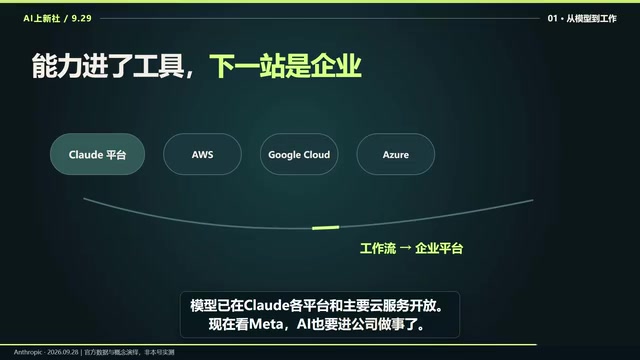
On the coding front, Sonnet 5.5 scores 70.6% on Anthropic's official coding benchmark. Worth noting: benchmark scores reflect performance on standardized test sets — they don't guarantee success on any arbitrary real-world project. Complex requirements, long context windows, and domain-specific edge cases all affect real-world outcomes. Sonnet 5.5 is now available across Claude's platforms and major cloud services.
The Product Logic Behind the Speed and Cost Claims
A 30% speed boost, up to 30% lower task costs, and no price increase — this combination points to a clear strategy: improve model efficiency so users get better value without a price hike, while Anthropic preserves its own margins. For teams running Claude in production, faster response times often improve user experience more directly than raw capability gains alone.
Tokens are the basic unit of text processing for large language models — roughly equivalent to "word fragments." In English, one word is approximately 1–2 tokens; in Chinese, one character is typically 1–2 tokens. API pricing is usually quoted per million tokens for both input and output. So even if the unit price stays the same, if the model completes a task using fewer tokens — for example, through shorter reasoning paths or fewer error-correction cycles — the actual bill goes down. This is why "efficiency gains" and "price cuts" can be functionally equivalent in business terms. The key caveat: this efficiency advantage only materializes when the model genuinely completes tasks in fewer steps.
Meta: Bringing AI Into Enterprise Workflows
Meta has announced a new enterprise AI platform — a signal that it's no longer content being just a chat assistant inside social apps. It wants AI to actually work inside companies.
According to the official plan, Meta intends to offer enterprise customers a bundled package of the MUSE agent, merchant agents, coding tools, and APIs. Think of it as plugging models and a full toolkit into customer service, business operations, and internal workflows — enabling AI to take on real functional roles in enterprise settings, not just answer questions.

This kind of "agentic" capability is a key battleground for major tech players right now. The AI value proposition is shifting from "can hold a conversation" to "can actually get things done." That said, it's worth keeping a measured perspective: Meta's announcement is largely directional and product-oriented — it doesn't promise every company can flip a switch today. Enterprise platform deployments typically involve significant costs around setup, compliance, and integration. There's usually a meaningful gap between an announcement and broad availability.
Agent mode refers to AI that doesn't just passively answer questions, but can actively plan steps, call external tools, and execute multi-step operations to complete a goal. For example, a sales agent might automatically check inventory, generate a quote, and send an email — all without human intervention at each step. The MUSE agent (short for Meta Universal Support Engine, though the official definition is still evolving) is Meta's concrete product attempt in this direction. The hard part of deploying enterprise agent systems isn't just model capability — it also involves API integration with existing systems, data permission isolation, operational audit compliance, and more. That's why enterprise AI platforms typically take months or longer to move from announcement to large-scale deployment.
OpenAI Developer Conference: Don't Mistake Speculation for Announcements
The OpenAI developer conference is being held in San Francisco, with the opening keynote livestreamed at 1:00 AM Beijing time.

Before the official presentations began, rumors and leaks about new products were everywhere. One media literacy principle worth keeping in mind: don't treat product speculation as official announcements. These conferences often set industry direction, but what actually matters is what's announced on stage.
Takeaways
This round of updates reveals a few shared signals: model vendors are competing on efficiency and value (Anthropic improves competitiveness by going faster and cheaper without lowering unit prices); major tech players are competing on real-world deployment (Meta pushes AI into enterprise internal workflows); and where the industry heads next depends on what OpenAI reveals at its developer conference. For users, the focus should gradually shift away from "how powerful are the parameters" and toward "can it actually get the job done, efficiently and cost-effectively."
Related articles

After the Right to Vote Was Lost: The Hidden Costs to American Democracy
Exploring how restrictive state voting laws, Supreme Court erosion of the Voting Rights Act, and partisan gerrymandering affect voter participation and fair representation after Democrats failed to pass the John Lewis Voting Rights Advancement Act and the Freedom to Vote Act.

Two Critical PHP Vulnerabilities Nearly Took Down the Internet: A Warning About the Fragility of the Web's Foundation
Two critical PHP vulnerabilities nearly shook the entire internet. This article analyzes why PHP vulnerabilities have such strong leverage effects, what real-world obstacles the patch chain faces, and what lessons infrastructure-level software security governance offers.
Musk Sounds the Alarm for Europe: A Wa…
Musk Sounds the Alarm for Europe: A Wave of US Tech Replacement Is Coming
Steve Blank's blog post sparks Hacker News debate: Musk's actions are prompting Europe to reconsider its reliance on US technology. This article sorts through the core arguments, the feasibility and divisions over replacing the US tech stack, and the practical impact on developers' technology choices.