Claude Sonnet 5.5 Launches: Faster, Cheaper, and More AI Model Updates Across the Board

Claude Sonnet 5.5 launches faster and cheaper as Manus, MiMo, and Kling all ship major updates.
Anthropic's Claude Sonnet 5.5 delivers ~30% faster output and up to 30% lower costs, targeting coding and office automation. On the domestic front, Manus 2.0 replaces its core framework and cuts token usage and runtime by ~30%; Xiaomi MiMo open-sources a fix for its repetitive tool-calling bug; and Kling 4.0 announces native 30-second video generation with multimodal reference support. Meanwhile, discrepancies between ChatGPT's Pro and Codex pricing pages raise transparency concerns, a platform issues a data compliance compensation notice pledging no default cloud sync, and Manus launches personal AI assistant "Q" with real-world execution capabilities.
Claude Sonnet 5.5: 30% Faster, 30% Cheaper
Anthropic has updated its flagship model lineup with the release of Claude Sonnet 5.5. Compared to the previous generation, the new version delivers approximately 30% faster output speeds and cuts task completion costs by up to 30%. For developers and enterprise users making high-frequency API calls, this combination of improvements translates into real gains in both efficiency and cost savings.
In terms of positioning, Sonnet 5.5 is explicitly aimed at bug fixing and office automation tasks, signaling a clear lean toward programming and productivity use cases. The model is already live on the Claude app and several third-party platforms, so developers can test its debugging performance firsthand.
For engineering teams that rely on large language models in production, speed and cost are non-negotiable metrics. The fact that Sonnet 5.5 improves on both simultaneously suggests that vendors are shifting their competitive battleground to "value for money" rather than simply stacking parameters or chasing benchmark rankings.
Domestic Models in Rapid Succession: Manus 2.0 and MiMo Fix
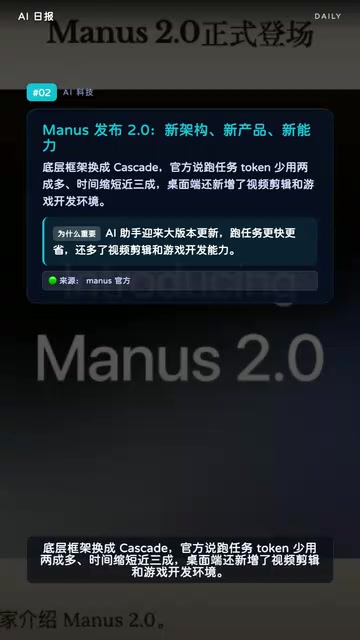
Beyond Claude, the domestic AI ecosystem is moving fast as well. Manus released version 2.0 — its first major update since resuming independent operations. The underlying framework has been replaced, and the team reports a significant reduction in token usage per task along with a roughly 30% cut in runtime. The desktop client also adds video editing and game development environments. This version is currently open to international users, with a domestic release in the works.
The Xiaomi MiMo team, meanwhile, patched a critical bug in MiMo V2.6 where the model would repeatedly issue identical tool calls — a "repetition loop" issue. The team trained a specialized fix model using repetition data, and the repetition rate has since dropped to near zero. The updated model is open-sourced and available via API under the same model name, and MiMo Desktop usage quotas have been reset.
Kling AI also officially announced its video generation model "Kling 4.0," set to launch next month. It supports native 30-second video generation, accepts up to 15 multimodal references in a single pass, and allows extension to 2-minute videos. Early access is currently available to Black Gold annual subscribers. Taken together, these updates show that domestic AI tools are pushing hard across three fronts: efficiency optimization, open-source ecosystems, and video generation.
The "repetitive tool calling" phenomenon is a classic failure mode for LLMs in agentic settings: the model gets stuck in a loop, repeatedly issuing identical calls to the same tool, burning through token quotas while making no progress on the task. This typically stems from flawed reward design during reinforcement learning, or the model's inability to recognize termination signals from tool return values. The MiMo team's fix — collecting repetition samples and training a specialized correction model — is a classic example of targeted post-training: addressing behavioral defects in the main model through focused fine-tuning on the problem distribution, without retraining the entire base model. This approach is cost-controllable, empirically verifiable, and is being adopted by an increasing number of engineering teams in practice.
ChatGPT Pricing Discrepancies Draw Scrutiny
Users have long wondered exactly how much usage they get with ChatGPT's $100–$200/month premium tiers, and official documentation has been vague. A recent update to the terms on the official site added "Unlimited Core Chat" to the Pro tier upgrade page, with image generation also listed as unlimited.

The problem is that the Codex pricing page still shows specific usage quotas broken down by tier — directly contradicting the "unlimited" language on the upgrade page. The two official surfaces are not aligned, and the actual usage limits should be treated as pending further clarification. This kind of opacity is not uncommon in high-priced subscription products, and users should carefully review the terms before committing to a payment.
Data Compliance and New Apps: Compensation Notice and an AI Assistant
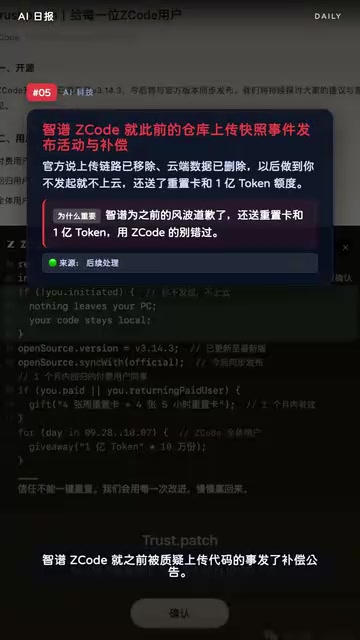
In response to earlier controversy over code uploads, the relevant platform issued a compensation notice. The company stated that upload records have been removed and cloud-stored data deleted, and committed to a future policy of "no cloud sync unless you initiate it." Users also received a reset card and 100 million tokens in credits. The offer runs from September 28 and is capped at 100,000 recipients.
In an era of growing sensitivity around data sovereignty and privacy, a commitment to "no default cloud sync" directly addresses developers' core concerns — and reflects a posture adjustment under compliance pressure.
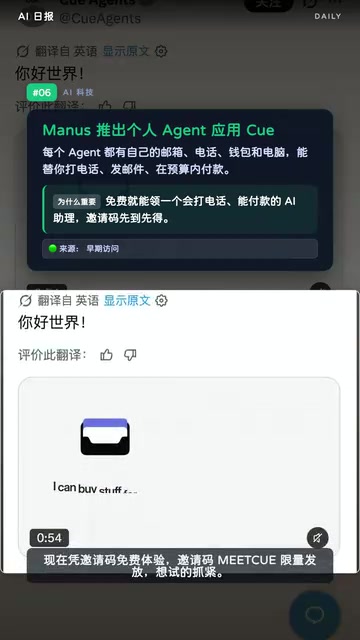
On a separate front, the Manus team introduced a personal AI assistant called "Q." Each agent comes with its own email address, phone number, wallet, and computer, and can make calls, send emails, and complete payments within a set budget on the user's behalf. This class of agents with real-world execution capabilities pushes LLMs from "answering questions" to "handling tasks." Q is currently available for free with an invite code, which is being distributed in limited quantities.
"Embodied agents" or agentic AI represent a significant evolutionary direction for LLM applications: shifting from passively responding to user queries to actively acting on behalf of users in the real world. The "digital identity" infrastructure Q provides — a dedicated email address, phone number, and wallet — is fundamentally about giving the agent an interface through which it can operate within real-world systems. The core challenges for this category of products lie not in model capability itself, but in authorization boundaries (how users control what the agent is permitted to do), error accountability (who bears responsibility when the agent makes a mistake), and financial safety (risk management around autonomous payments within a budget). The industry has yet to establish mature standards for these issues, and Q's limited invite-only rollout reflects, at least in part, that the product is still in an early validation stage where risk remains carefully contained.
Takeaway: Model, Tool, and Opinion Lines Move in Parallel
The day's developments paint a clear picture of the AI industry's relentless pace of change. At the model layer, Claude Sonnet 5.5 competes on speed and cost. At the tool layer, Manus, Kling, and MiMo each ship meaningful upgrades. At the discourse layer, ChatGPT pricing transparency and data compliance practices spark debate. These three threads advancing simultaneously sketch out the current contours of AI competition — it's no longer purely about capability; efficiency, cost, compliance, and execution are becoming the new lines of distinction.
Related articles

@ai-sdk/vue 3.0.306 Patch Release Syncs with [email protected] Update
@ai-sdk/vue 3.0.306 released, synced with [email protected]. A routine patch release for the Vercel AI SDK ecosystem with no public API changes; the Vue adapter layer stays version-aligned with the core package.

Gemini 4 Argon API Launches: The Era of Million-Token Output Begins
Google launches Gemini 4 Argon with sparse MoE architecture, up to 1M output tokens, and a 68.90% Vals Index score, available across API, AI Studio, and the Gemini app.

DukaanAI: Turning Product Photos into Inventory Lists with Open-Source AI
DukaanAI is an AI inventory tool for small retailers that turns product photos into inventory entries using the open-source Gemma 3 model, with local inference, editable fields, and CSV export.