Claude Sonnet 5.5 on the Horizon as Chinese Tech Giants Rush to Match Meta Muse

Claude Sonnet 5.5 imminent as Meta Muse triggers a personal AI agent race between Chinese tech giants.
This roundup covers key AI developments from around September 28th. Claude Sonnet 5.5 is in expanded beta, Gemini 4.0 is slated for mid-to-late October, and top-tier model cycles keep compressing. Meta Muse topped the App Store two weeks after launch, prompting ByteDance and Tencent to ship competing personal agents during a holiday. Fireworks' Amber-E cuts inference token usage ~40%, and DeepSeek 0.2 shifts from feature-stacking to a modular agent platform. NVIDIA launched chip-level agent safety isolation, while Honor and China Mobile introduced phone-bill-payable Token subscription tiers. The competitive focus is clearly shifting from raw model capability toward safe, economical, and sustained autonomous agent operation.
The AI landscape has been buzzing with activity lately — from flagship model updates to a personal agent product race, security platforms, and commercial pricing tiers, nearly every layer of the stack is accelerating in parallel. Here's a roundup of the key developments from around September 28th, capturing the real tempo of AI product competition right now.
Claude Sonnet 5.5 May Be Imminent
According to leaker Lyra, Claude Sonnet 5.5 could launch before 2:00 AM Beijing Time on the 29th. The model's gradual rollout has expanded noticeably, with access being pushed to a wider user base — typically the final signal before an official release.
Looking at Anthropic's release cadence, the Sonnet series has consistently been positioned as the go-to model balancing performance and cost. Sonnet 5.5's arrival signals another step up in mid-tier model capability. For the many developers and enterprises relying on API calls, Sonnet-level updates often carry more practical weight than flagship Opus releases, since they directly affect the cost and quality of everyday workloads.
Worth noting: within roughly the same window, Gemini 4.0 has also been rumored for a mid-to-late October launch, with the latest checkpoint being Baryon B from September 24th. The rapid succession of top-tier model releases is compressing competitive iteration cycles even further.
Meta Muse Ignites the Personal AI Agent Race
Meta Muse is a personal AI agent from Meta that understands users' long-term goals and proactively handles complex, multi-step tasks on their behalf. Just two weeks after launch, it topped the App Store download charts, surpassing ChatGPT — a clear signal that market demand for "proactive agents" has been fully unlocked.
Muse isn't available in China yet, but its success triggered an immediate chain reaction. ByteDance's Doubao team skipped the Mid-Autumn Festival holiday and spent roughly six days rebuilding a competing product; Tencent's lightweight cloud team moved even faster, already shipping a domestic Muse alternative called Viola — a 7×24 online dedicated cloud PC paired with a cloud-based Hermes Agent. New users get one free month plus 4,500 AI credits, with the regular price around $10/month.
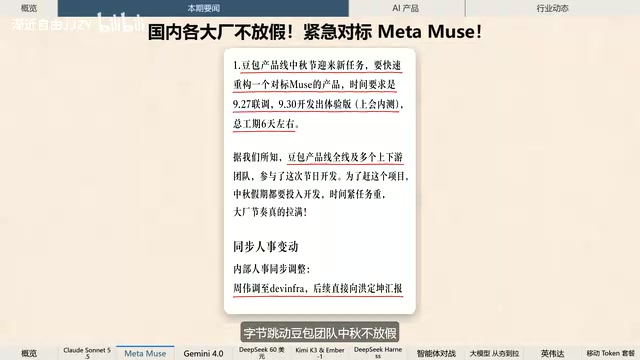
Chinese tech giants scrambling to ship competing products during a holiday is itself a signal: personal AI agents are moving from concept to a full-on land grab. Whoever gets to "an assistant that can actually do work autonomously" first will hold a meaningful head start.
The core difference between a Personal AI Agent and a regular chatbot comes down to autonomy: ordinary assistants passively respond to single prompts, while agents decompose a user's long-term goal into subtasks, plan execution order independently, and invoke external tools (browsers, calendars, file systems) along the way. The "proactive agent" paradigm Muse demonstrates relies on persistent memory of user preferences and context — enabling it to understand recurring intents like "compile my weekly work report every Friday" across sessions, not just answer one-off questions. The technical challenges here include long-term memory management, task interruption and resumption, and error correction during multi-step execution. This is exactly why domestic teams are gravitating toward a "cloud PC + always-on Agent" architecture (like Viola's Hermes Agent) — keeping the agent running 24/7 in the cloud sidesteps the local compute limitations of mobile devices.
Continuous Evolution in Open Source and Inference Efficiency
Beyond the model layer, toolchain and inference efficiency improvements have also been coming thick and fast. Building on OpenCode, after DeepSeekAd V4.1 Flash's $60 pricing was made permanent, CommandCode GOAT followed suit by also locking in the $60 price for 4.1 Flash — further lowering the barrier for developers.
Fireworks Research released a dedicated model called Amber-E, built on KimiK3, which generates shorter reasoning traces, reducing token usage by roughly 40% while maintaining equivalent quality.
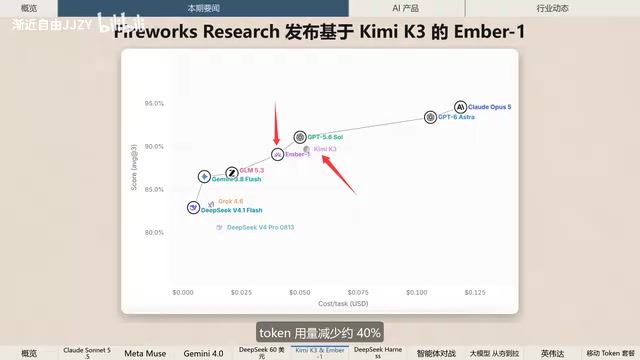
Cutting token usage by 40% without sacrificing quality is hugely meaningful for high-frequency call scenarios — it means the same budget can support more tasks, directly improving the economics of long-running agents.
DeepSeek also officially released the first release candidate of the 0.2.0 series. Where the 0.1 series focused on continuously adding capabilities to Hermes, the 0.2 series is about organizing those capabilities into a modular, reliable, long-running agent platform. The shift from "stacking features" to "building a platform" marks a turning point toward engineering maturity for open-source agent frameworks.
A Reasoning Trace is the sequence of intermediate thinking tokens a large language model outputs before arriving at a final answer — commonly seen in Chain-of-Thought prompting or dedicated reasoning models. While these intermediate steps improve accuracy on complex tasks, they consume significant additional tokens and directly inflate inference costs. Amber-E's core contribution is "trace compression": training the model to complete reasoning via more concise paths, eliminating redundant steps, and reducing token usage by ~40% without degrading answer quality. For agent scenarios requiring heavy use of reasoning models (such as iterative planning and self-reflection), this optimization's economic value far exceeds that of a single conversation — in extended autonomous operation, token costs are often one of the primary bottlenecks to scaling agents commercially.
AI Model Battles and Real-World Rankings
Interestingly, cross-model capability comparisons are becoming more transparent. The ShowHN project Tiny AI Arena has launched, letting multiple AI models compete head-to-head in agent battle format with public leaderboards. Results show Claude Sonnet 5 has competed in 21 matches with a leading 43% win rate; Fable 5.1 follows with a 32% win rate and an average rank of 1.88.
Prominent LLM evaluator Mia also published personal rankings of leading cloud and local AI models: only Opus 5.5 made the S tier, only Fable 5.1 landed in A tier, and Astra placed in B tier alongside three open-source models.
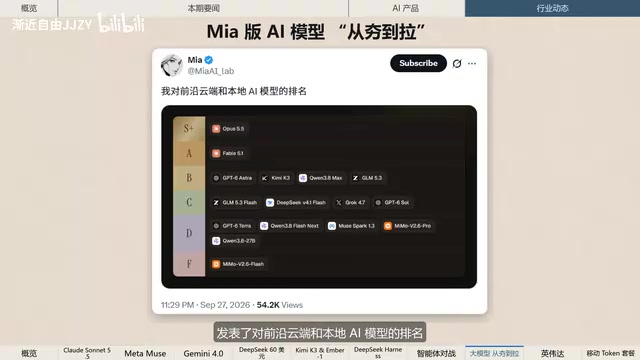
Since this evaluator runs a large number of open-source models locally, there's no server-side quality degradation to worry about — making their impressions of open-source models particularly valuable as a reference. These independent user-driven evaluations are becoming an important complement to official benchmark scores.
Agent Safety and Commercial Rollouts
As agent autonomy increases, safety is moving front and center. NVIDIA has released an open AI agent security platform comprising OpenShell security software and the NVIDIA Sentry watchdog system. OpenShell sets boundaries for AI agents running on CPUs, supporting open-source and closed-source models as well as third-party hardware; Sentry runs on the Bluefield 4 DPU and independently monitors agent behavior at the chip level — capable of isolating and halting a rogue agent within milliseconds if it detects boundary-breaking behavior. Anthropic, SpaceX, and others have already partnered with NVIDIA to adopt the platform.
Achieving independent monitoring at the chip level is a "hard constraint" approach — rather than relying on the model's own alignment, it draws an inviolable boundary at the hardware layer. This is especially critical for autonomous agents heading toward large-scale deployment.
On the commercial side, Honor CEO Li Jian announced a joint Token subscription tier with China Mobile, bundling intelligent and communications services, with support for mixing top AI offerings and on-demand AI app combinations, payable via phone bill. The plan comes in three tiers starting at ¥169/month, with top-up packs starting at 50 million tokens — initially piloted across six cities including Hangzhou and Zhengzhou. Bundling token consumption into phone bill packages is a noteworthy attempt by carriers to democratize AI access.
NVIDIA's Bluefield 4 DPU (Data Processing Unit) is a dedicated chip independent of the host CPU and GPU, originally designed for network and storage acceleration. Running Sentry's security monitoring on the DPU means that even if the host-side AI model or operating system is compromised or goes out of control, the monitoring layer itself continues to operate and execute isolation commands — the core advantage of an "out-of-band monitoring" architecture. Compared to soft-alignment approaches that rely on a model's own outputs to assert "I won't do harmful things," hardware-level isolation provides a physical line of defense completely decoupled from model behavior. As autonomous agents get deployed in high-risk environments like factory control systems and aerospace (SpaceX is already a partner), this kind of chip-level mandatory constraint mechanism will become a prerequisite piece of compliance infrastructure for large-scale commercial deployment.
Closing Thoughts
From model iterations and personal agent competition, to inference efficiency gains, safety foundations, and commercial subscription tiers — this batch of developments paints a clear picture of where the AI industry is heading: the competitive focus is gradually shifting from "how capable is the model" toward "can an agent do its job safely, economically, and reliably over the long term." The official debuts of Claude Sonnet 5.5 and Gemini 4.0 are well worth watching closely.
Related articles

Workbuddy for Absolute Beginners: How a Desktop AI Agent Fits Into Real Workflows
A beginner's guide to the Workbuddy desktop AI agent: installation, claiming credits, file management, and building automated workflows—compared with CodeX for fit and cost, helping professionals shift from AI question-askers to AI managers.

OpenAI's New Agent Stack: Computer Use, Decisions API, and Ultra-Fast Workflows
OpenAI Dev Day unveiled a new agent stack: Computer Use outperforms humans, Decisions API delivers ultra-low-latency classification via Luna, Agents API opens the same Computer Use capabilities, and GPT-6.1 Sol costs only one-seventh of Astra. Core updates, benchmark data, and developer insights.

Liang Wenfeng Open-Sources DeepInfo Inference Framework, Takes On U.S. Ban
DeepSeek open-sources its DeepInfo inference framework after its models, featuring GPU/CPU cross-pipelining, small-model prediction with large-model verification, and full Huawei Ascend and NVIDIA chip support—facing the U.S. federal ban head-on. This article analyzes its significance for AI deployment and open-source strategy.