Claude Sonnet 5.5 Review: The Business Sweet Spot Where Performance Soars and Costs Drop

Claude Sonnet 5.5 delivers a massive coding leap and 30% cost savings at half the price of Opus 5.5.
Anthropic's Claude Sonnet 5.5 targets high-frequency enterprise tasks as a "commercial sweet spot," priced at $3/million input tokens — roughly half of flagship Opus 5.5 — while delivering 30% faster generation and up to 30% lower per-task costs. Its most dramatic improvement is in coding: Terminal Bench scores jumped from 10.3% to 70.6%, marking a shift from code-snippet assistant to full development workflow driver. Real-world validation from Epic Games, Slack, and Zendesk confirms its stability on long tasks, reliable tool-calling, and speed gains. On the safety front, it's the first Sonnet model with a built-in anti-distillation classifier, complemented by cybersecurity and biosecurity protections for enterprise-scale deployment.
Sonnet 5.5's Position: A Commercial Sweet Spot Built for High-Frequency Tasks
Anthropic's quietly launched Claude Sonnet 5.5 is becoming the centerpiece of enterprise AI adoption discussions. Its value proposition is refreshingly pragmatic: over 30% faster, roughly 30% cheaper to run, and significantly more capable than its predecessor across the board.
Many enterprises hit the same frustrating wall when deploying AI — powerful models are too expensive, and budget-friendly models fall apart on complex workflows, making the numbers impossible to justify. Anthropic has drawn a clear line in the sand: Opus 5.5 handles the hard stuff — deeply ambiguous, open-ended tasks that demand heavy reasoning. Sonnet 5.5, meanwhile, is built for well-defined, high-frequency daily work — writing code, rapid iteration, debugging, generating reports.
It may not be an all-knowing reasoning oracle, but it hits the sweet spot of everyday work with surgical precision, striking a balance between performance and cost that's hard to argue with.
Coding Capabilities: A Generational Leap, Not an Incremental Nudge
For development teams, this upgrade is a genuine game-changer. The benchmark numbers tell the story clearly: on the demanding Terminal Bench evaluation, the previous Sonnet 5.0 scored just 10.3% — Sonnet 5.5 rockets that to 70.6%.

This benchmark simulates the kind of complex, multi-step professional tasks developers perform in a command-line environment — it closely mirrors real-world developer workflows. Going from 10.3% to 70.6% isn't incremental improvement; it's a qualitative leap. On a test simulating real Cursor-style coding, scores also jumped significantly from 34.1% to 55.5%.
What makes this especially striking is that these scores come at a fraction of the per-task cost of the previous generation. Paying less to get results that rival top-tier models — that's the core of its cost-efficiency story.
Enterprise Validation and Improved Reliability
Beyond benchmarks, real-world usage is even more telling. Epic Games' Chief Operating Officer revealed that they're using Sonnet 5.5 to harden tens of thousands of game systems in code — it runs fast, remains stable across sessions lasting several hours, and is genuinely capable of handling large-scale commercial workloads.
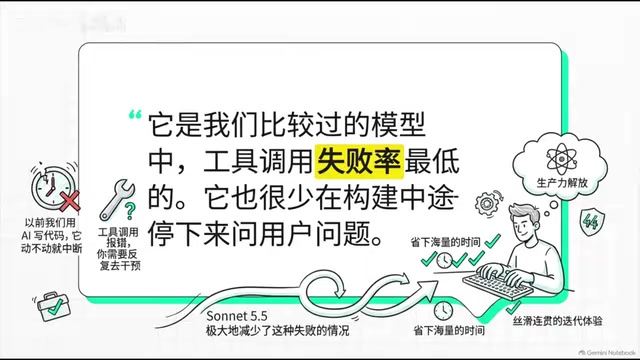
Anyone who's worked with AI-assisted coding knows the frustration: the model errors out mid-task, tool calls fail, and you're forced to intervene manually. The engineering lead at Base44 found that Sonnet 5.5 has the lowest tool call failure rate of any model they've tested — it almost never stops halfway through a build to ask clarifying questions. That kind of smooth, uninterrupted iteration saves developers an enormous amount of time.
Terminal Bench is a benchmark specifically designed to evaluate how well large language models handle complex tasks in real terminal environments. It requires models to complete highly production-realistic challenges through the command line — including file system operations, script debugging, dependency management, and multi-step automation — rather than simple code completion or single-function generation. Compared to traditional coding benchmarks like HumanEval or MBPP, Terminal Bench is harder because task chains are longer, context dependencies are stronger, and the model must autonomously determine the sequence and boundaries of tool calls. That's why its scores are a more faithful reflection of a model's real-world usability in actual development workflows. The jump from 10.3% to 70.6% signals a fundamental transition: from "capable of generating isolated code snippets" to "capable of independently driving complete development workflows."
Knowledge Work: More Than Just a Coding Specialist
Don't mistake Sonnet 5.5 for a one-trick pony. On comprehensive business benchmarks spanning dozens of professions and industries, it scores nearly on par with Opus 5.5.
Early testers have also noted an unusually sharp eye for design. For example: feed it a pile of dry financial data, a transcript from an earnings call, and a company slide template, and it can produce a polished, well-formatted operational review report — one that, with minimal edits, could go straight to investors.
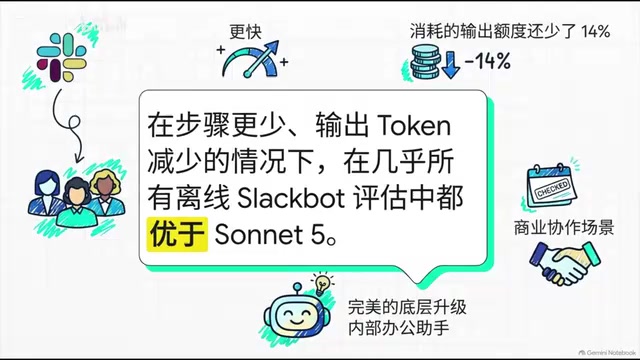
In real-world business collaboration, Slack's Chief Engineering Officer gave it a clear thumbs up: without changing a single prompt, Sonnet 5.5 performed better and faster — while consuming roughly 14% fewer output tokens. For a high-traffic assistant like SlackBot that handles massive request volumes with strict latency requirements, that's a meaningful infrastructure-level upgrade.
Zendesk's feedback was even more direct — ticket processing speed improved by a full 20%. In the fiercely competitive customer service space, time is money. That translates directly to delivering faster customer experiences at lower operational cost.
Cost and Efficiency: Running the Numbers
Let's put the cards on the table: compared to the flagship Opus 5.5, Sonnet 5.5 is aggressively priced — just $3 per million input tokens and $15 per million output tokens, roughly half the cost. That's the core reason it earns the "commercial sweet spot" label: at half the price, it delivers an experience that rivals the top-tier model for the vast majority of high-frequency everyday tasks.

Some might worry that cheaper means worse — but that intuition breaks down here. Compared to its predecessor, it generates responses more than 30% faster, and it's smarter — completing the same tasks in fewer steps, which naturally reduces total token consumption. In real-world deployment tests, the total cost per task can drop by up to 30%. Faster, better, and cheaper all at once.
Safety: Three Pillars for Enterprise-Scale Deployment
No matter how capable the technology, scaling AI across core enterprise operations requires a serious answer to the safety question. Sonnet 5.5 addresses this with three pillars.
Cybersecurity: Aligned with the protection standards of top-tier models — routine coding and debugging work is entirely unaffected, while high-risk cyberattack requests are blocked.
Biosecurity: Dedicated protection targeting high-risk requests in the life sciences domain.
Anti-Model Distillation: This is arguably the most forward-thinking addition. A distillation attack involves malicious actors using large numbers of fake accounts to bombard an AI with queries — attempting to extract the model's underlying reasoning logic at industrial scale in order to train unregulated AI systems. Because Sonnet 5.5's reasoning capabilities are so strong, it becomes an attractive target. This makes it the first Sonnet model with a built-in classifier to intercept such extraction attacks, enforcing thinking retention mechanisms that shut down any risk of capability leakage.
Model distillation is, in itself, a legitimate model compression technique: a large "teacher model" trains a smaller, lighter "student model" using its outputs, enabling the student to replicate much of the teacher's reasoning capability at lower computational cost. However, when weaponized maliciously, attackers use APIs to collect model responses at scale, systematically reverse-engineering its reasoning patterns to train clones that operate without safety constraints and without paying licensing fees. The commercial incentive is enormous — training a frontier reasoning model can cost hundreds of millions of dollars, while a distillation attack can steal the majority of that capability for a fraction of the price. The anti-distillation classifier built into Sonnet 5.5 identifies request patterns that probe reasoning boundaries in a large-scale, systematic way, blocking industrial-grade capability extraction without disrupting normal users. This has direct implications for protecting Anthropic's intellectual property and maintaining a healthy safety ecosystem around the model.
Final Thoughts
From a nuclear-grade leap in coding capability to a comprehensive upgrade in knowledge work experience, paired with a cost structure that's easy to justify on a spreadsheet — Claude Sonnet 5.5 presents itself as a production-ready engine for enterprise AI deployment. At a time when every dollar counts and every team is grinding to cut costs and boost output, an AI model that can accelerate throughput by 30% while reducing costs by 30% is genuinely worth a serious look from anyone focused on team productivity.
Related articles

@ai-sdk/vue 3.0.306 Patch Release Syncs with [email protected] Update
@ai-sdk/vue 3.0.306 released, synced with [email protected]. A routine patch release for the Vercel AI SDK ecosystem with no public API changes; the Vue adapter layer stays version-aligned with the core package.

Gemini 4 Argon API Launches: The Era of Million-Token Output Begins
Google launches Gemini 4 Argon with sparse MoE architecture, up to 1M output tokens, and a 68.90% Vals Index score, available across API, AI Studio, and the Gemini app.

DukaanAI: Turning Product Photos into Inventory Lists with Open-Source AI
DukaanAI is an AI inventory tool for small retailers that turns product photos into inventory entries using the open-source Gemma 3 model, with local inference, editable fields, and CSV export.