Claude Sonnet 5 Deep Dive: Impressive Benchmarks, Disappointing Reality — Stick with OPUS 4.8
Claude Sonnet 5 benchmarks well but disappoints in practice — OPUS 4.8 remains the better choice.
Claude Sonnet 5 boasts strong benchmark numbers and near-OPUS 4.8 performance claims, but hands-on testing tells a different story. A new tokenizer quietly inflates token costs, real-world Cursor rankings place it 13th, and creative tasks like SVG generation fall short of even open-source alternatives. For most users, OPUS 4.8 remains the smarter choice.
Sonnet 5 Launch: The Gap Between Official Claims and Real-World Experience
Anthropic recently released the biggest update yet to the Claude Sonnet series — Claude Sonnet 5. Officially positioned as the most autonomous model in the lineup, it represents a key trend in AI development: Agentic AI. These models don't just respond to one-off queries — they autonomously break down goals, plan execution steps, call external tools (such as browsers, code interpreters, and file systems), and drive tasks forward across multiple interaction rounds. This capability typically depends on the model's long-context management, Function Calling protocol, and self-reflection mechanism working in concert. According to Anthropic, Sonnet 5 can plan tasks, use tools like browsers and terminals, and operate autonomously — with claimed significant improvements over Sonnet 4.6 in reasoning, tool use, coding, and knowledge work. Overall performance reportedly approaches OPUS 4.8, but at a much lower price.
However, according to an in-depth hands-on test by a tech creator on Bilibili (translated from the YouTube channel WorldofAI), the model's actual performance falls noticeably short of its marketing. The reviewer put it bluntly: "This might be one of the worst models Anthropic has ever released." After a series of coding, creative generation, and benchmark tests, the conclusion was clear: stick with OPUS 4.8 rather than switching to Sonnet 5.
Impressive Benchmark Scores, Embarrassing Real-World Rankings
On paper, Sonnet 5 looks solid:
- Agentic coding (SWE-bench Verified): Score of 63.2 — a major leap from Sonnet 4.6, only about 6 percentage points below OPUS 4.8
- Terminal (2.1): Reaches 80.4, approaching OPUS 4.8
- Computer use: Score of 81.2
- HLE: On par with OPUS
- GDP evaluation: Reaches 1619, actually surpassing OPUS
SWE-bench Verified is a specialized evaluation benchmark introduced by Princeton University in 2023, designed to measure an AI model's ability to perform automated software engineering on real GitHub issues. Its Verified subset is human-reviewed to ensure task solvability and test case accuracy. The benchmark requires models to read codebases, understand problem descriptions, and autonomously generate patches that pass tests — widely regarded as a gold standard for measuring agentic coding capability. A score of 63.2 means the model can produce viable patches for roughly 60% of real engineering tasks, which is technically a meaningful improvement, though it also means nearly 40% of tasks remain unsolvable.
In real-world conditions, however, performance falls significantly short. In comprehensive rankings on actual developer tools like Cursor, Sonnet 5 places just 13th. Cursor is one of the most popular AI-assisted coding IDEs in the developer community — deeply customized on top of VS Code, supporting multiple large language models and continuously tracking each model's real-world coding performance through built-in benchmarks. Its ranking system weighs code completion accuracy, multi-file context understanding, instruction-following ability, and bug-fix efficiency — considered far closer to day-to-day developer experience than pure benchmark tests. Sonnet 5 ranking 13th means 12 other models outperform it in comprehensive coding assistance, a stark contrast to its benchmark scores and a reflection of the widespread "benchmark gaming" phenomenon in the AI industry. The reviewer noted that the model's appeal should have been "powerful performance that's faster and cheaper than OPUS," but Sonnet 5's cost advantage is nearly negligible — only about $0.72 cheaper than OPUS 4.8 — while performance lags significantly behind.
The Pricing Trap: Hidden Costs from Tokenizer Changes
The most important thing to watch out for in this update is buried in the pricing and tokenization mechanics.
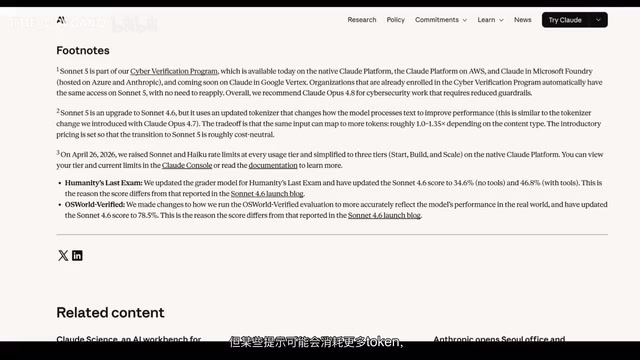
Current pricing is $2 per million input tokens and $10 per million output tokens, with a 1 million token context window — attractive on the surface.
The catch: Sonnet 5 has switched to a new tokenizer. Understanding the impact of this change requires knowing how tokenizers work — a tokenizer is the core component that converts raw text into discrete units (tokens) that a language model can process. Different tokenizers segment the same text at very different granularities. For example, GPT series models use BPE (Byte Pair Encoding), while Anthropic's models use a proprietary tokenization scheme. When a model upgrade replaces the tokenizer, even if the API price per token stays the same, the actual number of tokens billed can increase or decrease due to vocabulary changes. With Sonnet 5's new tokenizer, the same text may generate approximately 1.0 to 1.3× more tokens depending on content. This has a particularly significant impact on high-token-density tasks like long document processing and code generation, potentially exposing users to noticeably higher actual bills without realizing it — an important reason why enterprise users should run token usage regression tests before migrating to a new model version.
The reviewer argued that Anthropic's initial pricing was "designed to offset the tokenizer change and keep costs roughly balanced" — a clever piece of business design, but one that substantially dilutes the real value proposition for users.
More ironically, the enhanced agentic capabilities themselves come with exponentially higher token consumption — each tool call's inputs and outputs must be included in the context, meaning complex tasks can consume dozens of times more tokens than a normal conversation. Sonnet 5 in maximum effort mode consumes tokens comparable to OPUS while delivering worse results, making its claimed "highest token efficiency" sound hollow.
Real-World Tests: Coding Holds Up, Creative Tasks Fall Apart
macOS Interface Generation: A Surprising Bright Spot
In a test generating macOS-style UI code using the reviewer's custom tool, Sonnet 5 performed surprisingly well. The generated login page, notification system, and top bar were mostly functional, with support for light/dark mode switching and wallpaper settings. The bottom menu bar, multiple file types, and SVG icons looked decent, and even included working Safari, Calendar, Notes, Reminders, and Maps apps.
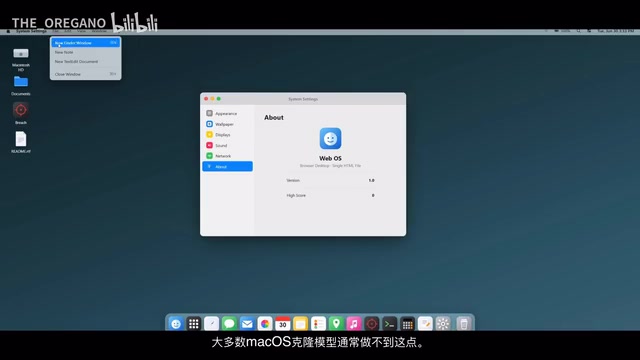
That said, the reviewer noted that the maps feature wasn't as good as a previous OPUS demo, and the entire workspace generation took about 40 minutes — consuming a massive number of tokens in max mode to complete, making it "extremely inefficient."
Minecraft Clone: Missing Features
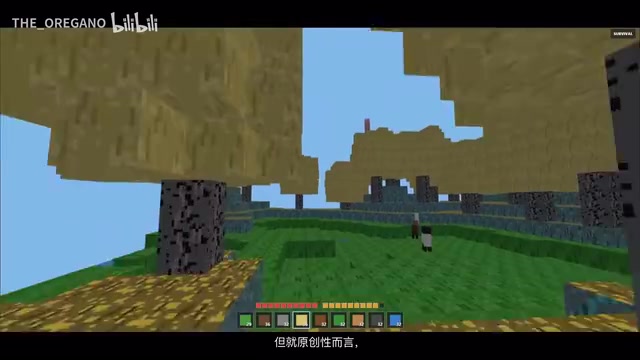
In a test generating a Minecraft-like game, Sonnet 5 scored 65 out of 100. It could generate different material textures, villagers, placeable blocks, and basic water physics — but with clear shortcomings: no block-breaking animations, rough water dynamics, no inventory system, and no infinite terrain. The cave system the reviewer requested was added, but it wasn't truly implemented despite including ore deposits.
Frontend and SVG Generation: Complete Breakdown
The real problems emerged in creative generation tasks. When generating a SaaS landing page, while it mimicked Anthropic's design style, the result was "quite basic" — components were incomplete and of limited practical use. The reviewer noted that the open-source model GLM 5.2 actually produced better frontend quality on the same task.
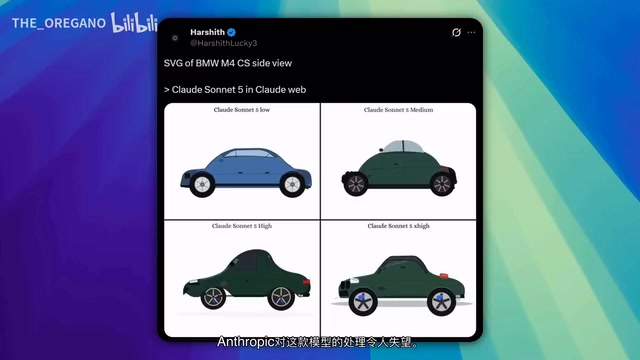
SVG generation was the worst failure. SVG generation is an extremely challenging task for large language models because SVG is fundamentally structured code that describes geometric paths, coordinate transformations, and color fills through XML — requiring the model to simultaneously handle spatial geometric reasoning, proportion perception, and visual composition. Generating a recognizable car SVG requires the model to understand complex spatial relationships like body curves, wheel positions, and window proportions, then accurately translate them into Bézier curve parameters — a dual challenge of multi-step reasoning and spatial imagination. The industry generally treats SVG generation quality as an unofficial litmus test for a model's "ability to fuse visual understanding with code generation," and the results often reveal deep capability boundaries beyond standard Q&A benchmarks. When asked to generate a vector illustration of a BMW M4 CS — even with increased reasoning intensity — Sonnet 5 completely failed to produce anything recognizable. Proportions, stance, and overall features were all distorted. OPUS, by contrast, at least captured the overall structure of a BMW. The reviewer's verdict: "In creative tasks like SVG, it's not even as good as GLM."
Overall Verdict: Poor Value, Stick with OPUS 4.8
Overall, the reviewer's take on Sonnet 5 is quite negative, with three core issues:
- Cost advantage is illusory: The new tokenizer drives up actual token consumption, and at only ~$0.72 cheaper than OPUS, the value proposition evaporates.
- Real-world performance lags behind benchmarks: Impressive on paper, but only 13th in real-world tools like Cursor — and in creative tasks, it doesn't even beat open-source GLM 5.2.
- Unclear positioning: The Sonnet series was supposed to be lean and economical. Now it consumes massive tokens and delivers worse results, raising real questions about Anthropic's intent in releasing this version.
The reviewer speculated that Anthropic could have released a Sonnet 4.8 first before pushing out a more mature version — the hurried release may have other motivations behind it. The recommendation is straightforward: use OPUS 4.8 for virtually all tasks, not Sonnet 5. OPUS 4.8 costs slightly more, but its performance advantage is substantial — in Max mode, a small additional cost yields significantly better results.
Of course, model iteration continues, and the reviewer expressed hope that Anthropic will release an improved version. For everyday users, the lesson from Sonnet 5 is a reminder: when faced with vendor benchmark scores and pricing claims, hands-on testing in real scenarios is the ultimate standard for judging a model's value. Pay particular attention to hidden cost changes from tokenizer upgrades, and the potential gap between benchmark rankings and real-world developer tool standings.
Key Takeaways
Related articles

JobRunner MCP Server: AI Agents Can Now Fix Failed Java Jobs
JobRunner launches an open-source MCP server enabling AI agents to view cluster status, diagnose failures, and recover Java jobs—incident response from any cloud coding environment or existing agent.

MLAI Digital Launches 9 Security Agents: MCP Server Safeguards the Full Lifecycle of Agentic AI
MLAI Digital launches Security MCP Server with nine built-in specialized security agents covering vulnerability discovery, attack simulation, prompt injection detection, API and infrastructure assessment, and accelerated remediation—embedding security validation across the full Agentic AI lifecycle from development to production.

Running Isaac Lab on H100 GPUs: Exploring Better Approaches
Exploring optimization methods for running Isaac Lab on NVIDIA H100 GPUs, including MIG configuration, mixed precision, TensorRT acceleration, and community experience to improve robotics simulation and reinforcement learning efficiency.