Claude Sonnet 5 In-Depth Review: Impressive Performance, but Hidden Traps in the Pricing Strategy

Claude Sonnet 5 delivers strong agentic performance, but a Tokenizer switch hides real cost increases.
Claude Sonnet 5 shows major agentic gains with benchmarks nearing Opus 4.8, but switching to the Opus 4.7 Tokenizer inflates real Token consumption—nearly erasing its price advantage over Opus. Hands-on tests reveal a mixed bag, from an impressive macOS clone to disappointing SVG generation, making its product positioning hard to justify.
Overview
At Code Summit 2, Anthropic officially unveiled Claude Sonnet 5, which the company calls the biggest update in the Sonnet series to date. Positioned as "the most agentic Sonnet model," it promises fewer hallucinations, stronger tool use, and performance approaching that of Opus 4.8. But after a battery of hands-on tests, things aren't as rosy as they seem—especially once you factor in two key variables: pricing and Token efficiency.
Performance: Genuine, Substantial Gains in Agentic Capability
On paper, Sonnet 5 shows clear improvements over its predecessor, Sonnet 4.6, across reasoning, tool use, coding, and general knowledge work. It can plan, invoke tools like browsers and terminals, and even run tasks autonomously—capabilities that just a few months ago required larger, more expensive models.
Behind the "most agentic" positioning lies a fundamental shift in AI system architecture. Traditional LLMs (Large Language Models) center on single-turn or multi-turn conversation as their primary interaction paradigm, whereas Agentic AI possesses a complete closed-loop capability: perceiving the environment, formulating plans, invoking external tools, and iterating execution based on feedback. This architecture is typically built from three core modules: the Planner, responsible for task decomposition and decision-tree generation; the Tool Use Layer, which interfaces with external systems like browsers, code interpreters, and APIs; and the Reflection mechanism, which evaluates outcomes after each step and dynamically adjusts strategy. Claude Sonnet 5's enhancements to this architecture mean it can complete multi-step engineering tasks with less human intervention—but this comes at the objective cost of longer reasoning chains and higher Token consumption.
Here are the specific benchmark results:
- SWE-bench Verified (Agentic Coding): 63.22%, a significant jump over Sonnet 4.6, trailing Opus 4.8 by only about 6 percentage points
- Terminal Bench 2.1: 80.4%, nearly matching Opus 4.8
- Computer Use: 81.2%
- GDP-WoW: 1619 points, actually surpassing Opus on this benchmark
Background on the Evaluation Suite: SWE-bench Verified is currently one of the most authoritative benchmarks for AI coding ability, developed by a research team at Princeton University. It pulls Issues requiring fixes from real GitHub repositories, requiring the model to autonomously locate the problematic code, generate a patch, and validate it against unit tests. The "Verified" version applies manual filtering to the original dataset, removing ambiguous problems to make the results more credible. Terminal Bench and Computer Use test a model's autonomous operation capabilities in command-line environments and graphical interfaces, respectively, representing core evaluation dimensions for the evolution of Agentic AI from "conversational assistant" to "autonomous executor." Compared with traditional Q&A-style academic evaluations, benchmarks based on real engineering scenarios better reflect a model's practical value in actual development workflows.
It's worth noting that LLM evaluation suites have long suffered from the "Lab-Reality Gap" problem. Academic benchmarks typically measure single-point capabilities on fixed datasets, with question distributions and scoring rules carefully designed. Models can easily achieve high scores through targeted training without necessarily possessing equivalent generalization ability. Since 2024, as models approach saturation on mainstream benchmarks, the industry has widely adopted "dynamic evaluation" strategies—periodically swapping questions and introducing adversarial samples—to counter the "benchmark gaming" phenomenon.
In terms of overall ranking, Sonnet 5 currently sits in fifth place, but this requires further evaluation and the position may shift. On the whole, it is indeed a competent model capable of handling everyday AI tasks.
The Pricing Trap: Behind the Promotional Low Price, the Tokenizer Hides Costs
This is the part of the release that demands the most caution.
Sonnet 5 launched with a promotional introductory price: $2 per million input Tokens and $10 per million output Tokens, running until August 2026, after which it will rise to $3 for input and $15 for output. It also supports an ultra-long context window of 1 million Tokens.
But the real issue is this: Sonnet 5 has switched to the Opus 4.7 Tokenizer. This means that for the same block of text, the number of Tokens it's split into may increase by roughly 1x to 1.3x (depending on content). In other words, while the unit price appears to have dropped, certain Prompts actually consume more Tokens, and in specific scenarios the total cost may end up considerably higher than expected.
The Technical Principle Behind the Tokenizer Switch: The Tokenizer is the core component that converts raw text into numerical sequences for an LLM. Different models use different tokenization strategies (such as BPE, WordPiece, etc.), which directly determine how many Tokens a given block of text is split into. Mainstream LLMs commonly build their Tokenizers using the BPE (Byte Pair Encoding) algorithm—the core idea being to iteratively merge high-frequency character combinations found in the corpus to form a vocabulary, striking an optimal balance between "character granularity" and "word granularity." The new Tokenizer Anthropic introduced for Opus 4.7 optimizes the handling of code, multilingual text (especially non-Latin scripts like Chinese and Japanese), and long structured documents—merging more common multi-byte character combinations and reducing Token consumption for such content. However, for certain types of Prompts—particularly text containing large amounts of English prose or specific symbols—the tokenization becomes more granular, noticeably increasing the Token count. For developers, this means the existing cost-estimation model needs to be rebuilt entirely; be sure to run actual comparisons using Anthropic's official Tokenizer tool against the content distribution of your own Prompts, rather than relying on historical estimates.
Additionally, the Tokenizer switch has a hidden impact on Prompt Caching. Prompt Caching is a cost-optimization mechanism Anthropic designed for high-frequency call scenarios: when multiple consecutive requests share the same prefix Prompt, the system can reuse the already-computed KV Cache (key-value cache), significantly reducing the Token cost of redundant computation. However, the new Tokenizer causes the existing cache to become completely invalid—even if the Prompt text content is unchanged, the new Token sequence differs from the old version, dropping the cache hit rate to zero. For enterprise applications that rely on long System Prompts, the actual bill increase during the early migration phase may far exceed what the unit-price adjustment suggests.
From this angle, Anthropic's introductory low price is, in a sense, designed to "offset" the cost increase from the Tokenizer change, keeping actual spending roughly flat—a rather clever pricing strategy, but not exactly user-friendly.
Sonnet 5 vs Opus 4.8: The Price Gap Has Nearly Vanished
More awkwardly, Cursor Bench tests show Sonnet 5 ranking only 13th. Cursor Bench is an internal benchmark maintained by the team behind the AI code editor Cursor, specifically designed to evaluate a model's overall performance in real software engineering workflows—covering code completion accuracy, multi-file refactoring capability, depth of context understanding, and quality of inferring user intent. Unlike academic benchmarks, Cursor Bench is far closer to developers' day-to-day usage scenarios—this "Lab-Reality Gap" phenomenon is extremely common in LLM evaluation, and it's the core reason developers shouldn't rely solely on official marketing figures when choosing a model. The gap between Sonnet 5's strong SWE-bench performance and its 13th place in Cursor Bench is a textbook illustration of the systematic divergence between academic and industrial evaluation.
For a long time, users have chosen Sonnet precisely because it was faster and cheaper than Opus while still delivering solid performance. But now the actual price gap between Sonnet 5 and Opus has all but disappeared—by some estimates, on certain tasks Sonnet 5 is only 72 cents cheaper than Opus 4.8.
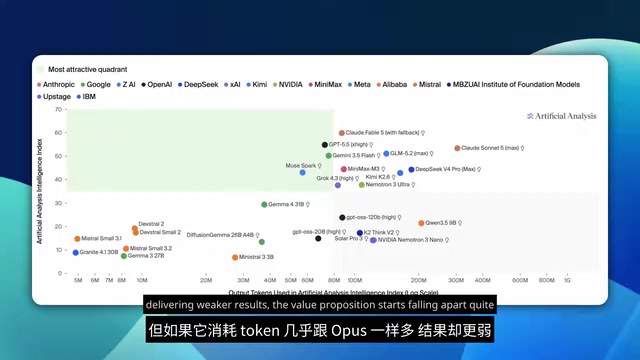
Once the cost-effectiveness advantage is gone, using Sonnet 5 for everyday work loses its point: you can simply spend a tiny bit more and go straight to Opus 4.8 for markedly stronger performance.
Multi-Scenario Testing: A Mixed Bag of Real-World Results
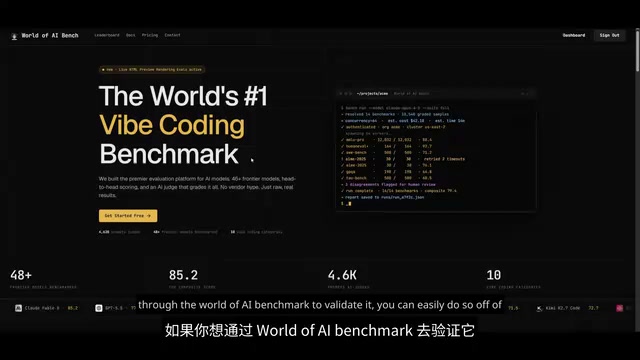
The following stress-tests the model across multiple domains based on World of AI Benchmark 2, with mixed results.
Highlight: The macOS Clone Project
The most pleasant surprise was the macOS clone task. Sonnet 5 generated a fairly complete desktop environment: a notification system, a functional top bar, light/dark mode toggling, and swappable wallpapers; apps like Launchpad, Mail, Photos, Calendar, Notes, Maps, and Music were all present, with icons entirely generated in SVG and a polished overall look. It even built a working FPS shooting mini-game, something most models struggle to pull off.
The cost, however, was steep—the task took about 40 minutes in Max Effort mode, consumed a large number of Tokens, and had low overall efficiency. "Max Effort mode" is a reasoning-enhancement mechanism Anthropic introduced for Sonnet 5, essentially a dynamic compute-allocation strategy whose theoretical basis comes from Chain-of-Thought (CoT) techniques. CoT was formally proposed by the Google Brain team in 2022, with the core finding that guiding a model to output intermediate reasoning steps before giving its final answer can substantially improve its accuracy on math, logic, and coding tasks. Sonnet 5's Max Effort mode upgrades this into a dynamic version: when handling complex tasks, the model automatically triggers multiple rounds of internal reasoning chains, tool-invocation loops, and self-verification steps, adaptively deciding reasoning depth based on task complexity—responding quickly to simple tasks while triggering longer internal thought chains for complex ones. This aligns with the "trade thinking time for quality" design philosophy of OpenAI's o-series models, but at the cost of significantly increased latency and sharply rising Token consumption. Overall latency and cost grow non-linearly with task complexity, introducing uncertainty for production environments dependent on SLAs (Service Level Agreements)—how to find a commercially viable balance between capability and efficiency remains an unsolved core challenge for the entire industry.
Mediocre: The Minecraft Clone

In the Minecraft test, the model adopted a distinctive texture style, with normal dynamic water effects, and generated creatures like villagers and creepers. But it ran choppily, block destruction lacked animation, and there was no inventory system or infinite terrain. Overall score: roughly 6.5/10—the originality is commendable, but the core mechanics are too thin.
Disappointment: SVG Generation and Front-End Development
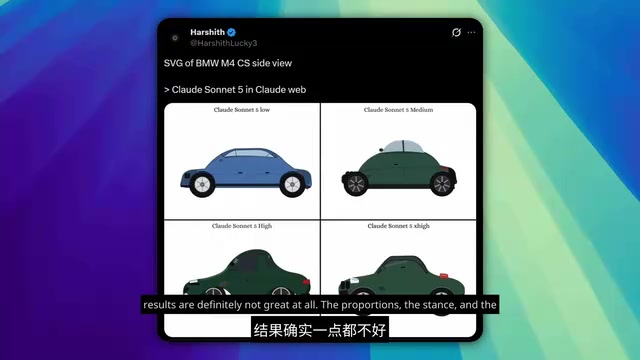
SVG generation was the most disappointing area this time. Asking the model to output a BMW M4 CS—even with parameters maxed out—produced an abysmal result, with the vehicle's proportions, stance, and recognizability all missing. By comparison, Opus 4.8 could at least assemble a recognizable main body structure.
On the front-end side, the SaaS landing page generated from the same Prompt was also fairly basic; while scroll-triggered interactive components worked, the experience left something to be desired. In a direct comparison, GLM 5.2 even outperformed Sonnet 5 in front-end generation quality. GLM 5.2 is a general-purpose LLM from Tsinghua University's Zhipu AI team, the latest iteration in the ChatGLM series, standing out in front-end code generation, Chinese understanding, and multimodal tasks, and rapidly building a reputation in the developer community thanks to its more competitive pricing strategy. This comparison reflects a deeper shift in the LLM competitive landscape in 2025: leading Chinese teams represented by Zhipu AI, DeepSeekAd, and Alibaba's Qwen, with more aggressive open-source strategies and more competitive API pricing, have already achieved the ability to compete head-on with GPT-4o and the Claude series on specific vertical tasks. This places dual pressure on leading US labs like Anthropic: on one hand, they need to maintain differentiated positioning between safety and capability; on the other, they must defend against the pricing impact of lower-cost alternatives. Sonnet 5's combination of promotional pricing plus a new Tokenizer is, to a degree, a direct manifestation of this competitive pressure—maintaining market appeal through a surface-level price cut while hedging actual revenue loss via tokenization-efficiency adjustments—a textbook product decision as LLM commercialization enters the zero-sum stage of a stagnant market.
Conclusion: Token Efficiency Falls Short, and the Product Positioning Can't Justify Itself
The most baffling aspect is Sonnet 5's Token consumption efficiency. The Sonnet series was supposed to emphasize speed and cost efficiency, yet in testing its Token consumption was nearly on par with Opus, while output quality was weaker. When a model is neither cheap enough nor powerful enough, its reason for existence becomes hard to defend.
On balance, for nearly every task the recommendation is to stick with Opus 4.8 rather than migrate to Sonnet 5; and even for general-purpose scenarios, GLM 5.2 is the more cost-effective choice. Perhaps this release from Anthropic is more about responding to external competitive pressure, while the truly anticipated Opus 5 may well be just around the corner.
Practical Advice for Developers: Don't rush to make Sonnet 5 your primary model. Before making a migration decision, be sure to recalculate real Token consumption and total cost against the new Tokenizer—especially examining the content distribution of your own Prompts (the varying proportions of English prose, code, and Chinese will produce vastly different Token-change magnitudes), and assessing the additional impact of Prompt Caching invalidation on high-frequency call scenarios. Then make a holistic judgment against the performance gains of Opus 4.8. A price cut on paper doesn't always mean your bill will follow suit.
Key Takeaways
Key Takeaways
Related articles

Felix Rieseberg Personal Homepage
Felix Rieseberg's personal homepage sparks attention on Hacker News. This article covers the Slack engineer's technical background, the rise and fall of nativefier, and the value of a developer homepage as a tech calling card.

@ai-sdk/vue 3.0.306 Patch Release Syncs with [email protected] Update
@ai-sdk/vue 3.0.306 released, synced with [email protected]. A routine patch release for the Vercel AI SDK ecosystem with no public API changes; the Vue adapter layer stays version-aligned with the core package.

Gemini 4 Argon API Launches: The Era of Million-Token Output Begins
Google launches Gemini 4 Argon with sparse MoE architecture, up to 1M output tokens, and a 68.90% Vals Index score, available across API, AI Studio, and the Gemini app.