Claude Sonnet 5 Leaked: Near-Opus Performance at a Fraction of the Price

Claude Sonnet 5 leaked with near-Opus performance at a rumored $2/million token input price.
A leak backed by Claude Code's own model list suggests Sonnet 5 is coming with near-Opus 4.8 performance at a promotional price of $2 input / $10 output per million tokens — roughly 60% cheaper than Opus 4.8. While the features aren't entirely new, the pricing could make this the most compelling option for cost-sensitive developers yet.
A Leak That's Taking the AI Community by Storm
The AI community has been buzzing about a leak related to Claude Sonnet 5. According to analysis from a Bilibili content creator, even though Anthropic had yet to make any official announcement at the time of publishing, this leak comes with a notably concrete detail: the name "Sonnet 5" has actually appeared in Claude Code's own model selection list.
Claude Code is Anthropic's developer-facing command-line coding assistant, integrated directly into terminal environments. It lets developers invoke Claude models for tasks like code generation, debugging, and refactoring. Its model selection list reads directly from Anthropic's backend configuration of available models — so when a model name shows up there, it means the model has already been at least partially registered or pre-configured on the server side. This is fundamentally different from circulating screenshots or pure speculation; it's a real signal at the API level.
In other words, this name didn't come from thin air — it genuinely appeared inside the product. And the most striking, most noteworthy aspect of this whole story isn't actually the performance claims. It's the price.
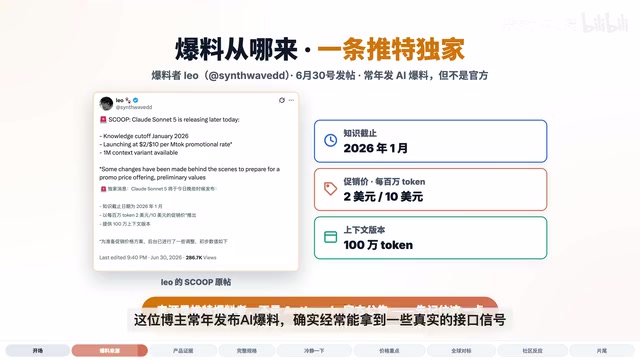
The leak originated from a Twitter user named Leo, who posted what he labeled an "exclusive" on June 30th, sharing three core details:
- Sonnet 5's knowledge cutoff date is January 2026
- It will launch at a promotional price of $2 per million tokens (input) / $10 per million tokens (output)
- It will support a 1 million token context window
This blogger regularly tracks AI industry developments and has occasionally obtained genuine API-level signals, but he's not an official source, and his past predictions haven't always been accurate — so some skepticism is warranted.
The "Hard Evidence" on the Product Side
If this were just a tweet, it would still be firmly in rumor territory. But this time is different — a screenshot of Claude Code's model selection interface clearly shows the third option, Sonnet, listed as "Sonnet 5" and described as "suitable for everyday tasks."
Another blogger, Bridgeman, also posted to confirm that Sonnet 5 is now visible in Claude Code, though it can't be used yet. You need to update the client to version 2.1.197 to see it.
Leo later followed up with more complete specs: the promotional pricing runs through August 31st; a new higher reasoning tier called "High" has been added; it will be the first Sonnet model to support high-resolution vision; and it uses a brand-new tokenizer. Its positioning was summed up in one compelling line — Sonnet pricing, with performance approaching Opus.
It's worth noting that "brand-new tokenizer" isn't just a technical talking point. A tokenizer is the core component that splits raw text into token sequences the model can process. Next-generation tokenizers typically express the same semantic content using fewer tokens (higher token efficiency). This means the same text costs fewer tokens, effectively lowering what users pay, while fitting more useful information into a fixed context window. An optimized tokenizer also handles code, Chinese, Japanese, and other non-Latin languages, as well as mathematical notation, far more efficiently — directly improving model performance in those domains.
High-resolution vision capability is equally noteworthy. Early multimodal models typically compressed input images to a fixed low resolution, losing detail in the process. High-resolution vision — through dynamic tiling (splitting large images into local patches encoded separately) or high-resolution encoders — allows the model to retain far more detail during understanding. This is especially important for developer use cases like code screenshot analysis, UI design mockup interpretation, and OCR of technical documents, and has been one of the key capability gaps between the Sonnet series and Opus.
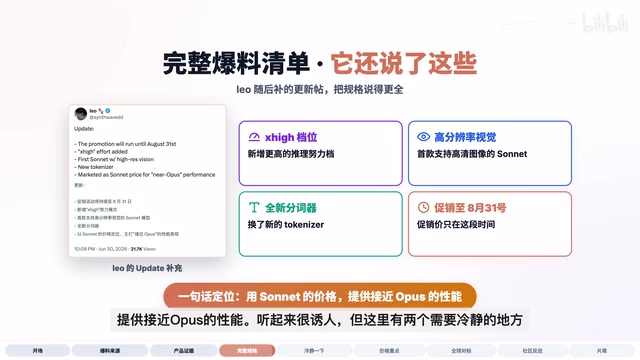
Two Reasons to Stay Grounded
As tempting as this all sounds, a couple of cold-water moments are worth calling out.
First, history may repeat itself. An almost identical Sonnet 5 leak surfaced back in February, complete with a codename called "Phoenix" — and what actually launched was Sonnet 4.6, not Sonnet 5.
Second, the features aren't new. The capabilities that sound exciting — the High tier, high-resolution vision, the new tokenizer, the January 2026 knowledge cutoff — already exist on Opus 4.7 and 4.8.
So the genuinely new thing here may be just one thing: bringing this full suite of flagship capabilities down to a more accessible Sonnet price point.
The Price Is the Real Story
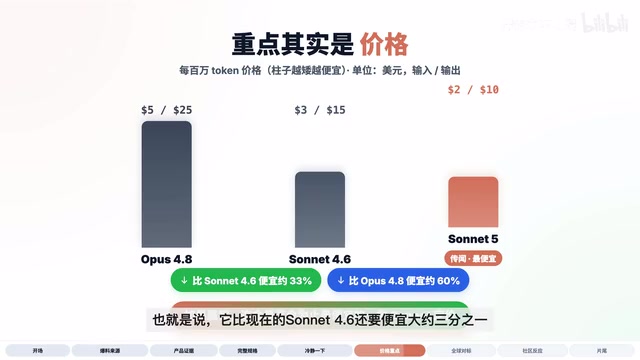
This brings us to the most critical question: the pricing. Here's how it stacks up against the current lineup:
| Model | Input Price | Output Price |
|---|---|---|
| Flagship Opus 4.8 | $5 | $25 |
| Current Sonnet 4.6 | $3 | $15 |
| Rumored Sonnet 5 | $2 | $10 |
(Per million tokens)
In other words, the rumored Sonnet 5 would be roughly one-third cheaper than the current Sonnet 4.6, and nearly 60% cheaper than the flagship Opus 4.8. If the pricing holds, this would be the lowest price point the Sonnet series has ever hit.
To understand why this matters, it helps to know how token pricing works. Large model API pricing typically breaks down into input tokens (prompt) and output tokens (completion), with output usually costing 4–5x more than input, since generating text is computationally heavier than processing it. For agentic workflows and code generation use cases, a single complete call often involves large context inputs and lengthy outputs. For a mid-sized code assistant product running a million calls per day, shaving a third off costs could mean tens of thousands of dollars saved per month — directly affecting commercial viability and technology stack decisions.
In the broader market context, the $2/$10 price point lands squarely in the same high-value zone as Google Gemini 2.5 Pro — the competitive intent is clear. This reflects the industry-wide systematic price decline between 2024 and 2025: inference chip costs continue to fall, model distillation and quantization techniques have matured, and fierce market share competition among top players has collectively made "rapid democratization of flagship capabilities" an industry norm.
What This Means for Developers
For developers — especially those building agents, code generation tools, or any other token-heavy use cases — if you can genuinely access near-flagship capability at this cost level, the appeal is hard to overstate. These applications tend to be extremely cost-sensitive, and improvements in price-performance ratios directly influence technology choices.
Of course, domestic Chinese model providers haven't been standing still either. Players like Zhipu GLM and Alibaba Qwen are pushing upward in capability while pushing prices even lower, further compressing the pricing space for international players. The price war across the large model market continues to heat up.
Community Reactions and a Rational Take
Community reactions have been enthusiastic. Some are flatly declaring "Sonnet 5 will beat Opus 4.8"; others are saying "it better surpass Opus 4.8 or it's a waste of time"; and many keep asking: is this real news, or just speculation?
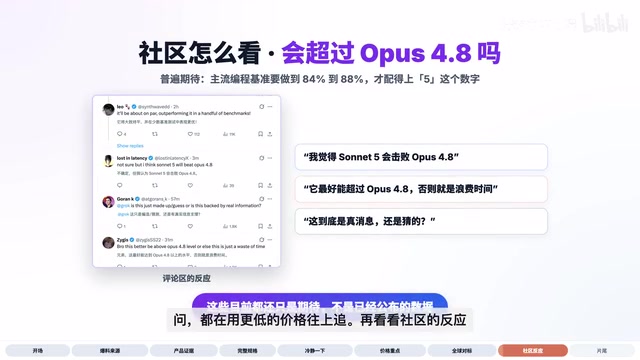
The general community expectation is that Sonnet 5 would need to score somewhere in the 84%–88% range on mainstream coding benchmarks to credibly claim "near-Opus" status. It's important to stress, though, that these are community expectations — not any officially published numbers.
False Alarm or a Real Surprise?
Is this really coming, or will it turn out to be another "Sonnet 4.6-level" letdown? The answer may come soon. Given that the model name has already shown up in the product itself, Sonnet 5's existence seems all but confirmed — the remaining question is whether the final pricing and performance will actually deliver on what the leak promised.
If Sonnet 5 genuinely reaches near-Opus 4.8 performance at Sonnet prices, it will almost certainly become the go-to choice for cost-sensitive developers. And what this reflects is a broader shift playing out across the large model market: the industry is moving from competing purely on capability to competing on value — with leading players racing to democratize flagship performance at ever-lower price points.
That said, until an official announcement lands, rational caution is still warranted. History has already taught us that the same kind of leak has cried wolf at least once before.
Key Takeaways
Related articles

Understanding DeepSeek in 3 Minutes: The Rise from a Quant Hedge Fund to an Open-Source AI Leader
DeepSeek's history in 3 minutes: from High-Flyer Quant's compute build-up to V2's MLA inference cost cuts, V3's $5.576M training bill, R1's open-source global shock, and V4 with a $7B Series A.

Local Creative Writing Model Showdown: Fine-tuned Qwen3.8 27B Wins, DeepSeek v4.1 Underwhelms
Bilibili creator tests seven local creative writing models: Hemingway and HumanLike Chat based on Qwen3.8 27B perform best, DeepSeek v4.1 is plain, Dongfang Shuo ranks last with confused characters. Includes three test prompts, scores, and usage advice.

Liang Wenfeng's Three Big Bets: Why Did DeepSeek Open-Source Its 82% Gross Margin?
Why did DeepSeek open-source DeepInfer, its 82% gross margin inference framework, and then launch a hundred-billion funding round? An analysis of Liang Wenfeng's three big bets and the open-source strategy.