Claude Suddenly "Throws Punches": When AI Assistants Stop Being Compliant

A Reddit post teasing Claude for "choosing violence" reflects users' shifting expectations for AI personality from compliant to trustworthy.
Starting from a minimalist Reddit post that uses "chose violence" to tease Claude for suddenly dropping its gentle tone and giving a blunt, even sharp response, the author notes that Claude's cautious image results from RLHF and style guidelines, whose cost is that excessive compliance dilutes information sharpness. The post's resonance shows expectations shifting from "error-free customer service" to "a partner you can argue with," creating contradictory design demands. The article ends with practical prompting advice.
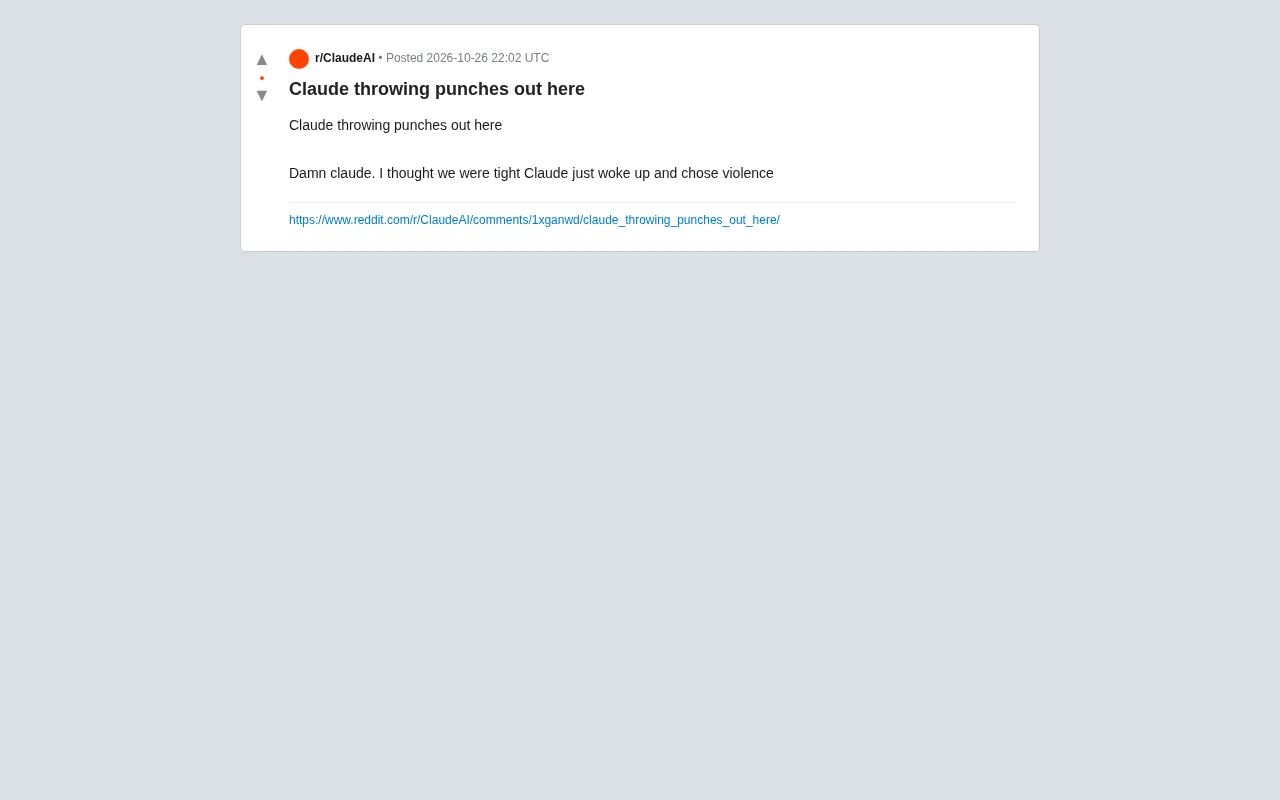
A Reddit post titled "Claude throwing punches out here" is sparking discussion. The original post is extremely short, containing just one slightly bemused exclamation: "Damn claude. I thought we were tight Claude just woke up and chose violence." There are no screenshot details, no conversation context, but the phrases "throwing punches" and "chose violence" are enough to make anyone familiar with LLM products smile knowingly — it describes Claude giving an unexpectedly direct, sharp, even aggressive response in some interaction, rather than the gentle tone users have come to expect.
Why This Meme Deserves Serious Attention
"Chose violence" is English internet slang that literally means "chose violence," but is actually used to describe someone suddenly dropping politeness and speaking bluntly or outright going on the attack. Applying it to Claude creates a contrast: Claude's long-standing public image is that of a cautious, restrained assistant that prefers indirect expression — users default to expecting it to soften its wording, add disclaimers, and wrap criticism in suggestions. When this expectation is broken, users' first reaction isn't anger but a "weren't we tight?" kind of bewilderment — the phrase itself shows that users have long treated Claude as a conversational partner with personality tendencies, not just a tool.
The original post's virality comes precisely from this sense of bewilderment. It provides no technical details, yet precisely hits the resonance points of two types of readers: veteran users who treat Claude as a daily partner and are used to its gentle tone; and observers who follow LLM alignment strategies and have opinions on whether "AI should have an attitude."
From "Gentle Assistant" to "Willing to Speak Up": The Side Effects of Preference Shaping
Claude's response style isn't innate. Major vendors generally introduce reinforcement learning from human feedback and explicit style guidelines during training and deployment, so that models remain polite and constructive when expressing refusal, correcting errors, or giving negative evaluations. This design reduces the probability of users being offended and also reduces the risk of models being misused as attack tools.
The cost is another kind of experience problem: excessive compliance dilutes the sharpness of information. When users propose an obviously flawed plan, the model tends to first say "that's a good idea" before adding "but perhaps you could consider." This structure is an advantage in most scenarios, but becomes noise in situations requiring clear judgment. When the model occasionally breaks out of this template and directly points out the problem, users' reactions are highly polarized — some feel offended, others feel they're finally hearing the truth. The original post belongs to the latter camp, just expressed through complaint.
RLHF (Reinforcement Learning from Human Feedback) is the key mechanism for understanding how model personality is shaped. The basic process has three steps: first, have the model generate multiple candidate responses to the same prompt, then have human annotators rank them by preference, then use this ranking data to train a "reward model," and finally use reinforcement learning algorithms (such as PPO) to optimize the language model so its outputs align more with directions that score high on the reward model. Vendors also layer on methods like Constitutional AI on top of this, using a set of written principles to have the model self-critique and revise, thereby writing styles like "polite, constructive, refusing harmful requests" into model behavior. This means the model's gentleness isn't accidental but a product of explicitly optimized objective functions; similarly, style drift or a particular "punch" may also stem from edge cases not covered by reward signals, or behavioral differences across versions and system prompts.
Users' Real Needs: The Tension Between Emotional Value and Honesty
Interestingly, the common response under such posts isn't demands for vendors to tighten restrictions — rather, many users hope the model "keeps some edge." This reveals an ongoing shift: as users engage more deeply, expectations of AI have moved from "error-free customer service" to "a partner you can converse with." A partner means you can argue, point out each other's problems, and even have moments of emotional tension.
This expectation creates contradictory demands for product design. Users may feel annoyed in the moment when AI criticizes them bluntly, but over time they'll stay because they get real feedback; conversely, an always-gentle model is friendly short-term but easily perceived as lacking judgment long-term. Every fine-tuning of style guidelines is essentially redrawing the line between the two.
Sycophancy is a specialized term in LLM alignment research, referring to models' tendency to cater to users' existing views and agree with their false premises rather than offering independent judgment. Research has found that during RLHF training, human annotators often prefer responses that align with their own views and have a friendly tone — this preference gets learned and amplified by the reward model, causing models to tend to agree even when users make incorrect statements. Sycophancy and the "excessive compliance" discussed in this article are two sides of the same phenomenon: it's not that the model lacks knowledge, but that the optimization objective prioritizes "satisfying users in the moment" over "telling the truth." This also explains why users cheer for a blunt denial on forums — that's precisely the moment the model temporarily breaks free from sycophantic tendencies, though such escape isn't necessarily stable or reproducible.
Implications for Content Creators
If you're using Claude or other LLMs for writing, coding, or analysis work, this post offers a practical perspective: treat the model's "punches" as signals rather than accidents. When it suddenly gives a strongly worded negative opinion, it's worth pausing to check your own assumptions rather than immediately adjusting the prompt to make it "gentler." Similarly, when you need the model to give real judgment, you can explicitly ask in the prompt for it to directly point out problems and not use encouraging opening lines — such instructions can typically significantly change output style.
The original post has limited informational value; it's more an emotional snapshot than a technical event. But what it reflects is real enough: LLM personality is becoming part of the product experience, and users' definition of "good personality" is shifting from compliant to trustworthy.
Note: This article analyzes based on a single public Reddit post and screenshot. The post does not provide specific conversation content; the portions concerning Claude's response style are background discussion of publicly known product behavior and do not make factual inferences about specific conversations not mentioned in the original post.
One-line Summary
A Reddit post teasing Claude for "choosing violence" reflects users' shifting expectations for AI personality from compliant to trustworthy.
Paragraph Summary
The article starts from a minimalist Reddit post that uses "chose violence" to tease Claude for suddenly abandoning its gentle tone and giving a direct, even sharp response. The author notes that Claude's cautious, restrained image isn't innate but the result of RLHF and style guidelines, whose cost is that excessive compliance dilutes information sharpness, leaving users with softened wording when they need clear judgment. The post's resonance shows users' expectations of AI are shifting from "error-free customer service" to "a partner you can argue with," creating contradictory demands for product design: blunt criticism may be uncomfortable in the moment but brings real feedback and retention long-term. The article concludes with practical advice: treat the model's strong negative judgments as signals to check your own assumptions, or actively request blunt feedback through prompts. The original post has limited information and is more an emotional snapshot than a technical event.
Related articles

Domestic AI Coding Plans Compared: How to Choose Between Zhipu, Kimi, and MiniMax
Compare Zhipu GLM Coding Plan, Kimi Code, and MiniMax M-Plan on pricing, points/quota rules, and model changes, plus scenario-based selection advice.

JetBrains Open-Sources AI IDE ThinkRail: Multi-Workspace Parallelism and Spec-Driven Development
ThinkRail is an open-source agentic IDE from the JetBrains Innovation Hub built on Pi, featuring multi-workspace parallelism, Git worktree isolation, spec-driven development, and diff review. Completely free under Apache 2.0.

Higgsfield: How AI Video Is Moving from the 1-Minute to the 10-Minute Era
Higgsfield shares AI video breakthroughs from 1 minute to over 10 minutes, covering Astra's text rendering, external tool use for 3D modeling, voice-to-movie, and productivity gains for small creative teams.