Claude Takes on Google Gemini with Its Own Docs and Slides
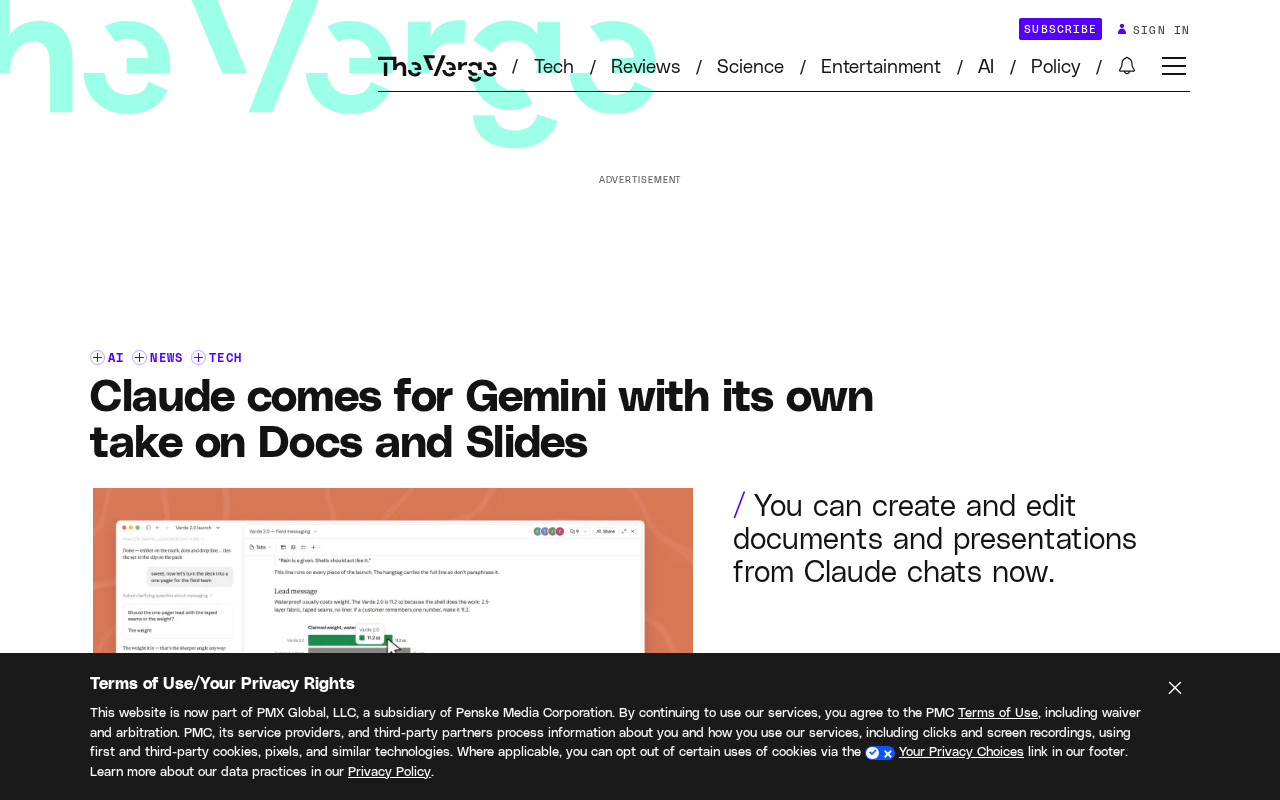
Anthropic adds Docs and Slides to Claude, directly targeting Google Gemini's office productivity ecosystem.
Anthropic has launched Docs and Slides for Claude, letting users generate exportable, editable, and shareable documents and presentations directly within a conversation. Simultaneously, Anthropic merged its standard chat and Cowork collaboration feature into "one Claude" to reduce friction between modes. The release is widely seen as a direct response to Google Gemini's deep Google Workspace integration. Claude takes a conversation-first approach rather than embedding AI into a traditional editor — representing a new phase in AI assistants evolving into productivity platforms, though details on export compatibility, collaboration permissions, and editing flexibility remain to be verified.
Claude's New Play for Office Productivity: Docs and Slides
Anthropic has introduced two new tools for Claude — Docs and Slides. Users can now generate documents and presentations directly within a Claude conversation, then export, edit, and share them with others. This move signals that Claude is no longer just a conversational assistant — it's beginning to evolve into a full-fledged productivity platform.
For users who are used to getting text suggestions from AI but still have to manually piece everything together into a formal document, this capability fills a critical gap between "generating content" and "delivering results." In a single conversation, you can ask Claude to draft a report or build out a presentation structure, then export it directly — no more bouncing between multiple tools.
"One Claude": A Unified Product Experience
Alongside this launch, Anthropic has also streamlined how users interact with Claude by merging the standard chat interface with the previously separate Cowork feature into a single experience called "one Claude." The intent is clear: reduce the cognitive overhead of switching between different modes and bring all capabilities under one unified entry point.
AI products have often managed complex functionality by separating it into distinct "modes" or "workspaces" — but this creates friction. Merging chat and collaboration into a single experience reflects Anthropic's push for a more coherent and consistent product, where users can go from ideation and discussion to finished output all within the same environment.
Cowork was a collaboration feature Anthropic introduced earlier, allowing multiple users to work together within a shared Claude conversation — essentially a real-time, AI-assisted co-editing space. Merging it with standard chat means users no longer need to decide upfront whether they're working solo or as a team. Claude supports both scenarios from the same entry point. From a product design perspective, this follows the principle of "progressive disclosure" — core functionality is visible and accessible to everyone, while advanced collaboration features surface naturally when needed, rather than forcing users to make a mode-selection decision before they even get started.
Taking Aim at Gemini: The Office Productivity Race Heats Up
The phrase "comes for Gemini" in the original headline captures the competitive undertone of this launch. Google has deeply integrated Gemini into Google Docs, Slides, and its broader Workspace suite, embedding AI capabilities directly into users' everyday document and presentation workflows — a meaningful ecosystem advantage.
Anthropic is now mounting a direct response. While Claude doesn't yet have Google's mature office ecosystem, by natively generating exportable, editable, and shareable documents and slides within a conversation, it's carving out a different path into the productivity market — one centered on conversation rather than the traditional document editor.
At the heart of this competition is a question of fit: who can make AI integrate more naturally into real-world workflows? Documents and presentations are among the most common outputs in knowledge work. Whoever delivers the smoother experience in these two areas has the better shot at winning lasting user habits.
Gemini's advantage in the office ecosystem stems from its deep integration with Google Workspace: when writing in Google Docs, Gemini can offer suggestions, generate paragraphs, and summarize content directly in the document's sidebar; in Slides, it can auto-generate presentation structures and visuals. This "AI embedded in native tools" model makes Gemini a natural part of users' existing workflows rather than a separate app they need to switch to. Claude, by contrast, has chosen a different path: making the AI conversation itself the starting point for document creation, where the document is the output of the conversation rather than its host environment. These two approaches represent distinct product philosophies — the former lowers migration costs, while the latter attempts to reshape where workflows begin.
What It Means and What to Watch
Claude's latest update marks a continued evolution of mainstream AI assistants — from "answering questions" to "delivering results." Documents and presentations are staples of office work, and building their creation natively into the conversation flow can significantly shorten the distance from idea to finished product.
For users, the practical questions worth watching include: How compatible are the export formats? How well does the permission management work for multi-user collaboration and sharing? And does the editing freedom in generated content meet professional-grade needs? These details will determine whether Claude can genuinely hold its ground in a head-to-head matchup with Gemini.
Given that publicly available information is still relatively limited, specifics around feature depth, supported export formats, and pricing strategy will need to be confirmed through more detailed official announcements and real-world testing.
Related articles
The Siberian Ice Maiden and the Archaeological Mysteries of the Scythian World
The Siberian Ice Maiden is a Scythian female mummy from the Ukok Plateau. Her tattoos, silk garments, and grave goods reveal ancient nomadic art, social hierarchy, and cross-regional trade — alongside ongoing repatriation controversies.
SQL Row Pattern Matching: Implementing "Row-Level Regex" with MATCH_RECOGNIZE
MATCH_RECOGNIZE gives SQL regex-like power over row sequences. Detect brute-force attacks, fraud patterns, and user behavior flows with clean, declarative syntax — no more messy self-joins.
Hackers Break Into Flock Surveillance Cameras, Exposing the Inner Workings of License Plate Recognition Systems
Hackers breached Flock Safety's ALPR cameras, exposing how license plate recognition systems collect data and the privacy and security risks they pose.