Claude Training Data Exposed: Large-Scale Protein Sequences Included

Hacker News says Claude trained on protein sequences at scale, but lacks evidence—worth a calm look.
A brief Hacker News post claims Claude used protein sequence data at scale during training, but attaches no papers, model cards, or official documentation. The article argues that protein sequences, like natural language, are discrete symbolic sequences suitable as language model training signals, and public databases are sizable with manageable crawling costs, making their inclusion methodologically coherent. However, "at scale" could mean pipeline coverage, emergent ability, or merely crawling scope—three interpretations with very different engineering implications that the post cannot distinguish. The article stresses that this information really reflects the ongoing expansion of training corpus boundaries for general large models, with code, math formulas, and scientific symbol systems having already entered pretraining data. Without cross-validation, one should not infer that Claude has protein modeling expertise, but treat this as a training data clue awaiting confirmation.
An Overlooked Detail in the Training Data
A post on Hacker News caught attention despite carrying little information: Claude used protein sequence data at scale during training. The original post was just one sentence with no elaboration or argument, and no comments yet, but the issue it points to is no small matter—why would protein sequences appear in the training corpus of a general-purpose conversational model?
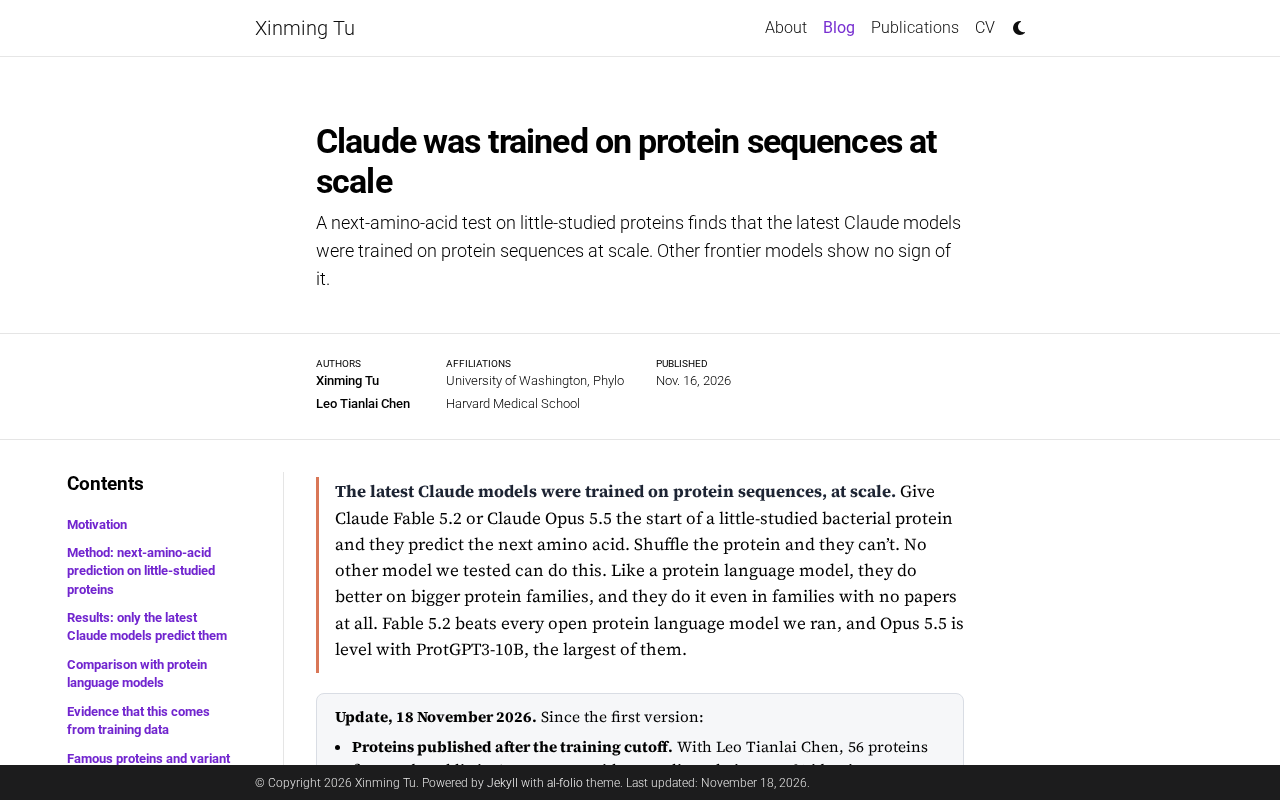
Only two facts can be confirmed from the post title itself: the training subject is Claude, the data type is protein sequences, and the scale is described as "at scale." As for the specific source, proportion, or cleaning methods, the original information provides none. This is precisely where a calm perspective is needed: a conclusion being valid does not mean the explanations surrounding it are also valid.
Why Protein Sequences Would Enter a Language Model Corpus
Protein sequences are formally very similar to natural language: both are linear sequences composed of discrete symbols, with structural constraints akin to "grammar"—the combinations of amino acid residues are not random, and statistical correlations exist between local patterns and global folding structures. This makes protein sequences naturally suited to being modeled as a kind of "language."
From the perspective of language model pretraining, mixing protein sequences into the corpus is not an eccentric practice. Public sequence databases on the internet are considerable in size and mostly exist in plain text form, making crawling and cleaning costs relatively manageable. When a model's goal is to learn general sequence modeling capabilities, this type of data provides a training signal with a distribution completely different from human language.
According to the Hacker News post, this occurred "at scale." But it should be noted that this is a single-source statement, and the post does not attach papers, model cards, or official documentation as supporting evidence.
Protein sequences are typically recorded in plain text formats such as FASTA, where each entry consists of a description line beginning with > followed by a string of amino acid residues, represented by the single-letter codes of the 20 standard amino acids. Public databases such as UniProt, PDB, and Pfam together contain hundreds of millions of sequences, totaling tens of GB in size. These sequences are not random strings: evolutionary conservation causes homologous sequences to retain similar residues at specific positions, forming motifs and profiles that can be captured by statistical models. The next-token prediction objective of language models can precisely exploit this position-dependent distributional regularity, so modeling protein sequences as a kind of "language" is methodologically coherent. Furthermore, protein language models (such as ESM and ProtBERT) have already demonstrated that self-supervised pretraining on sequences alone can learn representations useful for structure prediction and functional annotation, providing precedent for general models to incorporate such data.
Three Possible Interpretations Behind "At Scale"
The phrase "at scale" is highly elastic, allowing for at least three distinct interpretations, and the original post does not clarify which one applies.
Interpretation 1: Scale at the Data Pipeline Level
This refers to protein sequences being incorporated as a component of the pretraining corpus, included in bulk within the data mixing ratio. In this case, its role is to enhance the model's generalization ability for structured symbolic sequences.
The data mixing ratio is a key hyperparameter in pretraining, referring to the share of different source corpora in the total training tokens. A common practice is to set weights by domain—for example, code, mathematics, multilingual text, and web text each occupying a certain proportion—and then sample according to weights. If protein sequences are included in the mix, their weight may be extremely low (such as one in a thousand or even lower), but they would still appear as tens of millions of sequences at the scale of billions of tokens. The design of the mixing ratio directly affects the model's capability distribution across domains: too high a weight for one type of data crowds out training signals from other data, while too low a weight may result in complete dilution. Therefore, "large-scale use" in engineering terms usually does not mean a high proportion but rather a considerable absolute quantity. Understanding this helps distinguish "being included" from "being effectively utilized."
Interpretation 2: Scale at the Level of Emergent Ability
This refers to the data volume being large enough that the model exhibits observable capabilities on protein-related tasks, such as sequence completion and structure-related question answering. This requires not just data volume but also supporting evaluations.
Emergent ability typically refers to the phenomenon where, after model parameters or training data reach a certain threshold, performance on specific tasks suddenly improves from near-random to significantly better than random. To determine whether protein-related abilities have emerged, independent evaluation benchmarks are needed, such as sequence completion perplexity, mutation effect prediction, secondary structure classification, or remote homology detection. These evaluations are only meaningful when compared with protein-specific models of comparable scale (such as ESM-2). The mere inclusion of protein sequences in the training corpus cannot lead to the inference that the model possesses protein modeling expertise, because a general language model may simply have memorized local patterns rather than learned structural constraints. The original post provides no evaluation results, so this interpretation remains only one possibility.
Interpretation 3: Merely Referring to Crawling Scope
This refers to the training data pipeline covering such sources, but the actual proportion entering training may be very small. Data "being included" and "being effectively utilized" are two different things.
The engineering implications of the three interpretations differ greatly, and the brief statement in the original post cannot distinguish among them. Without further disclosure, any inference that "Claude possesses protein modeling expertise" exceeds what the information itself can support.
What Is Truly Worth Noting About This
Setting aside proteins themselves, this information touches on an increasingly common phenomenon in general large model training: the boundaries of training corpora are blurring.
Code, mathematical formulas, structured tables, and scientific symbol systems—these non-natural-language texts have long entered the pretraining data of mainstream models. The addition of protein sequences is an extension of this trend, not an exception. For model developers, this brings new problems in designing data mixing ratios—how to proportion sequences of different modalities under the same objective function to avoid dilution or excessive dominance of any one type of data.
For users, the more practical impact lies at the cognitive level: when a model gives fluent answers in professional fields such as biology and chemistry, its basis may come from professional sequence data in the training corpus or may simply be transfer of natural language knowledge. The reliability of these two is not the same, and it is difficult for outsiders to distinguish.
The original post has no comments and no follow-up discussion, meaning the community has not yet formed cross-validation on this claim. Treating it as a training data clue awaiting confirmation is more prudent than treating it as an established conclusion.
A direct consequence of blurred training corpus boundaries is the difficulty of attributing evaluation results. When a model gives fluent answers to professional questions in biology, chemistry, medicine, and other fields, its capability may come from three different sources: professional sequences or texts in the pretraining corpus, domain data injected during instruction fine-tuning, and compositional transfer of natural language knowledge at inference time. The reliability of the three differs greatly—answers supported by professional sequence data are usually closer to domain facts, while pure language transfer may use terminology correctly but err on numerical values or mechanisms. External users cannot distinguish these sources and can only judge output credibility through independent verification by domain experts. This is also why model cards and training data disclosure are particularly important for professional scenarios.
Unresolved Questions
If this claim is subsequently confirmed by official or technical reports, several questions are worth pursuing: What is the proportion of protein sequences in the pretraining corpus? Have they undergone deduplication and privacy filtering? Is there independent evaluation of the model's performance on protein tasks?
None of these questions currently have answers. The original material provides only a direction, not a complete body of evidence.
One-line Summary
Hacker News claims Claude used protein sequences for training at scale, but lacks supporting evidence and warrants a calm perspective.
Paragraph Summary
A brief post on Hacker News claims that Claude used protein sequence data at scale during training, but no papers, model cards, or official documentation were attached. The article's analysis suggests that protein sequences, like natural language, are discrete symbolic sequences suitable as training signals for language models, and public databases are considerable in size with manageable crawling costs, so mixing them into the corpus is methodologically coherent. However, "at scale" could mean data pipeline coverage, emergent ability, or merely crawling scope—three interpretations with very different engineering implications that the original post cannot distinguish. The article emphasizes that what this information truly reflects is the ongoing trend of expanding training corpus boundaries for general large models, with code, mathematical formulas, and scientific symbol systems having already entered pretraining data. In the absence of cross-validation, one should not infer that Claude possesses protein modeling expertise, but rather treat this as a training data clue awaiting confirmation.
Related articles

Prompt Engineering for Beginners: From Writing Prompts to Engineering Thinking
Starting from the essence and four functions of prompts, this article systematically explains the six-step process, four success criteria, learning value, and practical limitations of prompt engineering to help you build a complete understanding.

Anthropic Launches Nasdaq IPO: AI Giant's Listing and Risk Disclosures
Anthropic officially launches its Nasdaq IPO under ticker ANT, with market valuation expected to potentially exceed SpaceX's record. The prospectus devotes nearly 100 pages to AI risks, while first-half revenue grew over 14x but net losses widened sharply, reigniting the AI bubble debate.

Rust cURL Clone Uses 4,832 unsafe Blocks—Is the Memory Safety Myth Broken?
A Rust cURL clone uses 4,832 unsafe keywords, challenging Rust's memory safety narrative. We analyze what unsafe really means, compare Fil-C, and examine rewrite motives.