Claude Ultra Refund Stuck on Pending? User Faces Subscription Cancellation and Refund Deadlock

A Claude Ultra user's account was canceled after requesting a refund, but the refund remains pending, exposing multiple flaws in the refund process and customer support system of subscription-based AI services.
After a Reddit user canceled their Claude Ultra subscription, the account was immediately canceled, but the refund status remained stuck on "waiting for update," leaving them unable to use the service and worried about financial loss. The article analyzes that refunds and subscription cancellations are two independent backend processes: cancellation can take effect immediately, while refunds require payment gateways and manual review. The lack of linkage in the system creates a service gap period. Users also face risks such as possible double charging when resubscribing and non-inheritance of usage quotas. AI customer service bots can only provide templated replies and cannot handle complex refund scenarios. The article advises users to save communication records, follow up proactively, avoid immediately resubscribing, and calls on platforms to improve refund transparency and automation.
Background: A Confusing Subscription Refund
Recently, a Reddit user shared the trouble they encountered when canceling their Claude Ultra subscription. They had subscribed to the Ultra plan a few days earlier, but decided to request a refund because they were confused by the 10x/20x usage limits. The support bot replied that the refund request was being processed and promised an update by email within 24 hours. However, their account was canceled immediately afterward, while the refund status remained stuck on the "waiting for update..." screen. Now they have completely lost access to Claude, and they urgently need it for work, which has left them very anxious.
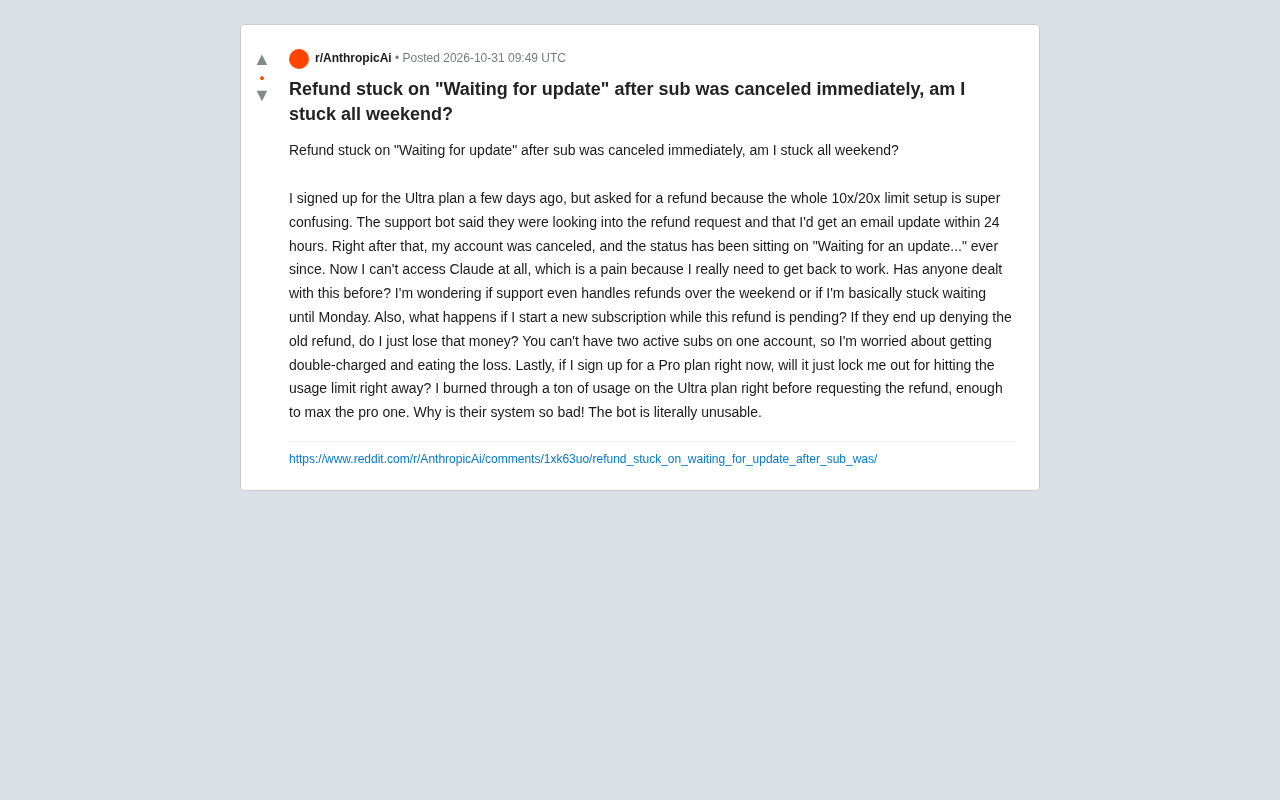
The post quickly gained attention, and many users replied that they had encountered similar situations. The core issue is that the refund process and account cancellation do not seem to be synchronized, leaving users unable to use the service while waiting for a refund—stuck in the awkward position of "the money may not be refunded, and the service is gone too."
What Does a Refund Status of "Waiting for Update" Mean?
According to the user's description, the support bot promised an email update within 24 hours, but the account was canceled immediately. This sequence of operations may reflect the automated logic of the backend system: once a user submits a refund request, the system may first cancel the subscription to prevent continued billing, but the refund review still requires human intervention, causing the status to get stuck.
"Waiting for update" is essentially an intermediate state, indicating that the refund request has been accepted but the review has not yet been completed. The user is worried that the support team does not process refunds on weekends, which could delay things until Monday. This concern is not unfounded—refund processing for many online services does rely on manual work and may be delayed on weekends.
From a technical perspective, subscription management systems usually treat "canceling a subscription" and "issuing a refund" as two separate processes. Canceling a subscription can take effect immediately, while refunds involve payment gateways and financial review, which often take longer. If the system design does not consider the linkage between the two, it is easy to create a gap period where the service has stopped but the refund has not arrived.
Payment Gateway is a technical intermediary that connects merchants, acquiring banks, and card networks, responsible for transmitting authorization, charging, and refund instructions. When a user initiates a refund, the subscription system first submits the refund request to the payment gateway, and the gateway then interacts with the issuing bank. The entire process usually takes 3-10 business days to complete fund settlement. Therefore, so-called "refund pending" is often not the platform intentionally delaying, but the objective time required for funds to flow among multiple financial institutions. Understanding this helps users set reasonable expectations: account cancellation is an internal platform operation that can be completed in seconds, while refund arrival involves external financial networks and cannot be completed instantly. If the platform conflates these two statuses in the interface, it will create a perceived gap of "money not refunded, service also gone."
Risks of Parallel Subscription and Refund: Double Charging and Usage Limits
The user also raised two key questions: What happens if they resubscribe while the refund is pending? If the old refund is rejected, is the money lost?
First, most platforms do not allow the same account to have two active subscriptions. This means users cannot directly purchase a new plan while the old subscription has not been fully terminated. The system may block the new subscription or force replacement of the old subscription, but the refund process may become more complicated as a result. If the user forcibly subscribes through other means, there is indeed a risk of double charging—if the old subscription's refund is rejected and the new subscription has already been charged, the user may lose money.
Second, the user mentioned that before requesting the refund, they had already used the Ultra plan extensively, with usage enough to exhaust the Pro plan's quota. If they subscribe to Pro now, they may immediately trigger usage limits and be unable to work normally. This reflects the problem that usage is not inherited between subscription plans: Ultra's high usage will not reset simply because of a downgrade, and users may face quota lockout immediately after subscribing to Pro.
This system design is not user-friendly enough. Ideally, the refund process should clearly inform users of the current status, estimated processing time, and provide temporary access or usage reset options. But in reality, users can only wait passively.
Usage Quota is the core constraint mechanism of AI subscription plans, usually measuring token consumption or request counts within a time window (such as every 5 hours or every week). Quotas between different plans are calculated independently, and downgrading or resubscribing generally does not inherit or reset existing usage. This means that the quota consumed in a higher-tier plan will not be cleared simply because the user switches to a lower-tier plan; the new plan's quota is recalculated from the moment of subscription, but the portion already used in the old plan cycle may still be recorded by the system. Some platforms merge usage statistics within the same billing cycle, causing users to trigger limits immediately after subscribing to a lower-tier plan. Before requesting a refund or changing subscriptions, users should check the platform's usage reset rules and confirm when the new cycle starts and whether old usage affects the new plan.
Limitations of Support Bots and User Dilemmas
The user complained that "the bot is literally unusable," which points to a common problem with AI customer service: it cannot handle complex scenarios and can only provide templated replies. Refunds involve financial and account status, and bots often can only create tickets and cannot give exact timelines or solutions. When users urgently need to work, this uncertainty is especially frustrating.
Judging from community feedback, similar problems are not isolated cases. Some users suggest contacting human support directly or applying pressure through social media channels, but weekend response speed remains questionable. Other users share that the refund will eventually be processed, but it may take several days, during which the account cannot be used.
For users who rely on Claude for work, this interruption may cause actual losses. The platform may need to optimize the transparency of the refund process, such as providing real-time status tracking, clarifying processing time limits, or retaining limited access during the refund period.
AI customer service bots usually work based on intent recognition and preset dialogue trees. They are good at handling standardized requests such as checking orders and changing addresses, but when encountering scenarios that require cross-system queries and human judgment, such as refund review and account status conflicts, they often can only generate tickets and forward them to the backend. Their promise of "update within 24 hours" is usually templated SLA language and does not mean that a human has intervened. If users only engage in circular conversations with the bot, the problem may remain unresolved for a long time. An effective approach is to explicitly request "transfer to a human" in the bot conversation, or initiate a ticket through the platform's public support email or official social media account, including the account ID and refund request number so that human customer service can locate it quickly.
Advice for Users Encountering Similar Problems
If you also encounter a stuck refund, you can try the following steps:
- Save all communication records: including screenshots of bot conversations, email confirmations, etc., for future disputes.
- Follow up proactively: even if the bot says it will update within 24 hours, you can ask again by email or support channel after 24 hours, emphasizing urgency.
- Avoid resubscribing immediately: before the refund is completed, do not easily purchase a new plan to avoid double charging or usage conflicts.
- Check usage reset rules: if you decide to resubscribe, first confirm whether the new plan will inherit old usage or whether there is a cooling-off period.
- Consider alternatives: if work is urgent, you can temporarily use other tools to avoid relying entirely on a single service.
On the platform side, it is hoped that this incident will prompt improvements in the automation and communication transparency of its refund system. After all, user trust is the cornerstone of subscription-based services.
Conclusion: Refund Experience of Subscription Services Urgently Needs Optimization
This incident reflects common pain points in the refund process of subscription-based AI services: the disconnect between automation and manual review, opaque status, and lack of consideration for users' urgent needs. As AI tools become increasingly widespread, users' expectations for service reliability are also rising. Platforms need to improve their after-sales support systems while pursuing growth; otherwise, similar complaints will only increase.
For users, carefully reading the terms before subscribing, understanding the refund policy, and actively communicating when problems arise are effective ways to reduce losses. Hopefully this user can get their refund back as soon as possible and resume work.
Related articles

How Technology Is Reshaping Sex and Love: From Vibrators to VR Sex
From vibrators to Tinder to VR sex, how has technology reshaped human sexuality and intimacy? This article distills the key points of the documentary Original Sin: Sex, exploring the liberation, alienation, and new ethical challenges brought by technology.

Aina Smart Ring with Screen and Joystick: Calls and Voice Control of AI
Aina smart ring features a screen, joystick, and microphone, enabling voice dialogue with AI agents, phone calls, and Mac dictation. This article analyzes its interaction design, UX challenges, and the ring form factor's potential as an AI entry point.

Instagram Edits Launches on Desktop, Taking Aim at CapCut
Instagram's video editing app Edits launches a desktop version, competing more directly with ByteDance's CapCut. This article analyzes the platform logic and creator ecosystem battle behind Edits' desktop expansion.